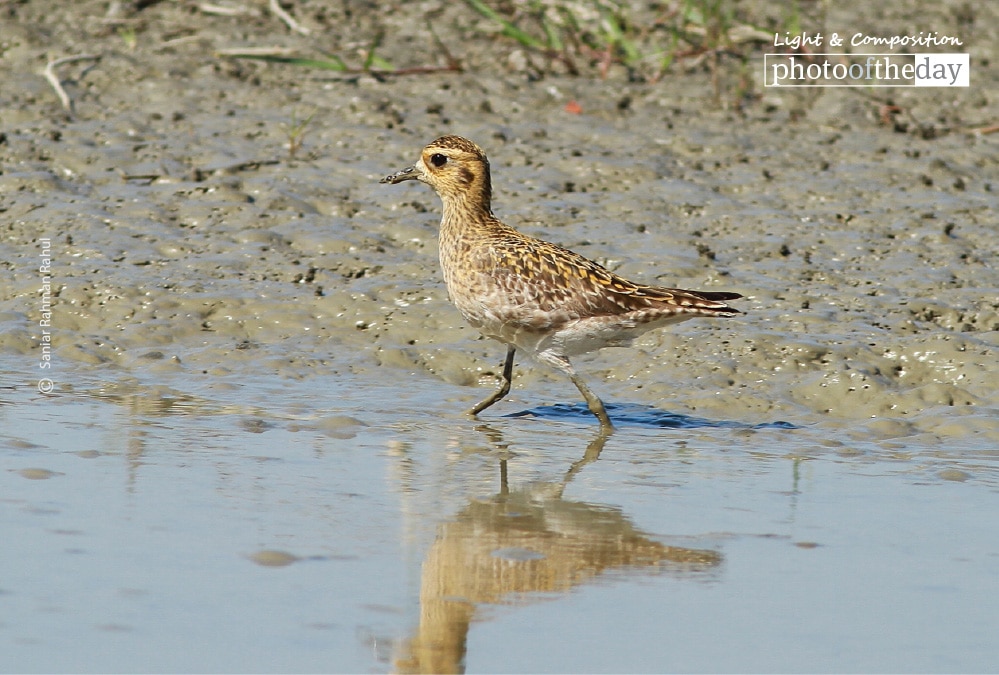
Pacific Golden Plover by Saniar Rahman Rahul
Captured in the waning days of winter in Kalapara, Bangladesh, this portrait of a Pacific Golden Plover highlights the delicate beauty of a migratory species. The photographer skillfully documented the bird in its preferred dry, open habitat, capturing the essence of a creature that traverses the globe from the Arctic tundra to South Asia. The image is award-worthy for its sharp focus and natural composition, which brings the viewer into an intimate encounter with the plover’s quiet, grounded existence. It serves as a poignant reminder of the vast, interconnected journeys undertaken by wildlife across the planet.
Saniar Rahman Rahul
Based in Dhaka, Bangladesh, Saniar Rahman Rahul is an accomplished Art Director at Grey Worldwide with a deep-rooted passion for visual storytelling. His creative journey began in childhood, inspired by his father’s photography, and was later refined through a distinguished career in graphic design and advertising. As a celebrated wildlife photographer, Rahul blends his professional expertise in composition and design with a keen eye for nature, consistently earning international recognition for his ability to capture the intricate details of the natural world.
Resonance Score Breakdown
Transparency Note: The resonance score (12.3/20) is calculated based on social engagement metrics collected before the award announcement.
Expert Photography Reviews · 8
The Long Way Home
I spent an hour this morning watching a stray cat navigate the fence in my backyard. It moved with such deliberate, quiet focus, pausing every few steps to check the wind or listen to a sound I couldn't hear.
Read the reflection →The Weight of the Journey
I keep a small, rusted compass in my desk drawer, its needle long ago surrendered to the stillness of the casing. It belonged to a grandfather who spoke of distances as if they were living things, measured not in miles but in the slow, rhythmic beating of wings against the wind.
Read the reflection →Reviews & Comments
Share your thoughts about this award-winning photograph. Your reviews contribute to the community engagement score.
Of the thousands of wildlife shots I’ve reviewed, most are just technical exercises. What separates this from the pack is the Plover’s weary, grounded posture against the cracked earth. It’s not just a bird; it’s a traveler caught in a moment of exhaustion. I actually felt a pang of loneliness looking at those tired eyes. It’ll endure because it captures the fragility of a global journey, not just the sharpness of a lens. It’s hauntingly honest.
Before the eye identifies the plover, a sudden stillness settles in the chest. It’s the weight of that vast, dry earth pressing against the bird’s fragile, speckled frame. I’ve returned to this portrait three times today; each time, my pulse slows to match its grounded, watchful gaze. It doesn’t just capture a bird; it anchors my own restlessness. I feel a strange, quiet ache for the miles it’s traveled just to stand so perfectly still.
The plover stands. It doesn’t ask for attention. The ground stretches, a vast, pale reach of nothing. I feel a sudden, sharp ache in my chest looking at that horizon. It’s the weight of the distance it’s traveled. The bird is small. The space around it is immense. Nothing here is accidental. The empty corner is not empty. It’s the breath between heartbeats. It’s the silence I’ve been waiting for all day.
The light here is soft, the kind that only arrives when the world holds its breath. Saniar waited in the cooling mud of Kalapara, listening to the silence of a traveler resting its wings. I’ve felt that same stillness, where the bird and the earth become one. It’s not just a portrait; it’s a prayer of patience. Looking at the plover’s steady gaze, I find myself wanting to sit beside him, just to share the quiet.
We look at this Pacific Golden Plover and we aren’t just seeing a bird; we’re meeting a traveler. Saniar Rahman Rahul didn’t just point a lens; he waited until the creature felt safe enough to reveal its weary, grounded soul. I’m moved by that steady, watchful eye. It’s a portrait of a long, lonely journey across the sky. We feel the weight of the Arctic tundra in its gaze. It’s a photograph that asks to be returned to.
The plover stands against the parched earth, a creature defined by its own displacement. It’s not the bird I see, but the silence it carries from the tundra. Shadows here don’t merely fall; they anchor the subject to a world that’s rapidly drying up. I’ve felt this ache before, this desperate need to remain still while the horizon shifts. It’s a haunting, grounded meditation on what we leave behind when we finally choose to land.
The plover stands in the dirt, a traveler caught in a frame that feels suspiciously tidy. Why does this landscape look so barren, so scrubbed of the human presence that defines Kalapara? I’m struck by a sudden, sharp loneliness looking at it. Is this bird a guest, or is it a prop for our aesthetic consumption? We admire the sharpness, but we ignore the borders. Who decided this patch of earth was worth isolating from the world?
It’s a tidy bit of work, though one wonders how many hours Rahul spent belly-down in that Patuakhali mud before the plover stopped viewing him as a threat. The focus is sharp, certainly, but it’s the bird’s weary, migratory stillness that caught me. I’ve spent enough damp mornings waiting for a subject to settle to know this wasn’t a lucky snap. He didn’t just find this bird; he earned its quiet company. A decent day’s work.