Kankaria Lake by Sudeep Mehta
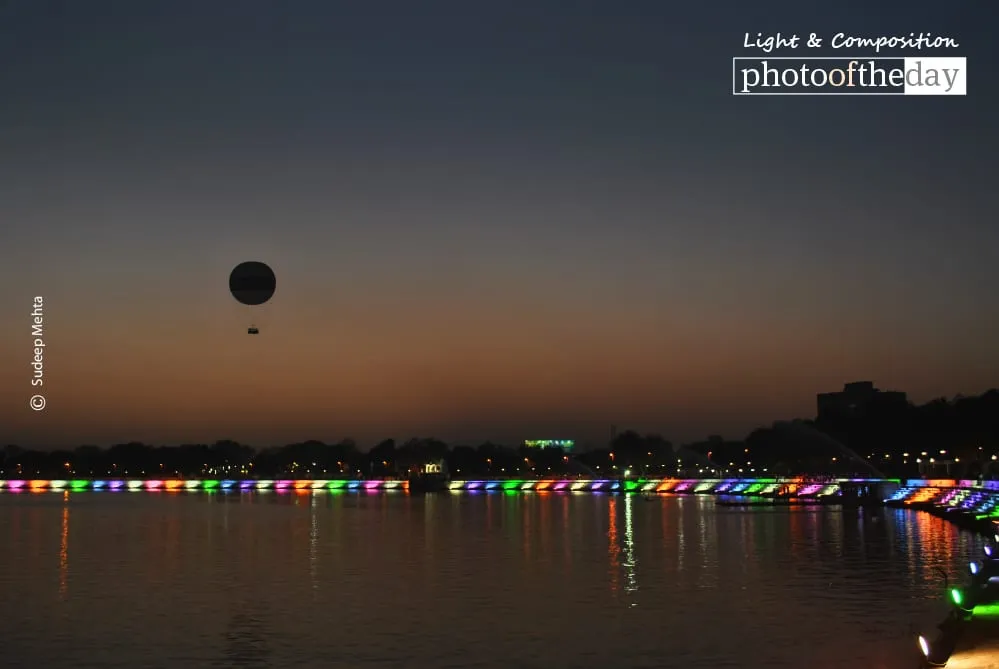
Captured at Kankaria Lake, this evocative image highlights the historic 15th-century landmark transformed by modern leisure. As the sun dipped below the horizon, the photographer seized the opportunity to frame the vibrant lakefront lights against the dramatic silhouette of a tethered balloon ride. This composition masterfully balances the architectural heritage of Sultan Qutbuddin’s creation with the contemporary energy of Ahmedabad’s public attractions. The resulting image is award-worthy for its precise timing, capturing the serene transition from day to night while maintaining a clean, striking silhouette that tells a story of urban recreation and timeless beauty.
Sudeep Mehta
Based in Mumbai, India, Sudeep Mehta is a versatile freelance photographer with a professional background in film editing and documentary filmmaking. His diverse portfolio spans event, wedding, and portrait photography, complemented by a dedicated interest in photojournalism and environmental advocacy. Drawing from his experience as a short filmmaker, Mehta brings a narrative-driven perspective to his still photography, consistently seeking to capture the intersection of human activity and the environment. His work reflects a lifelong passion for visual storytelling that bridges his technical expertise in motion media with the art of the still frame.
Resonance Score Breakdown
Transparency Note: The resonance score (12.9/20) is calculated based on social engagement metrics collected before the award announcement.
Expert Photography Reviews · 7
The Hum of Cooling Stone
The air at dusk has a specific weight, a thickness that clings to the skin like damp linen. I remember the feeling of sitting on stone steps that had spent the entire day soaking up the sun, only to release that stored heat against my palms as the evening deepened.
Read the reflection →The Weight of the Tether
In the seventeenth century, the Dutch began to map the invisible currents of the air, realizing that what we perceive as empty space is, in fact, a dense, pressurized ocean.
Read the reflection →Reviews & Comments
Share your thoughts about this award-winning photograph. Your reviews contribute to the community engagement score.
Kankaria Lake isn’t just a landmark; it’s a stage where history meets the restless pulse of Ahmedabad. We look at that tethered balloon against the velvet night and we feel the weight of centuries shifting into modern play. I’ve spent hours wondering what the people inside that basket whispered to the stars. It’s a quiet, haunting conversation between the ancient stone and the neon glow. This is a photograph that asks to be returned to, again and again.
Kankaria Lake glows, but at what cost to the history beneath the neon? Mehta frames a tethered balloon against a 15th-century backdrop, yet the people are mere ghosts in the periphery. Why does the leisure of the present demand we erase the weight of the past? I feel a cold detachment looking at this. Whose Ahmedabad are we actually consuming here? It’s a pretty postcard, but it doesn’t tell me who gets to belong in this frame.
The diffraction of light across the lake’s surface is, in the strictest physical sense, extraordinary. By stopping down, Mehta has pushed the aperture toward the diffraction limit, turning those distant point sources into sharp, geometric starbursts. I’m genuinely moved by how the focal plane holds the balloon’s silhouette against the encroaching twilight. It’s a rare moment where the lens’s glass resolves the transition from day to night with such clinical, yet haunting, optical precision.
Of the thousands of night shots I’ve reviewed, most drown in neon clutter. What separates this from the pack is the tethered balloon’s silhouette; it anchors the frame, turning a chaotic tourist spot into a quiet, geometric study. I’ll admit, the balloon’s stark shape against the fading dusk actually made me stop and breathe. It’s a rare, clean capture of urban transition that’ll still feel relevant in thirty years, long after these specific lights dim.
The bruised indigo of the Kankaria dusk bleeds into the electric, synthetic amber of the lakefront, creating a tension that feels almost like a Morandi still life set adrift in the humid Indian night. It’s a gorgeous, aching collision of ancient stone and neon artifice that makes my heart stutter with recognition. One finds here a chromatic dialogue where the shadows aren’t merely absent light, but deep, velvet reservoirs of cooling, nocturnal silence.
The tethered balloon is a clever touch, though one wonders if it’s a lucky grab or a calculated arrival. I’ve spent enough nights shivering by water to know that waiting for the perfect balance of dusk and artificial light is a tedious, often thankless business. It’s a clean frame, certainly. I find myself wishing the photographer had braved a few more nights to catch the sky with more depth. It’s competent, but did they earn it?
Kankaria Lake’s tethered balloon is a static silhouette, yet it’s the blur of the surrounding lights that actually captures the kinetic pulse of Ahmedabad. I’m bored by the curator’s obsession with clean lines. Why resolve the architecture so sharply when the atmosphere is clearly in flux? It’s closer to Sugimoto’s long-exposure theatres than conventional travelogue. I’d have pushed the motion further; why settle for clarity when you could have captured the city’s actual heartbeat?