Jumping Spider by Avi Chatterjee
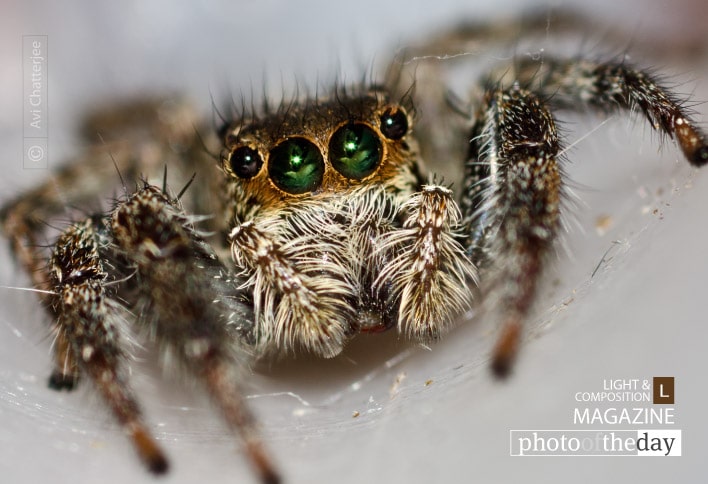
In a display of patience and precision, the photographer captured this striking jumping spider within the confines of a home garden. The encounter proved challenging, as the spider repeatedly lunged toward the lens in a spirited defensive display. By maintaining composure and waiting for an hour, the photographer allowed the subject to settle, eventually securing a sharp, point-blank macro shot. This image is award-worthy for its intimate perspective and the technical discipline required to document such a volatile subject, transforming a fleeting garden moment into a captivating, high-detail portrait of nature’s smallest creatures.
Avi Chatterjee
Born in Kolkata, India, in 1982, Avi Chatterjee is a Dubai-based photographer and technical sales consultant. After an international career in engineering, he transitioned into professional photography, founding his studio, Time Machine Works, to pursue his passion for macro, wedding, and product imagery. Inspired by the artistic perspective of his wife, Chatterjee has dedicated himself to mastering the technical nuances of the craft, evolving from a casual hobbyist into a committed professional who seeks to document the world with both precision and creative intent.
Resonance Score Breakdown
Transparency Note: The resonance score (11.8/20) is calculated based on social engagement metrics collected before the award announcement.
Expert Photography Reviews · 7
The Weight of a Gaze
How much of the world do we miss simply because we are too large to notice it?
Read the reflection →The World in a Glance
I spent twenty minutes this morning trying to shoo a moth out of my kitchen. It kept fluttering against the window, frantic and confused, while I just stood there with a dish towel, feeling like a giant intruder in its tiny, panicked world.
Read the reflection →Reviews & Comments
Share your thoughts about this award-winning photograph. Your reviews contribute to the community engagement score.
1/100sec at f/2.8, ISO 800. A risky gamble. At 105mm, f/2.8 leaves a razor-thin plane of focus. It’s barely enough to cover the spider’s cephalothorax. The ISO 800 introduces noise that compromises the fine texture of the setae. I’ve spent hours chasing macro subjects; I know the frustration. Chatterjee’s patience paid off, but the technical margin is dangerously slim. The focus is dead on the eyes. It’s a correct, disciplined choice. I respect the precision here.
Most macro shots of spiders are just clinical exercises in depth of field, but this one actually looks back at you. I’ve seen thousands of bugs under glass, yet the sheer intensity in those primary eyes makes me shudder. It’s the decision to shoot at f/2.8 that saves it; by softening the background, Chatterjee forces us into a claustrophobic, intimate standoff. It’s not just a bug; it’s a confrontation that’ll still feel unsettling in thirty years.
We look into these eight eyes and we aren’t just seeing a spider; we’re meeting a guardian. Avi waited an hour, listening to the silence of a Kolkata garden until the creature stopped lunging and started trusting. It’s a portrait of a truce. I’ve never felt so small before a lens, yet so seen. It’s a photograph that asks to be returned to, because it reminds us that even the tiniest life has a story to tell.
The frame holds its breath. That gaze—eight eyes locked onto the glass—it’s unnerving. I’ve spent hours on sets waiting for a lead to find their mark, and Chatterjee’s patience here is palpable. At f/2.8, the depth is razor-thin, a cinematic choice that isolates the subject’s intensity against the soft, blurred garden bokeh. It’s a tense, silent standoff. I honestly felt a shiver when I first saw it. This is the frame the editor keeps.
The spider stares back, its multiple eyes reflecting a garden I’ll never inhabit. Chatterjee claims he waited an hour, but does the spider’s defensive lunge suggest a creature forced into submission for our aesthetic consumption? I feel a strange, sharp discomfort watching this tiny life pinned by a macro lens. Why must we dominate the small to appreciate it? Is this intimacy, or is it just another form of capture? It’s technically precise, yet deeply unsettling.
Macro photography usually ignores the built environment, yet here, the spider’s carapace mimics the complex fenestration of a brutalist facade. The light hits those multifaceted eyes like sun striking a clerestory, revealing a depth I rarely see in static shots. It’s a tiny, alien architecture of chitin and shadow. I’m genuinely unsettled by how much this creature’s gaze feels like a threshold I’m not invited to cross. It’s a masterclass in capturing the scale of the inhabitant.
The frame’s geometry hinges on the spider’s ocular cluster. It’s a rigid, triangular anchor point. The shallow depth of field isolates the subject, forcing the eye into the creature’s gaze. There’s a brutal spatial tension here; the negative space doesn’t bleed, it constricts. I’ve rarely seen such aggressive focus. It’s clinical, yet the symmetry of those eight eyes is unsettling. The composition holds because it refuses to soften the subject’s inherent, predatory architecture.