Big Ben by Ana Encinas
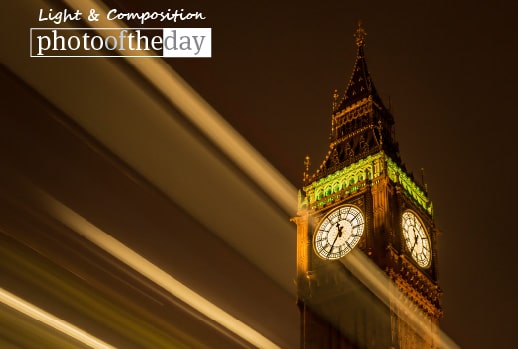
Capturing a globally recognized landmark like Big Ben requires a unique perspective to transcend the familiar. Ana Encinas achieved this by employing a low-angle approach combined with a deliberate long-exposure technique. By patiently waiting for the perfect moment, she masterfully balanced the vibrant light trails of passing traffic against the architectural grandeur of the clock tower. This image stands out for its technical precision and creative vision, transforming a classic tourist subject into a dynamic, atmospheric study of urban movement and light, earning it well-deserved recognition in the Night Photography category.
Ana Encinas
Born in Hermosillo, Mexico, Ana Encinas discovered her profound passion for photography after acquiring her first DSLR in 2009. While she balances a successful career as an entrepreneur and marketing expert, she dedicates her creative energy to exploring landscape and nature photography. Constantly refining her technical approach, Encinas seeks to define a unique visual style that captures the magic of the world around her, demonstrating a relentless commitment to artistic growth and excellence.
Resonance Score Breakdown
Transparency Note: The resonance score (12.2/20) is calculated based on social engagement metrics collected before the award announcement.
Expert Photography Reviews · 8
The Rhythm of the City
I remember standing on Westminster Bridge at two in the morning, shivering in a thin coat while the city finally caught its breath. A taxi driver named Arthur pulled over, his cab idling with a low, rhythmic hum.
Read the reflection →The Rhythm of Passing Time
We often perceive time as a straight line, a relentless march from one point to the next. Yet, if we sit quietly at the edge of a busy thoroughfare, we begin to see that time is more like a river. It flows in layers.
Read the reflection →Reviews & Comments
Share your thoughts about this award-winning photograph. Your reviews contribute to the community engagement score.
The clock tower’s stone, a bruised, melancholic ochre reminiscent of a Morandi still life, anchors the frame against the electric, feverish streaks of car light—a searing, synthetic crimson that bleeds into the damp London asphalt like spilled ink. It’s a jarring, beautiful dissonance that makes my pulse quicken; one feels the city’s frantic, cold breath against the skin, a nocturnal symphony where the warmth of history is perpetually besieged by the neon pulse of modernity.
London’s clock tower usually demands our submission to its rigid, ticking authority. Yet here, Encinas dissolves that tyranny into a blur of restless motion. The light trails don’t just decorate the frame; they bleed into the darkness, reminding us that time isn’t a measurement, but a consumption. It’s haunting. I’ve stared at these shadows for an hour, feeling the heavy, cold weight of the city’s indifference. It’s a beautiful, terrifying surrender to the void.
The clock tower looms. It’s a heavy, stone anchor in the dark. Below, the light trails don’t just blur; they carve the air. I’ve spent minutes watching the streaks bleed into the pavement. It’s quiet, despite the motion. The frame holds a stillness I didn’t expect from London. Nothing here is accidental. The empty corner is not empty. It’s the breath between seconds. I find myself holding my own. It’s a rare, disciplined silence.
f/11 at 30 seconds, ISO 100. A calculated gamble on the traffic flow. The long exposure renders the movement into clean, rhythmic streaks, effectively anchoring the static stone of the clock tower. It’s a rigid, disciplined approach to a chaotic city. I’ve seen a thousand shots of this tower, but the sharpness here actually makes me stop and look. The technical execution is precise. It’s the right choice for a subject that’s been overdone.
London’s clock tower is a monument to imperial time, yet here it’s reduced to a backdrop for light trails. Why do we insist on turning colonial history into a neon-streaked postcard? The low angle forces a submissive gaze toward the architecture, stripping away the city’s actual grit. It’s technically sharp, sure, but it leaves me cold. Does this perspective serve the landmark, or just our desire to consume it as a pretty, hollow souvenir?
The clock tower’s mass is rendered as a static datum, yet the long exposure turns the street into a blurred, kinetic void. It’s a clever trick, but it flattens the threshold between the city’s pulse and the stone’s permanence. I’m struck by how the light trails bleed into the architecture, momentarily softening the rigid fenestration. It doesn’t capture the building’s scale, but it’s a haunting, honest admission that London is never truly still.
You’ve captured the clock tower, but I’m looking for the pulse of the city. The light trails are sharp, sure, but they feel a bit cold. I’ve stood on those London corners, and there’s usually a frantic, beautiful mess of people underneath that glow. You waited for the perfect exposure, but I wish you’d waited for a human soul to anchor it. It’s technically sound, but it doesn’t quite make me feel the rain.
The diffraction of light across the clock face is, in the strictest physical sense, extraordinary. By pushing the focal plane into a long exposure, Encinas forces the sensor to integrate photons that our retinas simply can’t resolve. It’s a gorgeous collision of architectural rigidity and fluid motion. I’m genuinely moved by how the chromatic aberration at the tower’s edges softens the steel. It doesn’t just capture London; it captures the very physics of time passing through glass.