A Sea of Grass by Sébastien Beun
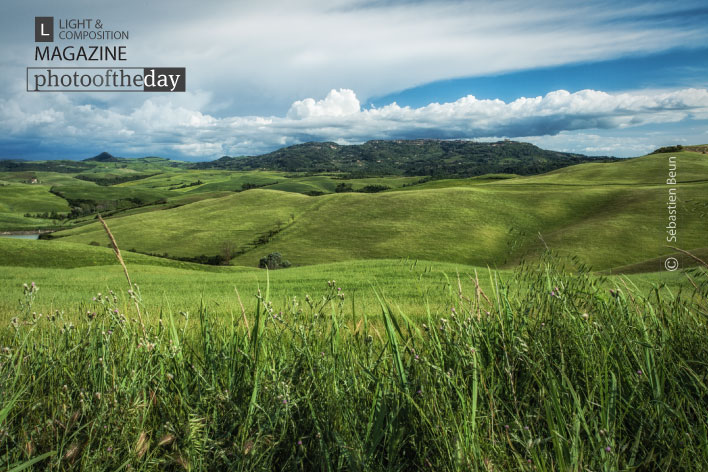
Captured in the rolling landscapes surrounding Volterra, Italy, this photograph highlights the vibrant, verdant beauty of the Tuscan countryside during springtime. Sébastien Beun masterfully frames the ancient, historic city, using the deep, undulating greens of the grass to create a rhythmic foreground that leads the eye toward the medieval ramparts. The image serves as a testament to the enduring allure of Italy’s Neolithic and Etruscan heritage. Its award-worthy quality lies in the harmonious balance between the timeless architectural grandeur of Volterra and the transient, lush vitality of the seasonal landscape, rendered with precise technical clarity.
Sébastien Beun
Born in 1981 and based in Thuin, Belgium, Sébastien Beun is a dedicated photographer whose journey began at age twelve with his father’s vintage darkroom equipment. After mastering the art of black-and-white film development and printing, he transitioned into the digital realm, where he now captures subjects that resonate with his personal perspective. His work reflects a deep appreciation for both traditional craftsmanship and modern digital techniques, driven by a desire to preserve the legacy of photography for future generations.
Resonance Score Breakdown
Transparency Note: The resonance score (12.3/20) is calculated based on social engagement metrics collected before the award announcement.
Expert Photography Reviews · 5
The Weight of Green
I remember sitting on a stone wall in a small village outside of Siena, watching a farmer struggle with a stubborn gate. He didn't seem bothered by the time it took, or the way the wind was starting to whip through the valley.
Read the reflection →The Weight of Green
I spent this morning trying to pull weeds from the patch of dirt behind my apartment. It was supposed to be a quick chore, but I ended up sitting on the damp ground for nearly an hour, just watching the way the stalks leaned against one another.
Read the reflection →Reviews & Comments
Share your thoughts about this award-winning photograph. Your reviews contribute to the community engagement score.

The camera pans across the emerald swells of Volterra, catching the light just before the cut. It’s a wide shot that breathes. The rolling grass acts as a tracking movement, pulling the eye toward those ancient ramparts with a steady, rhythmic pace. I’ve stood on those hills, and this frame captures that exact silence. It doesn’t need a sequence; the stillness is the point. It’s the shot the editor keeps because it says everything without moving.
The composition relies on a series of nested parabolas, where the undulating hills create a rhythmic sequence of vectors pulling the eye toward the vertical anchor of Volterra. It’s a classic spatial equation: the foreground’s heavy, verdant mass occupies exactly two-fifths of the frame, balancing the architectural density above. I’m genuinely struck by how the 36mm focal length compresses these curves into such a tight, logical sequence. It’s a perfectly solved problem of terrestrial geometry.
The light here isn’t forced; it’s a soft, patient glow that breathes life into the Volterra hills. I’ve stood in fields just like this, waiting for the wind to settle the grass. Beun didn’t just capture a view; he listened to the rhythm of the earth. It’s quiet, almost sacred. Looking at those rolling, verdant waves, I feel a sudden, aching stillness in my own chest. He knew exactly when the land was ready.
Volterra’s ramparts shouldn’t feel this heavy. Beun’s grass is too bright, too eager to please, yet it’s the encroaching gloom at the frame’s edge that truly haunts me. It’s here the image finally thinks. I’ve spent hours staring at those shadows, feeling the weight of the Etruscan earth beneath the green. It doesn’t invite us in; it resists our gaze, reminding us that history isn’t a postcard, but a slow, darkening erosion of time.
The verdant swells of Volterra’s hills possess a chromatic intensity that recalls the fevered, saturated pigments of a Turner landscape, where the grass isn’t merely green, but a shifting, liquid emerald that aches against the stone’s pale, calcified ochre. It’s breathtaking, really; one feels the weight of the sun-drenched earth pressing upward, a lush, rhythmic tide of chlorophyll that makes my heart stutter, grounding the medieval ramparts in a living, breathing, and utterly intoxicating vitality.