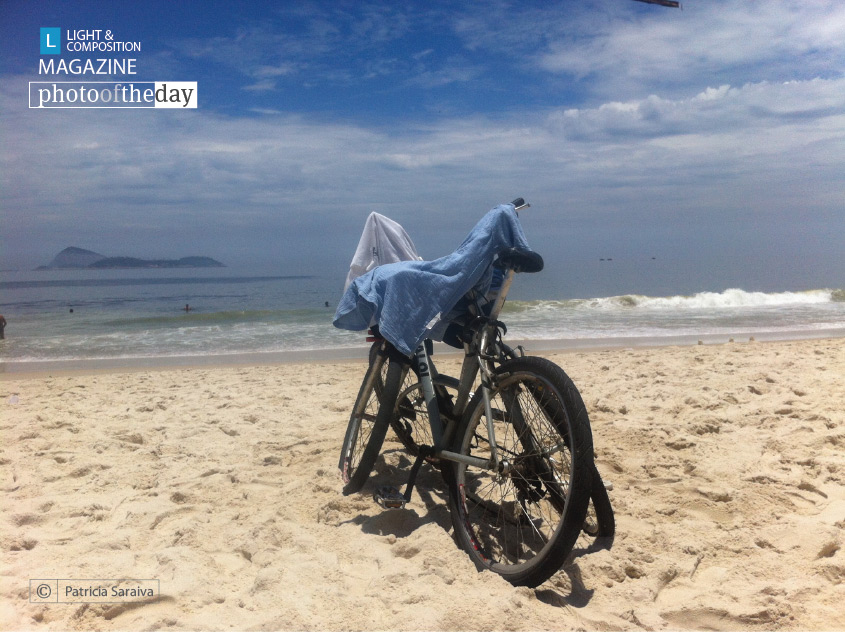
Bikes by Patricia Saraiva
Captured with the spontaneity of a mobile device, this image celebrates the simple joy of cycling along the seaside. The photographer was drawn to the collective presence of the bicycles, finding beauty in their arrangement and the sense of complicity they evoke. By focusing on the rhythmic, repetitive nature of the bikes against the coastal backdrop, the image transforms a mundane scene into a study of simplicity and connection. This photograph is award-worthy for its ability to find profound visual harmony in everyday life, demonstrating a keen eye for composition and the beauty of the ordinary.
Bogdan Carcel
Bogdan Carcel was born in Romania and has been living in Germany for 14 years. A passionate photographer since childhood, he never misses an opportunity to capture moments that hold personal significance. Bogdan is an avid traveler, always seeking to document the essence of the places he visits. He has a particular talent for capturing candid moments when people are unguarded and natural, believing these result in his most authentic and impactful photographs. Current Location Germany Website https://bogdancarcelphotography.com/ Best Achievements, Educational Background, and Exhibitions None Award Winner Photo of the Day Camera Gears Olympus Om d em1x Canon R6 Olympus 8mm f1.8 Olympus 12-40mm f2.8 Olympus 300mm f4 Canon 35mm f1.8 Canon 16-35mm f4 Canon 135mm f2 Sigma 56mm f1.4 mft Sigma 16mm f1.4 mft
Resonance Score Breakdown
Transparency Note: The resonance score (11.5/20) is calculated based on social engagement metrics collected before the award announcement.
Expert Photography Reviews · 8
The Geometry of Waiting
In the quiet corners of a city, objects often hold a conversation long after their owners have wandered away.
Read the reflection →The Weight of Waiting
Why do we feel a sense of abandonment when an object is left behind, as if the inanimate could suffer the ache of being forgotten? We leave our tools, our vessels, and our extensions of self in the corners of the world, expecting them to wait patiently for our return.
Read the reflection →Reviews & Comments
Share your thoughts about this award-winning photograph. Your reviews contribute to the community engagement score.
The shutter snaps, freezing the rhythm of the Rio coast. It’s a sequence of handlebars and spokes, a static tracking shot that refuses to pan. I love how the bikes lean into each other; it’s a silent, collective breath before the ride begins. The cut would’ve been a mistake. You don’t need motion when the composition hums like this. It’s the frame the editor keeps, capturing the exact moment the world stops to catch its light.
The rhythmic cadence of these bicycle frames establishes a necessary geometric order against the chaotic coastal horizon. It’s a rigid, linear sequence that anchors the picture plane. The negative space between the handlebars creates a precise, recurring tension that holds the composition together. I’m genuinely surprised by how effectively this mobile sensor resolves such complex spatial weight. It doesn’t rely on sentiment; it relies on the discipline of the frame. The architecture here is absolute.
We look at these bikes lined up against the Rio coast and we don’t just see metal; we see the ghosts of a conversation. They’ve been left behind, waiting for their riders to return from the sea. It’s a quiet, rhythmic stillness that makes me ache for the laughter that just left the frame. Patricia listened to the silence of the beach before she clicked. It’s a portrait of absence, and I find it deeply moving.
The cyan of these bicycles, echoing the bruised, salt-heavy blue of a Rio horizon, creates a chromatic tension that feels almost like a Morandi still life set adrift in the tropics. It’s a quiet, rhythmic pulse of pigment against the sand’s bleached ochre, and honestly, it’s enough to make one weep for the simplicity of a summer afternoon. They’ve captured a fleeting, atmospheric resonance where the light doesn’t just illuminate; it breathes, it sings, it lingers.
The frame resolves into a series of parallel vectors, where the bicycles establish a rhythmic, repeating sequence against the horizontal horizon line. It’s a study in spatial intervals; the negative space between the wheels creates a precise, syncopated cadence. I’m genuinely struck by how the verticality of the handlebars disrupts the dominant horizontal plane. It’s a beautifully solved equation of mass and void. The geometry here doesn’t just hold the frame together; it makes the composition sing.
Most entries I reviewed this year relied on heavy post-processing to manufacture depth. Patricia’s work succeeds because it doesn’t try so hard. The iPhone 4’s limitations actually force a raw, honest geometry here. I love the way those handlebars lean into the frame; it’s a quiet, rhythmic pulse that feels like a summer afternoon in Rio. Will we care in thirty years? Yes, because it’s a perfect, unpretentious record of how we lived. It’s simply, beautifully human.
The salt air clings to these frames. She stood there as the Rio sun bleached the pavement, waiting for the rhythm of the metal to settle into a quiet, collective breath. It’s a humble geometry, isn’t it? I find myself wanting to reach out and touch the cool handlebars, feeling the stillness she captured amidst the coastal heat. She didn’t rush the light; she let the bicycles simply exist, anchored in that bright, honest silence.
You caught the rhythm of a Rio afternoon, and it’s infectious. I look at these bikes and I don’t just see metal; I feel the heat of the pavement and the salt in the air. You didn’t overthink the frame, and that’s why it works. It’s honest. You waited for the stillness to settle between the handlebars. And honestly? It makes me want to drop everything and go for a ride myself. Good eye.