Colosseum Patch by Nilla Palmer
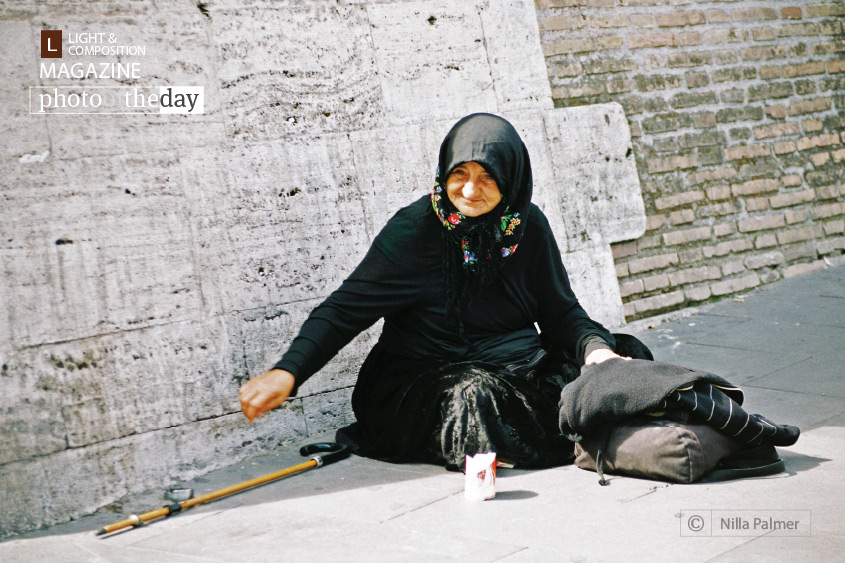
Captured amidst the historic backdrop of Rome, this photograph explores the complex social landscape surrounding the Colosseum. The photographer focuses on the persistent figures who populate the area, highlighting the ambiguity between professional panhandling and genuine hardship. By utilizing film, the image achieves a raw, authentic texture that strips away modern artifice, forcing the viewer to confront the stark realities of urban life. This piece is award-worthy for its candid approach to social documentary, successfully transforming a common street encounter into a poignant, thought-provoking narrative that challenges the observer's perceptions of poverty and human interaction.
Tisha Clinkenbeard
Photography captured Tisha years ago before we had the digital wonders for cameras. She became more serious with her hobby after she received a camera for Mother’s Day in 2010. Nature, travel and some still life photos make up most of Tisha’s portfolio. Since she and her husband do travel often and spend as much time outdoors as possible she has a lot to work with! Life offers many opportunities to capture the things she sees as she wanders this earth – usually adventures with her husband. Her goal is to share what she finds Round & About – which was the inspiration for her photo blog: foundroundandabout.com. Tisha’s works have been in exhibits at The Fine Arts Center of Hot Springs, AR, Black Box Gallery in Portland, OR, ART120 in Taylor, TX, ArtSpace in Round Rock, TX, Georgetown Art Center in Georgetown, TX and at the Austin Bergstrom International Airport. Two of he
Resonance Score Breakdown
Transparency Note: The resonance score (11.2/20) is calculated based on social engagement metrics collected before the award announcement.
Expert Photography Reviews · 5
The Weight of Passing Time
There is a quiet dignity in simply existing within the flow of a city. We often walk past one another as if we are ghosts, caught in the momentum of our own private seasons, forgetting that every person we encounter is a vessel for a story we will never fully know.
Read the reflection →The Weight of Worn Stone
The smell of damp limestone always brings me back to the feeling of a heavy wool coat against my neck, itchy and grounding.
Read the reflection →Reviews & Comments
Share your thoughts about this award-winning photograph. Your reviews contribute to the community engagement score.
Before the eye identifies the Colosseum’s stone, a tightness gathers in the chest. It’s the weight of the gaze, that uncomfortable friction between the tourist’s indifference and the subject’s stillness. I’ve felt that exact, hollow ache in my own throat when walking past such raw, exposed survival. A year later, it’s not the architecture I recall, but the way the grain of the film seems to vibrate against the skin, demanding an answer I don’t have.
Rome’s stone weight presses against the frame. Palmer leaves the Colosseum to the shadows. It’s the pavement that holds the story. A single figure sits in the vast, grey expanse. I’ve caught myself holding my breath. The distance between the man and the edge of the frame is where the truth lives. Nothing here is accidental. The empty corner is not empty. It’s a quiet ache. It doesn’t need the monument to be felt.
Rome’s ancient stone doesn’t just frame these figures; it swallows them. Palmer’s shadows aren’t mere voids, but the heavy, suffocating weight of history pressing against the desperate present. I’ve stared at these dark patches until my eyes ached, feeling the cold indifference of the Colosseum’s arches. It’s a brutal, honest confrontation. When light fails to penetrate the gloom, we are forced to acknowledge that some human suffering isn’t meant to be illuminated. It’s simply endured.
The frame’s geometry is compromised. Palmer’s placement of the subject creates a lopsided distribution of mass that fails to anchor the eye. While the negative space around the Colosseum’s archway offers potential, the visual weight remains trapped in the foreground’s clutter. It’s frustrating. The tension doesn’t resolve; it merely drifts. Without a disciplined fulcrum, the composition collapses under its own narrative ambition. It doesn’t hold. The structure is simply too loose to sustain the frame.
In the shadow of the Colosseum, we find a face etched by more than just the Roman sun. Nilla Palmer didn’t just point a lens; she sat with the weight of this man’s silence. It’s a raw, grainy portrait that makes my chest ache with the familiarity of his struggle. We look into his eyes and we understand that he’s not just a backdrop to history. I’m haunted by his gaze. It’s a photograph that demands we listen.