The Cliffs of Moher by Oscar Garcia
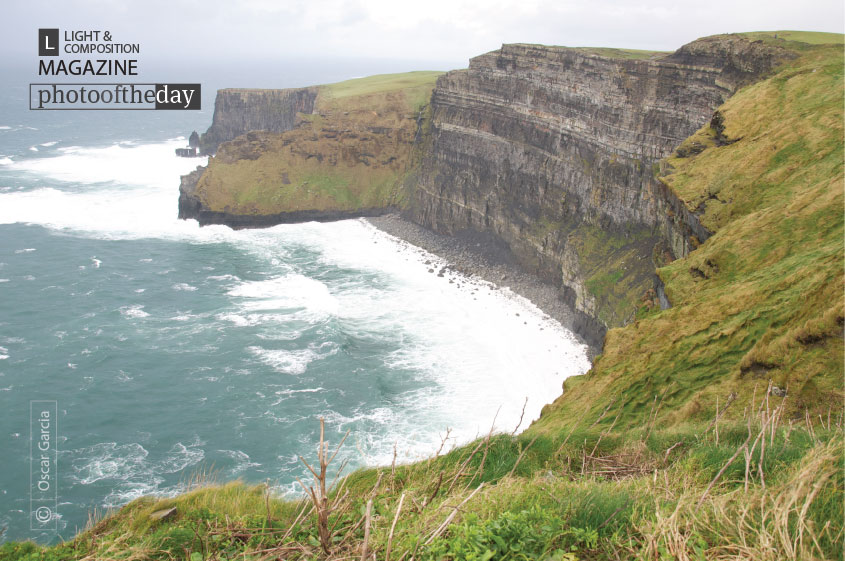
Captured on a day defined by biting winds and the raw power of the Atlantic, this photograph showcases the Cliffs of Moher as they stand defiant against the crashing surf. The photographer focused on the dramatic geological strata of the cliffs, illustrating the natural transition from solid rock to pebbles and sand. By choosing a wide-angle perspective, the image emphasizes the immense scale and arrogance of these ancient formations. This piece is award-worthy for its ability to translate the chaotic energy of the Irish coast into a balanced, evocative composition that highlights both the fragility and the enduring strength of the landscape.
Oscar Garcia
Born in Mexico City and raised in Guadalajara, Oscar Garcia is a geological engineer who currently resides in Houston, Texas. His extensive international career in the petroleum industry has taken him to over 30 countries, providing a global backdrop for his evolving photographic practice. Beginning his journey with a rudimentary camera in the 1960s, Garcia has since refined his craft through various digital formats, ultimately finding his creative voice in landscape photography. His work has been featured in numerous publications, reflecting a lifelong fascination with the earth sciences and the natural world.
Resonance Score Breakdown
Transparency Note: The resonance score (12.3/20) is calculated based on social engagement metrics collected before the award announcement.
Expert Photography Reviews · 3
Standing Before the Edge
I spent this morning trying to organize my bookshelf, pulling out old journals that I haven't touched in years. I found a note tucked into a page from a trip I took when I was twenty, back when I thought I had to have my entire life mapped out by now.
Read the reflection →The Weight of Ancient Stone
There is a patience in stone that we, in our fleeting lives, struggle to comprehend. While we measure our days in hours and our years in seasons, the earth measures its existence in the slow, rhythmic pulse of the tides.
Read the reflection →Reviews & Comments
Share your thoughts about this award-winning photograph. Your reviews contribute to the community engagement score.
1/100sec at f/10, ISO 200, 18mm. It’s a safe, clinical choice for a landscape. The D90’s sensor handles the dynamic range well enough, but f/10 at 18mm doesn’t push the optics. It’s sharp, sure, but it lacks the grit I’d expect from the Atlantic. I’m tired of seeing these cliffs rendered with such sterile caution. It’s technically competent, but it doesn’t make me feel the cold. It’s just data, perfectly recorded and utterly forgettable.
The wind must have been relentless, stinging his cheeks as he waited for the light to soften against those jagged strata. He stood here in the cooling hour, listening to the Atlantic’s rhythm until the cliffs finally yielded their silence. It’s a humbling sight; I’ve felt that same ache in my own chest when the land stops resisting. He didn’t just capture stone; he caught the exact moment the earth decided to breathe.
The strata don’t just exist; they dictate the frame’s geometry. The horizontal layering creates a rigid, rhythmic pulse that anchors the chaotic surf below. It’s a disciplined study in mass. The wide-angle distortion doesn’t weaken the structure; it forces the eye toward the fulcrum of the cliff face. I’ve rarely seen such aggressive negative space hold its own against the Atlantic’s kinetic energy. It’s cold, precise, and frankly, it’s the only way to frame stone.