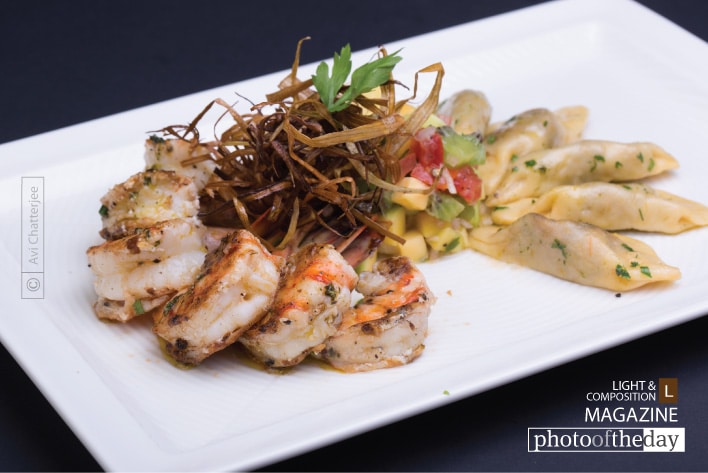
Prawn Salsa by Avi Chatterjee
Prawn Salsa captures a vibrant, refreshing culinary composition featuring grilled prawns paired with the tropical sweetness of mango, kiwi, and coconut, accented by delicate pumpkin dumplings. The photographer meticulously arranged these elements to highlight the dish's textures and colors, utilizing a narrow aperture to ensure every detail remains sharp and inviting. This image succeeds as an award-winning piece through its clean, balanced composition and the deliberate play of light, which elevates a simple dinner dish into a sophisticated visual experience that celebrates the artistry of food presentation.
Avi Chatterjee
Born in Kolkata, India, Avi Chatterjee is a Dubai-based photographer who transitioned from a career in electrical engineering to professional photography. Inspired by his wife, a painter, he established his studio, Time Machine Works, to pursue his passion for macro, wedding, food, and product photography. His work reflects a technical precision honed through his engineering background, combined with a growing artistic vision that seeks to capture the beauty in both everyday moments and professional culinary displays.
Resonance Score Breakdown
Transparency Note: The resonance score (11.1/20) is calculated based on social engagement metrics collected before the award announcement.
Expert Photography Reviews · 6
The Architecture of a Meal
In the quiet hours of the afternoon, when the kitchen has been scrubbed clean and the steam has long since vanished from the windows, there remains a lingering sense of what we have consumed.
Read the reflection →The Weight of Sustenance
We eat to forget the cold. There is a ritual in the preparation, a quiet geometry of ingredients placed upon a plate. It is a temporary architecture.
Read the reflection →Reviews & Comments
Share your thoughts about this award-winning photograph. Your reviews contribute to the community engagement score.
Of the thousands of food shots I’ve reviewed, most are merely appetizing. This one survives because the f/14 aperture forces a clinical, almost architectural precision onto the prawns and kiwi. It’s not just dinner; it’s a study in geometry. I’ll admit, the vibrant acidity of that mango makes me genuinely hungry, even a decade later. It avoids the usual soft-focus cliches, proving that when you treat a plate like a landscape, the composition actually lasts.
1/125sec at f/14, ISO 100, 100mm. Stopping down to f/14 on a macro lens is a calculated risk. It’s a sharp, clinical choice that keeps the prawns and kiwi in focus, though it risks diffraction. I’ve seen enough soft food shots to appreciate the discipline here. It’s technically sound, even if the lighting feels a bit flat. It doesn’t excite me, but it’s a precise execution of a very rigid, functional plan.
Before the eye identifies the prawns, a sudden, sharp brightness hits the back of my throat. It’s a visceral, salivary response to the acidity of that mango. The composition is so clinical it almost hurts, yet there’s a strange, cooling stillness here. I’ve returned to this frame three times today; it doesn’t feed me, but it triggers a phantom hunger that lingers long after I’ve looked away. It’s a beautiful, icy, calculated ache.
The frame’s geometry relies on the circular repetition of the prawns against the rigid, linear placement of the mango cubes. It’s a calculated grid. The depth of field at f/14 forces a relentless clarity that refuses to soften the edges. I’m genuinely irritated by the lack of negative space, yet the spatial tension holds. The composition doesn’t collapse under the weight of the garnish. It’s a clinical, balanced architecture that barely survives its own density.
At f/14, Chatterjee pushes the EF 100mm toward its diffraction limit, yet the focal plane remains remarkably crisp across the prawn’s fibrous texture. It’s a calculated risk that pays off; the light hitting the mango’s translucent edges reveals a cellular structure the naked eye simply misses. I’m genuinely moved by how the optics resolve the coconut’s fine grain against the dumplings. It’s a clinical, beautiful dissection of color that makes me crave the dish’s very chemistry.
We look at these prawns and mangoes, and we aren’t just seeing a meal; we’re seeing a conversation between the sea and the sun. Avi listened to the ingredients before he framed them. He’s captured the quiet dignity of a dish that knows its own worth. It’s vibrant, yes, but there’s a stillness here that moves me. I’d sit at this table for hours, just to hear what the coconut and kiwi have to say.