Starred At by Nirupam Roy
Captured in the marshy backyard of a factory in Tufanganj, this striking wildlife portrait documents a moment of unexpected connection. While documenting the daily activities of the subjects, the photographer found himself suddenly observed by them. Rather than fleeing, the creatures remained still, locking eyes with the lens in a series of curious, varied poses. This image is award-worthy for its intimate proximity and the palpable sense of mutual recognition, transforming a quiet, candid encounter into a compelling narrative of wildlife behavior that bridges the gap between the observer and the observed.
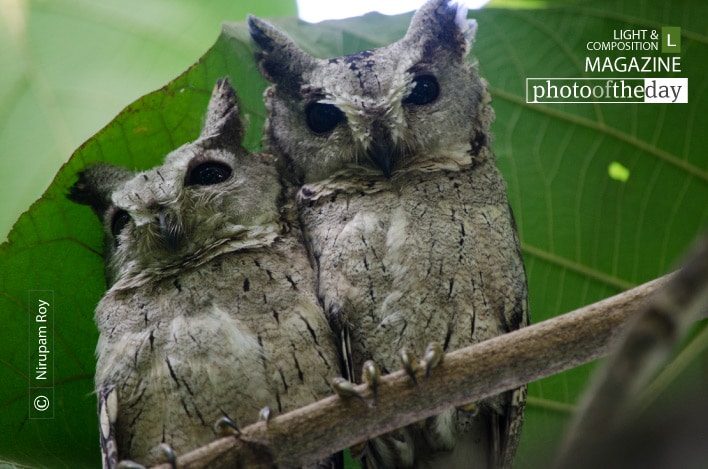
Exposure 1/40sec @ f/5.6 | ISO 800 | Focal Length 300mm
Nirupam Roy
Hailing from the town of Tufanganj in West Bengal, India, Nirupam Roy balances his professional life as a school teacher with a profound dedication to photography. His creative journey began during a family trip to Odisha, where the desire to document scenic landscapes and personal moments ignited a lasting passion. Since transitioning to DSLR photography, Roy has developed a keen eye for the beauty in everyday life, viewing the medium as a transformative force that brings peace and a fresh perspective to his understanding of nature and humanity.
Resonance Score Breakdown
Transparency Note: The resonance score (12.5/20) is calculated based on social engagement metrics collected before the award announcement.
Expert Photography Reviews · 7
The Weight of a Gaze
There is a profound vulnerability in being truly seen. We often move through the world as observers, believing we are separate from the life that surrounds us, yet there are rare, quiet moments when the boundary dissolves.
Read the reflection →The Weight of a Glance
I was walking through the park this morning when a stray cat stopped dead in its tracks. It didn't run. It didn't hiss.
Read the reflection →Reviews & Comments
Share your thoughts about this award-winning photograph. Your reviews contribute to the community engagement score.
Before the eye identifies the creature, a sudden stillness anchors the chest. It’s that held-breath moment where the gaze isn’t just received; it’s returned. I feel a prickle of vulnerability, as if the marshy shadows of Tufanganj are watching me back. When I return to this a year later, the recognition remains—a quiet, unsettling intimacy. It’s rare to feel so thoroughly seen by something that doesn’t know my name, yet somehow knows I’m there.
The marsh grass recedes. It’s a blur of muted greens. Then, the eyes. They don’t blink. I’ve felt that gaze before, in the quiet of a temple garden. It’s heavy. The stillness isn’t a lack of movement; it’s a presence. Nothing here is accidental. The empty corner is not empty. It’s a breath held in the tall weeds. I find myself holding my own breath, too. It’s a rare, sharp silence. I’m grateful for it.
Most wildlife shots are just trophies, but this one hits differently. I’ve seen thousands of animals staring down a lens, yet Roy’s capture of these creatures in a Tufanganj marsh feels like a genuine conversation. The 300mm compression flattens the space, forcing us into their uneasy stillness. It’s the raw, unblinking curiosity in their eyes that gets me; I actually felt a shiver of recognition. Thirty years from now, we’ll still be wondering what they saw.
The marshy gloom of Tufanganj doesn’t merely frame these creatures; it swallows them. Roy’s lens captures a gaze that pierces through the industrial rot, forcing an uncomfortable communion. I’ve stared into those eyes, and it’s haunting—the way the darkness clings to their fur, refusing to let them be mere specimens. It’s not a portrait, but a confrontation. When the light fails, the animal soul finally emerges. It’s a heavy, silent truth I can’t escape.
One doesn’t find such stillness in a factory backyard without a fair amount of damp trousers and mosquito bites. It’s clear Roy didn’t just stumble upon these creatures; he sat until he became part of the scenery. I’ve spent enough mornings shivering in tall grass to recognize that look of mutual suspicion. It’s a rare, quiet victory. He didn’t just take a picture; he earned an invitation to watch them breathe. That’s worth the price of admission.
The ochre of the marsh grass, reminiscent of a muted Morandi still life, anchors this encounter in a humid, suffocating warmth that I find utterly intoxicating. It’s the way the creature’s coat bleeds into the bruised, earthy tones of the Tufanganj soil that captures one’s soul; the light doesn’t merely illuminate, it clings to the fur like damp velvet, creating a chromatic intimacy that makes me ache for the wild, silent stillness of that forgotten backyard.
At 300mm, the D7000’s sensor resolves the creature’s iris with startling clarity. The focal plane is razor-thin, yet it captures the exact refraction of light within the pupil. I’m genuinely moved by the way the bokeh, a function of the f/5.6 aperture, isolates that gaze from the marshy chaos. It’s not just a portrait; it’s a precise optical intersection where the lens’s resolution finally meets the raw, unblinking intelligence of the wild. It’s hauntingly beautiful.