Different Exposures by Nirupam Roy
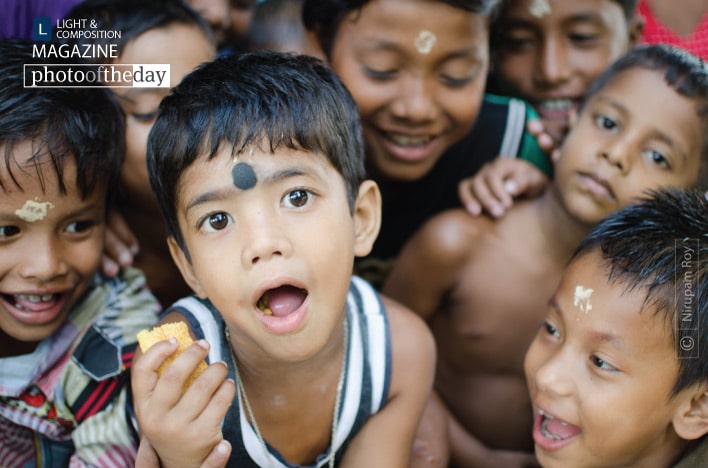
During a local festival, the photographer captured a candid moment of children finding joy in simple pleasures amidst the surrounding rituals. Observing from a distance to avoid disrupting their play, the photographer was struck by the children's natural ease; some posed playfully while others remained absorbed in their own world. This image is award-worthy for its authentic documentary quality, capturing a fleeting, humanizing moment of childhood innocence. The shallow depth of field, achieved through a wide aperture, isolates the subjects beautifully, ensuring the viewer’s focus remains entirely on their genuine expressions and the unscripted narrative of the scene.
Nirupam Roy
Based in the small town of Tufanganj, West Bengal, Nirupam Roy balances his professional life as a school teacher with a deep-seated passion for documentary photography. His transition from video production to still photography was sparked by a family trip to Odisha, which ignited a desire to document both the natural world and his personal life. Now an avid photographer, Roy views his craft as a meditative practice that has fundamentally transformed his perspective on society and human nature, driving him to constantly explore new creative concepts through his lens.
Resonance Score Breakdown
Transparency Note: The resonance score (13.3/20) is calculated based on social engagement metrics collected before the award announcement.
Expert Photography Reviews · 7
The Grit of Unfinished Games
The smell of damp earth after a sudden rain always pulls me back to the knees of my childhood. I remember the specific, gritty texture of soil under my fingernails—the way it felt like a secret I was burying, or perhaps unearthing.
Read the reflection →The Weight of Play
We forget how to occupy space without purpose. As children, the world is not a sequence of tasks, but a series of textures. A stone is not a tool; it is a companion.
Read the reflection →Reviews & Comments
Share your thoughts about this award-winning photograph. Your reviews contribute to the community engagement score.
The shallow depth of field here doesn’t just isolate; it abandons the periphery to a murky, suffocating void. Roy’s children exist in a fragile, illuminated pocket, yet I’m haunted by the darkness pressing against their skin. It’s a cruel, beautiful tension. Heidegger argued that truth happens in the clearing, but here, the clearing is under siege. I find myself shivering, terrified that the shadows will eventually reclaim these small, defiant faces. It’s a heavy, necessary struggle.
Before the eye identifies the children in Chilakhana, a sudden stillness settles in the chest. That shallow depth of field doesn’t just isolate them; it creates a vacuum where my own pulse slows to match their unscripted play. I’ve returned to this frame for years, and it still triggers a phantom ache for a forgotten, sun-drenched ease. It’s the way they inhabit their world—unbothered, entirely present—that makes me want to breathe again.
The shallow depth of field creates a precarious isolation. It’s a gamble that doesn’t quite pay off. While the foreground subject holds the frame, the background blur lacks the necessary architectural weight to anchor the composition. The spatial tension is lost in the bokeh. I’m frustrated by the lack of geometric discipline here. It’s a missed opportunity for structure. The eye wanders, searching for a fulcrum that simply isn’t there. It’s technically soft, structurally hollow.
The light here isn’t forced; it’s the soft, diffused glow of a humid afternoon in Coochbehar. Nirupam waited, letting the festival’s chaos recede until these children existed in their own quiet sanctuary. I’ve spent enough hours in the field to recognize that stillness. It’s a rare, sacred patience. Looking at their faces, I feel a sudden, sharp ache for my own lost childhood. He didn’t just take a picture; he listened to their silence.
Of the thousands of festival shots I’ve reviewed, most drown in chaos. What separates this from the pack is the restraint. By using that 35mm at f/1.8, Roy didn’t just blur the background; he carved out a private sanctuary for these children. It’s a rare, quiet exhale in a loud world. I find myself smiling every time I look at it. Thirty years from now, this won’t just be a record; it’ll be a feeling.
At f/1.8, the 35mm lens creates a razor-thin focal plane that isolates these children from the chaotic festival background. The bokeh, a function of that wide aperture, renders the distant ritual as soft, chromatic blurs. It’s a delicate optical separation. I’m genuinely moved by how the diffraction of light across their faces reveals such raw, unscripted joy. It’s rare to see a sensor resolve human innocence with this much precision while the physics of the glass does all the heavy lifting.
The shallow depth of field creates a wall. Behind the children, the festival dissolves into soft, grey light. It’s a quiet border. They don’t notice the lens. I’ve spent minutes watching the boy on the left. He’s anchored in his own stillness. Nothing here is accidental. The empty corner is not empty. It’s a breath. I feel a sudden, sharp ache for that kind of focus. To be present, and nothing more.