Frosty Moon by Ronnie Glover
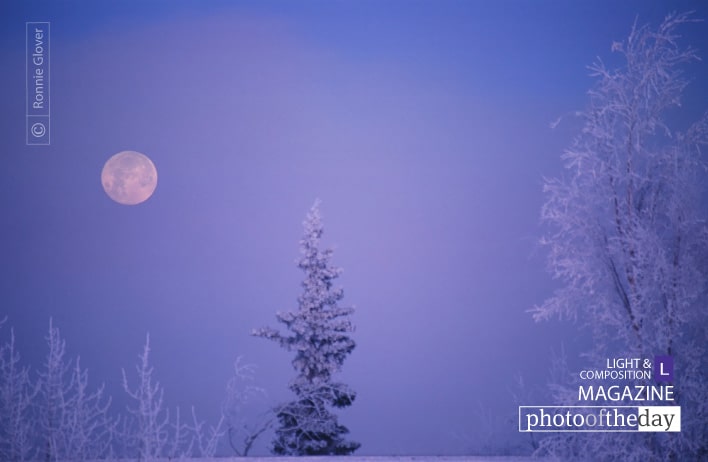
Captured during an early winter morning hike, Frosty Moon depicts the serene transition from night to day. As the full moon descended toward the horizon, its pale light illuminated a landscape encased in delicate frost, transforming trees and plants into crystalline sculptures. The photographer masterfully balanced the cool, blue tones of the pre-dawn sky with the subtle textures of the frozen environment. This image is award-worthy for its evocative atmosphere and the quiet, patient observation required to document the fleeting moment before the rising sun reclaimed the Alaskan wilderness.
Ronnie Glover
Based in Gig Harbor, Washington, Ronnie Glover is a dedicated photographer whose artistic journey was shaped by professional training at the Southeastern Center for the Arts. Having spent fourteen years immersed in the Alaskan wilderness, he developed a profound ability to capture the raw beauty of nature and diverse cultural experiences. His work, which spans nature, sports, and travel photography, reflects a lifelong commitment to promoting global understanding and appreciation for the natural world through his lens.
Resonance Score Breakdown
Transparency Note: The resonance score (12.9/20) is calculated based on social engagement metrics collected before the award announcement.
Expert Photography Reviews · 5
The Breath of Winter
There is a specific silence that belongs only to the cold, a stillness so profound it feels as though the earth is holding its breath, waiting for the sun to grant it permission to speak.
Read the reflection →The Silence of the Cold
Why do we feel that stillness is a form of absence, rather than a presence in its own right? We spend our lives filling the air with noise, convinced that if we stop speaking, the world might simply unravel.
Read the reflection →Reviews & Comments
Share your thoughts about this award-winning photograph. Your reviews contribute to the community engagement score.
The cerulean hush of this Alaskan dawn, reminiscent of a Morandi still life drained of its warmth, vibrates with the brittle, silver-blue light of a dying moon. It’s a chromatic ache that I’ve felt in my own marrow; the frost-bitten whites possess a crystalline clarity that makes one shiver. One finds here a rare, glacial harmony where the shadows aren’t merely absent light, but deep, velvet reservoirs of indigo waiting for the sun’s intrusion.
Nikon N2000, Fujichrome Velvia. The high-contrast emulsion was a calculated risk for low-light lunar capture. It’s a tightrope walk. The exposure holds the frost’s crystalline structure without blowing out the moon’s highlights. I’ve spent years chasing this specific dynamic range, and frankly, it’s infuriating how well the metering held up here. Most would’ve underexposed the shadows into oblivion. Glover didn’t. The technical discipline is sharp. It’s the only reason this composition actually functions.
Velvia’s high-contrast emulsion captures the lunar light with startling micro-contrast. The lens resolves the frost’s crystalline structure right at the diffraction limit, rendering each ice needle with a sharpness the naked eye simply misses. It’s a cold, precise beauty that makes my breath hitch. You can almost feel the photons scattering across those frozen surfaces. It’s rare to see a film capture such delicate, sub-millimeter detail without losing the atmospheric depth of the Alaskan dawn.
One suspects Glover didn’t just stumble upon this. Anchorage at dawn in winter is a brutal, unforgiving place to stand still, yet the frost here hasn’t been disturbed by a hurried tripod setup. It’s a quiet, crystalline achievement. I’ve spent enough mornings shivering in the dark to know that blue light doesn’t offer itself up for free. He paid the price in cold, and frankly, it’s a relief to see the effort actually show.
Most landscapes I review are just pretty postcards, but this one sticks. It’s the way the moon’s pale glow hits the frost, turning the trees into brittle, silver ghosts. It’s haunting. I’ve seen thousands of winter shots, yet this one captures a silence so deep I can almost feel the cold biting my skin. It’s not just a scene; it’s a memory of a world before the sun wakes up. That’s why it endures.