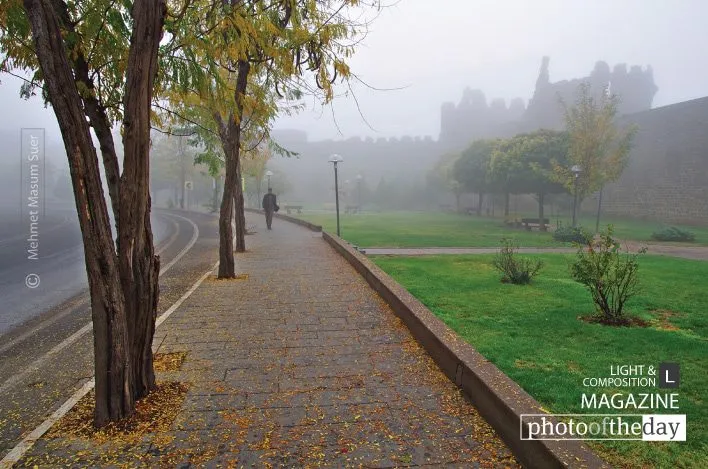
Castle of Diyarbakir under Fog by Mehmet Masum
Captured amidst the atmospheric embrace of a heavy fog, this photograph highlights the imposing black basalt masonry of the historic Diyarbakir Castle. By utilizing a wide-angle perspective, the photographer emphasizes the sheer scale of these ancient fortifications, which rank among the longest medieval walls in the world. The soft, diffused light of the fog creates a moody, timeless aesthetic that contrasts with the rugged, enduring texture of the stone. This image is award-worthy for its masterful balance of historical documentation and artistic composition, effectively transforming a monumental architectural relic into a hauntingly beautiful scene that evokes the deep, storied past of the region.
Mehmet Masum
Based in Diyarbakir, Turkey, Mehmet Masum Suer is a distinguished Kurdish photographer and former journalist whose career spans decades of cultural documentation. Transitioning from a prolific career in photojournalism to a dedicated focus on historical and cultural research, he specializes in capturing the architectural heritage of cities like Diyarbakir, Mardin, and Van. His work, which frequently appears in international tourism publications and exhibitions across Turkey, Iraq, and the United States, serves as a vital visual record of cultural festivals, historic landmarks, and the lives of prominent regional figures.
Resonance Score Breakdown
Transparency Note: The resonance score (11.4/20) is calculated based on social engagement metrics collected before the award announcement.
Expert Photography Reviews · 5
The Weight of Ancient Breath
The air this morning tastes of damp wool and wet slate. It is a heavy, clinging cold that settles deep into the marrow of my bones, the kind of chill that makes you want to pull your shoulders toward your ears and disappear into the collar of a thick coat.
Read the reflection →The Weight of Unseen Walls
Why do we build monuments to things that were never meant to last? We stack stone upon stone, convinced that by hardening the earth into shapes, we can somehow anchor our fleeting presence against the erosion of time.
Read the reflection →Reviews & Comments
Share your thoughts about this award-winning photograph. Your reviews contribute to the community engagement score.
Before the eye identifies the basalt, something in the chest constricts. The fog doesn’t just obscure; it erases the present, forcing a physiological stillness. I feel a sudden, sharp chill—a phantom weight of centuries pressing against my ribs. When I return to this a year later, the stone feels less like architecture and more like a held breath. It’s a haunting, quiet anchor that follows me into sleep, reminding me how easily history dissolves into mist.
At f/5, the Tamron’s focal plane barely grazes the basalt’s porous texture, yet the fog’s scattering effect softens the diffraction limit beautifully. It’s a delicate interplay; the wide 17mm perspective stretches the masonry, while the atmospheric haze suppresses micro-contrast, creating a haunting, ethereal depth. I’m genuinely moved by how the lens resolves the stone’s grit against such pervasive moisture. It’s a rare moment where the optics don’t just record history—they breathe with it.
The basalt massing anchors the frame, asserting a brutalist geometry against the vaporous void. It’s a rigid architecture that refuses to dissolve into the fog. The wide-angle lens forces a spatial tension, pushing the stone toward the viewer’s periphery. I’ve rarely seen such cold, calculated weight. The composition holds because the horizon doesn’t waver. It’s a disciplined study of volume. The frame is tight, precise, and entirely devoid of unnecessary noise. It’s structurally perfect.
1/125sec at f/5, 17mm, ISO 100. A conservative choice for a wide-angle landscape. The f/5 aperture keeps the basalt masonry sharp while letting the fog soften the background into a manageable blur. It’s technically sound, though I’d have preferred a tighter aperture to force more detail into the distant ramparts. Still, the exposure is precise. It’s rare to see such restraint with a wide lens. I actually found myself leaning in to check the focus. It holds.
The basalt masonry doesn’t merely sit there; it exhales a charcoal melancholy, a bruised, volcanic grey that Vermeer might have envied for its quiet, impenetrable depth. As the fog bleeds into the stone, it’s like watching the world dissolve into a Turner-esque vapor, and I’ve found myself shivering at the sheer, suffocating beauty of it. It’s a chromatic ache, where the cold, dampened light renders history not as a fact, but as a fading, monochromatic ghost.
her bijî hunermendê hem welatî gelek pîroz dikim…
Zor spas hevala delal Dem An…