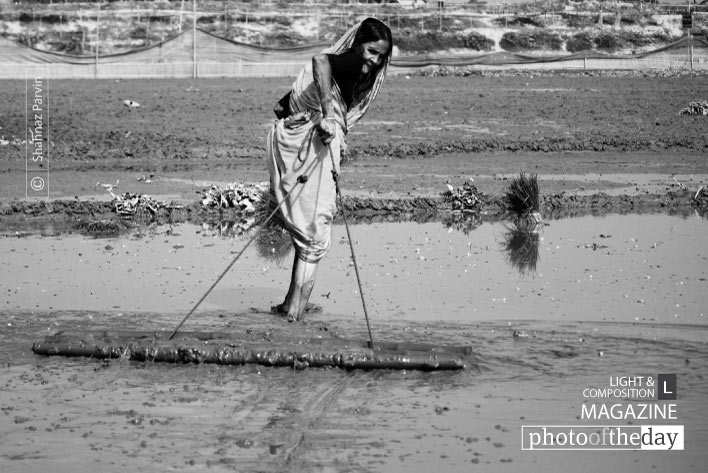
The Mother of the Land by Shahnaz Parvin
Captured in the rural landscape near Dhamrai, Bangladesh, this poignant portrait documents the quiet resilience of an elderly female farmer. Navigating the uneven, muddy slopes of the rice fields, the photographer approached the subject, who agreed to be photographed only on the condition of anonymity. The image captures the essence of rural life, where women balance household duties with demanding agricultural labor well into their later years. The photograph is award-worthy for its raw, authentic portrayal of human dignity and the profound connection between the subject and the land, rendered with technical precision.
Shahnaz Parvin
Based in Dhaka, Bangladesh, Shahnaz Parvin was a celebrated photojournalist and a passionate advocate for documentary photography. Recognized as one of the world's top photographers during her career, she dedicated her lens to capturing the rich culture, people, and landscapes of her homeland. A prolific contributor to Light & Composition, her work remains a testament to her commitment to storytelling and her exceptional ability to document the human experience across South Asia.
Resonance Score Breakdown
Transparency Note: The resonance score (13.0/20) is calculated based on social engagement metrics collected before the award announcement.
Expert Photography Reviews · 5
The Soil Beneath Our Names
We often speak of the earth as something beneath us, a floor for our ambitions, yet it is the skin that holds our history.
Read the reflection →Hands That Hold the Earth
I spent this morning trying to fix a loose stone in my garden path. My hands were covered in dirt, and for a moment, I felt frustrated by how much effort it took just to keep things steady.
Read the reflection →Reviews & Comments
Share your thoughts about this award-winning photograph. Your reviews contribute to the community engagement score.
The mud holds her weight. She doesn’t lean; she persists. I’ve spent minutes watching the way the horizon swallows her silhouette. It’s a quiet ache in my chest. The frame isn’t crowded by her labor. It’s defined by the vast, unyielding space around her. Nothing here is accidental. The empty corner is not empty. It is the silence of the field, waiting for the next step. She is the pause between breaths. It’s enough.
The ochre of the sun-baked earth, a shade reminiscent of Morandi’s dustiest pigments, anchors this woman in a landscape that’s essentially her own skin. It’s a chromatic ache, really; the way the muted, bruised greens of the rice stalks bleed into the sky’s pale, humid haze makes me want to weep for the sheer weight of her toil. One finds here a harmony so profound, it’s as if the light itself is breathing with her.
One suspects the mud on those boots wasn’t acquired in a single afternoon. It’s a relief to see a portrait that hasn’t been hurried. The shutter speed is unnecessarily fast, perhaps a nervous reflex, but the subject’s gaze suggests a long, quiet negotiation before the click. I’ve spent enough time in wet fields to recognize that look of weary patience. It’s earned. She didn’t just pose; she allowed the photographer to exist in her space.
Most documentary work from this region settles for mere observation, but Parvin’s frame captures a weight I haven’t seen in years. The way the subject’s weathered hands grip the soil tells me more about survival than a thousand portraits of poverty. It’s the mud-caked texture against the soft focus of the rice field that makes this endure. I felt a genuine ache in my chest looking at it. It’s a rare, honest piece of history.
Shadows here don’t merely cling to the mud; they consume the subject’s labor, anchoring her to the earth with a gravity that feels almost biblical. It’s a brutal, honest darkness. I’ve stared at the way the light dies against her weathered skin, and it’s haunting—it feels like watching time itself erode a soul. Most photographers fear this depth, but she invites it. It’s not just a portrait; it’s a confrontation with the inevitable weight of existence.