Daisy by Ronnie Glover
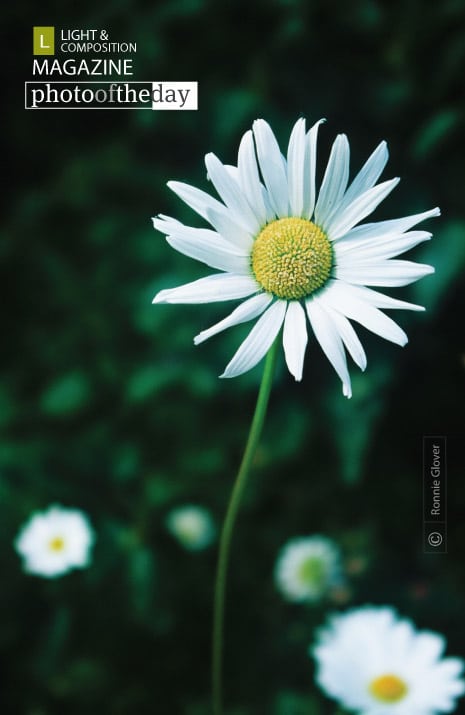
In this evocative capture, the photographer seeks to distill the essence of the Alaskan summer, a season defined by its transition from long, dark winters to nearly twenty hours of brilliant daylight. By focusing on a single daisy, the image serves as a vibrant testament to the resilience and joy that blooms across the landscape once the frost recedes. The composition is a celebration of light and color, capturing the warmth of the season with a clarity that highlights the delicate textures of the flower against the vast, wild backdrop of the North.
Ronnie Glover
Based in Gig Harbor, Washington, Ronnie Glover developed his professional foundation at the Southeastern Center for the Arts in Atlanta. His extensive fourteen-year tenure in Alaska provided him with profound opportunities to immerse himself in nature photography, shaping his artistic vision and technical precision. Beyond his work in the wilderness, Glover is an avid travel photographer who seeks to bridge cultural divides through his lens, aiming to inspire viewers to appreciate the diverse beauty of the natural world and the richness of global cultures.
Resonance Score Breakdown
Transparency Note: The resonance score (13.1/20) is calculated based on social engagement metrics collected before the award announcement.
Expert Photography Reviews · 6
The Persistence of Light
Winter is a long, hushed conversation between the earth and the frost, a time when the world holds its breath beneath a heavy, white blanket. We often think of growth as a loud, sudden arrival, but it is actually a slow, quiet negotiation with the dark.
Read the reflection →The Persistence of Small Things
In the high latitudes, where the earth tilts its face toward the sun with a desperate, lingering hunger, the concept of time begins to fray. We are taught that growth is a steady, rhythmic affair, a slow climb toward a peak.
Read the reflection →Reviews & Comments
Share your thoughts about this award-winning photograph. Your reviews contribute to the community engagement score.
The sun in Anchorage doesn’t just shine; it lingers, heavy with the weight of a long-awaited thaw. I feel a sudden, sharp ache in my chest looking at this daisy. It’s a quiet defiance against the frost. He stood here in the cooling hour, waiting for the light to soften the petals. It’s not just a flower; it’s a prayer of resilience. I’ve spent enough dawns in the field to know he was listening.
Velvia’s aggressive saturation here feels like a desperate scream against the encroaching Alaskan void. It’s a fragile daisy, yet it doesn’t invite us in; it resists the vast, indifferent tundra behind it. I find myself shivering, not from the cold, but from the terrifying clarity of that light. The shadows are too thin, too shallow. They don’t hold the weight of the earth. It’s a beautiful bloom, but it’s terrified of its own darkness.
It’s a charming enough daisy, but I’m left wondering if Mr. Glover simply stumbled upon it during a pleasant afternoon stroll. There’s a lack of grit here. I’ve spent enough hours shivering in Alaskan mud to know that true nature photography demands more than a quick shutter click. It’s pretty, certainly, but it doesn’t feel earned. I’d have liked to see him return when the wind was howling, not just when the sun was behaving.
Most floral shots are forgettable, but this one sticks. Of the thousands I’ve reviewed, it’s the Velvia’s punchy saturation that saves it from being just another postcard. The off-center placement of the daisy against that blurred Alaskan expanse creates a quiet tension I find genuinely moving. It’s not just a flower; it’s a stubborn, bright defiance of the dark. I’m glad this exists because it captures a fleeting, fragile victory that’ll still matter in thirty years.
Velvia’s high-contrast emulsion renders the daisy’s white petals with startling micro-contrast, pushing the Nikon’s optics to their resolution limit. I’m genuinely moved by how the focal plane slices through the central disc florets; it’s a surgical precision that reveals cellular textures invisible to the naked eye. The bokeh, a function of the wide aperture, softens the Alaskan backdrop into a creamy, chromatic blur. It’s a rare moment where the physics of glass perfectly captures the ephemeral.
The daisy holds the frame. It doesn’t crowd the space. It breathes. I’ve spent minutes watching the petals against the Alaskan blur. It’s quiet. I feel a sudden, sharp ache for the stillness of that tundra. Nothing here is accidental. The empty corner is not empty. It is the weight of the North, held in a single stem. Glover trusts the silence. It’s rare. I’m grateful he didn’t add more.