Dancing in the Water by Saniar Rahman Rahul
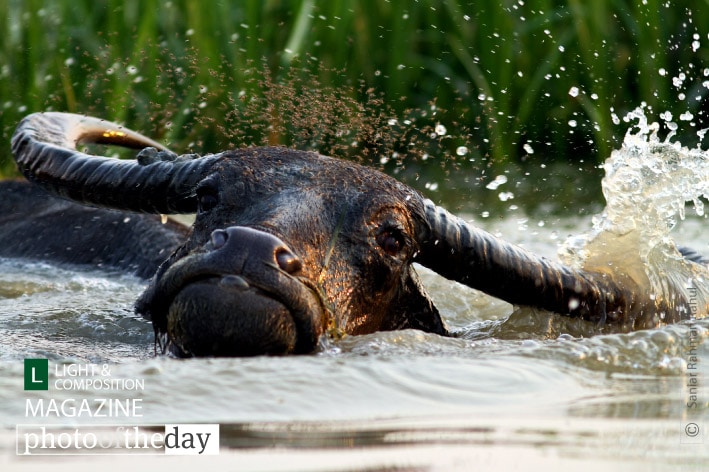
Captured within the intricate maze of Bengal’s waterways, this photograph documents a common yet captivating scene of water buffaloes seeking relief from the summer heat. The photographer was drawn to the rhythmic, fluid motion of the animal as it waded through the river, creating a visual impression of a dance. By utilizing a long focal length, the photographer isolated the subject against the water, emphasizing the grace and vitality of the creature. This image is award-worthy for its ability to transform a routine wildlife encounter into a poetic, dynamic composition that highlights the harmonious relationship between the animal and its environment.
Saniar Rahman Rahul
Based in Dhaka, Bangladesh, Saniar Rahman Rahul is an accomplished Art Director at Grey Worldwide with a deep-rooted passion for visual storytelling. His journey into photography began in childhood, inspired by his father, and was later refined through his extensive professional background in graphic design and advertising. Rahul’s work reflects a sophisticated eye for composition and rhythm, honed over decades of experience in the creative industry. As a recognized talent in the international photography community, he continues to capture the raw beauty and cultural essence of his homeland through his lens.
Resonance Score Breakdown
Transparency Note: The resonance score (11.5/20) is calculated based on social engagement metrics collected before the award announcement.
Expert Photography Reviews · 4
The Weight of the Current
There is a peculiar physics to immersion. When we step into water, we are not merely occupying a space; we are being held by it, our own density suddenly countered by a buoyant, invisible hand. It is a surrender of the terrestrial.
Read the reflection →The Weight of Water
There is a heavy grace in things that do not know they are being watched. We spend our lives performing for an audience that is rarely there, yet the animal in the river has no such burden.
Read the reflection →Reviews & Comments
Share your thoughts about this award-winning photograph. Your reviews contribute to the community engagement score.
The water isn’t merely liquid; it’s a bruised, slate-grey expanse that recalls the melancholic, muted stillness of a Morandi canvas, against which the buffalo’s hide emerges as a rich, earthy umber, vibrating with a warmth that makes my own skin ache for the river’s cool relief. It’s a chromatic dialogue of temperature, where the heat of the beast’s vitality quarrels beautifully with the frigid, atmospheric depth of the Bengal silt, creating a dance of pure, unadulterated light.
One suspects the photographer didn’t just stumble upon these buffaloes while out for a stroll. Getting that precise, rhythmic spray of water requires sitting in the humidity until your clothes feel like a second, sodden skin. I’ve spent enough mornings in the marsh to know the ache of waiting for the light to align with the movement. It’s a quiet, earned grace. I find myself wanting to be there, if only to share the silence.
Of the thousands of wildlife frames I’ve reviewed, most are just clinical records. What separates this from the pack is the water’s texture; it’s not just a backdrop, but a tactile partner to the buffalo’s movement. I’m genuinely moved by how the spray catches the light, turning a mundane cooling ritual into a ballet. It’s a rare, quiet dignity that will still feel vital in thirty years. It’s exactly why this deserved the win.
The buffalo’s mass anchors the frame, creating a necessary fulcrum against the fluid, chaotic texture of the water. It’s a rigid geometry that keeps the composition from dissolving into mere sentiment. The negative space around the horns provides a sharp, clinical clarity. I’ve rarely seen such discipline in wildlife work; it doesn’t rely on the subject’s grace, but on the tension of the frame itself. It’s a cold, calculated success. The structure holds perfectly.