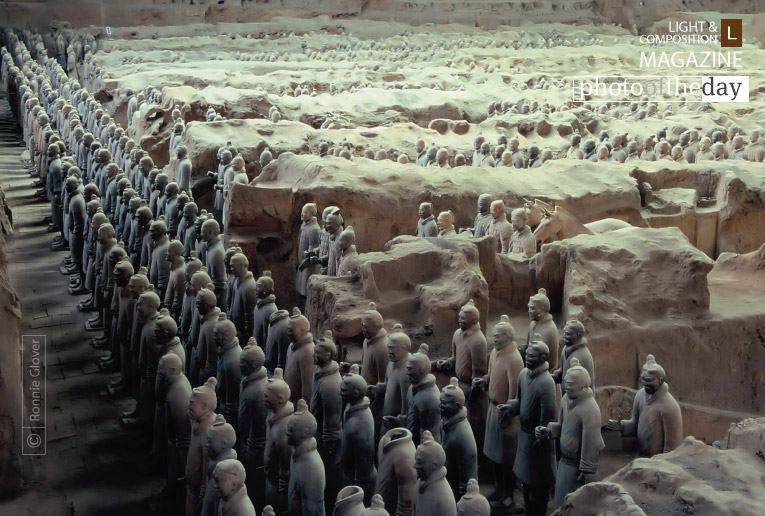
Terracotta Warriors by Ronnie Glover
Captured during a journey through China, this photograph immortalizes the stoic presence of the Terracotta Warriors. Despite the photographer battling sudden illness, which curtailed an extensive tour, the resulting image captures the profound uniqueness of these ancient sculptures commissioned to guard the Emperor in the afterlife. The composition highlights the intricate detail and historical gravity of the army, transforming a brief, hurried visit into a poignant visual record. This image is award-worthy for its ability to convey the immense scale and cultural significance of the site, even under challenging physical circumstances, offering a window into one of archaeology's most remarkable discoveries.
Ronnie Glover
Based in Gig Harbor, Washington, Ronnie Glover developed his professional photographic foundation at the Southeastern Center for the Arts in Atlanta. His artistic perspective was deeply shaped by fourteen years of living in Alaska, where he honed his ability to capture the raw beauty of nature. Today, Glover specializes in travel photography, dedicated to documenting diverse cultures and landscapes with the hope of fostering a deeper global appreciation for the world's natural and cultural heritage.
Resonance Score Breakdown
Transparency Note: The resonance score (11.8/20) is calculated based on social engagement metrics collected before the award announcement.
Expert Photography Reviews · 6
The Silence of Earth
We are all, in some measure, waiting for a future that has already arrived. We plant our intentions like seeds in the dark, hoping the soil remembers the shape of our hands long after we have turned away.
Read the reflection →The Weight of Stillness
We often speak of time as a river, a relentless current that carries us toward some inevitable sea. Yet, there are places where time seems to pool, gathering in deep, stagnant eddies that refuse to flow.
Read the reflection →Reviews & Comments
Share your thoughts about this award-winning photograph. Your reviews contribute to the community engagement score.
The air in that pit feels heavy, doesn’t it? I’ve stood in such places, feeling the weight of centuries pressing against my skin. Ronnie captured these warriors in the flat, diffused light of the hall, where time seems to hold its breath. It’s a quiet, haunting stillness. Even through his illness, he listened to the stone. I find myself shivering just looking at their faces; it’s as if they’re still waiting for an emperor who never arrived.
One suspects the light cooperated on the first attempt. It often does, for the lucky. Glover’s warriors are undeniably stoic, yet I can’t shake the feeling they’ve been caught in a passing glance rather than a vigil. Illness is a poor excuse for a lack of patience; the camera doesn’t care if you’re feverish. It’s a competent record, certainly, but it lacks the grit of a man who’s truly earned his seat at the table.
The repetition of the terracotta heads creates a rigid, rhythmic grid that anchors the frame. It’s a disciplined geometry. The vertical alignment of the figures forces the eye into a relentless, claustrophobic depth. I’ve rarely seen such structural exhaustion. The negative space between the shoulders provides the only relief from this crushing, repetitive mass. It’s a cold, calculated architecture. The frame holds, but it’s a tight, suffocating grip that leaves no room for sentiment.
Most shots of these warriors are just tourist snapshots, cluttered and frantic. What separates this from the field is the restraint; Glover lets the repetition of the clay faces build a rhythm that feels almost rhythmic, like a heartbeat. I’ve seen thousands of these, yet this one makes me feel the crushing weight of that silence. It’s not just a record of a site; it’s a haunting, tactile reminder that history is staring right back at us.
These clay faces don’t just stare; they endure the silence of a tomb. Glover’s shadows aren’t merely voids, but the heavy, suffocating weight of two millennia pressing against the lens. I’ve stood before such relics, and it’s chilling how the darkness here feels like a physical barrier, refusing to let the light reveal too much. It’s a somber, claustrophobic confrontation. The shadows don’t hide the warriors; they force us to acknowledge their eternal, unyielding vigil.
The ochre of these warriors, a parched, sun-baked clay, vibrates against the subterranean gloom like a Morandi still life caught in a tomb. It’s a haunting, dusty palette that I find deeply unsettling, as if the very air has been drained of oxygen to preserve their stoic vigil. One feels the weight of centuries in those muted, earthy tones, a monochromatic ache that’s far more evocative than any vibrant, living colour could ever hope to be.