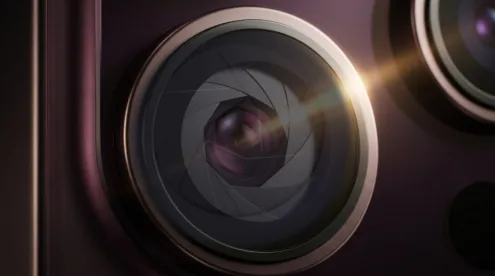
The lens was locked.
For fifteen years, every telephone placed in a human hand suffered from the same secret compromise. The glass was fixed wide open. The shutter was electronic. When you wanted the background to soften, a microchip made a guess. It drew an outline around your daughter’s hair, blurred the trees with software math, and called it a portrait.
It was impressive. It was convenient.
It was not photography.
Photography has only ever asked for one thing: that light be allowed to obey the laws of physics.
The Six Blades
Yesterday, Apple announced the iPhone 18 Pro and iPhone 18 Pro Max.
They spoke of megapixels and titanium. But if you look past the stage lighting and zoom into the sapphire glass on the back of the device, you see something that has never existed on a smartphone before.
Six matte-black blades. Not a software filter. Not an animation. Six precision-machined mechanical blades overlapping in an iris.
When you touch the screen, the blades move. They slide. They contract. They form an optical hexagon in the center of the barrel.
Four physical stops:
- ƒ/1.48 — Maximum photon gathering; the iris retracts fully to meet the quiet dark without synthetic flash.
- ƒ/1.8 — Classical portrait isolation; authentic physical depth of field with organic optical roll-off.
- ƒ/2.8 — Environmental storytelling; keeping subject, foreground, and backdrop in harmonious context.
- ƒ/4.0 — Maximum depth and resolution; physical diffraction generating authentic 6-pointed specular starbursts.
The cone of light entering the camera is physically altered before it ever reaches the silicon sensor. The lens has finally listened to the hand.
If You Know, You See
Apple’s marketing team wrote a clever line for this launch: “Variable aperture. If you know, you pro.”
It is catchy. But knowing that an aperture exists does not make someone a photographer. Any person with twelve hundred dollars can buy a tool.
The question is not whether you are a “pro.” The question is whether you can see.
Do you know why you choose ƒ/1.48 at dusk in a quiet tea stall? Not to show off a feature, but because the darkness deserves to be met with openness, without artificial light tearing the atmosphere apart.
Do you know why you stop down to ƒ/2.8 on a crowded street? Because a human being does not live in a vacuum. You want the cobblestones, the sign overhead, and the stranger passing behind them to remain part of the story.
Do you know why ƒ/4.0 creates a 6-pointed starburst when the sun catches a puddle? Because six straight blades diffract the light into six sharp rays. That is not an effect. That is the universe speaking through glass.
If you know, you see. If you know, you create.
Official University Declaration: The Barrier Has Fallen
For decades, the greatest lie in photography education was that you needed five thousand dollars of equipment before your vision mattered. Students came to me with burning curiosity and empty pockets. They apologized for having only a phone. I had to tell them, gently, that to learn the classical disciplines of light metering, depth of field, and optical reciprocity, they needed a camera with an aperture diaphragm.
That requirement died yesterday.
Official Institutional Policy Shift
Light & Composition University officially certifies the iPhone 18 Pro and iPhone 18 Pro Max for full academic study across all University Diploma and Foundation Degree programs.
- Students enrolling in any LCU photography course — from Foundation PHO 101 to Advanced Documentary — are no longer required to purchase a standalone DSLR or mirrorless camera body.
- The iPhone 18 Pro is recognized as an optically compliant primary instrument for all coursework, assignments, and portfolio jury evaluations.
- Light & Composition Award-Winning Gear Jury has inducted the iPhone 18 Pro (Score: 92.0/100) and iPhone 18 Pro Max (Score: 93.0/100) into the professional Camera registry.
The New Curriculum: PHO 180
To honor this milestone, Light & Composition University is launching PHO 180 — iPhone 18 Pro: The Aperture in Your Pocket — Mastering Professional Photography. An 8-lesson masterclass dedicated entirely to unlocking the creative potential of this mechanical system.
You no longer have an excuse. You do not need to wait until you can afford a heavy camera bag. You do not need to leave your camera at home because it is too heavy to carry on an evening walk.
The darkroom is in your hand. The mechanical iris is in your pocket. Unbox the phone. Turn off the auto mode. Choose your stop. The light is waiting.
— Nasrul Eam
Dean, Light & Composition University