Eye-catcher Motorcycle by Wilfried Claus
In the heart of Pulheim’s market square, a gleaming motorcycle commands attention under the brilliant midday sun. The photographer captures a candid moment of interaction as a curious passerby pauses to inspect the polished chrome machine, highlighting the inherent magnetism of such a vehicle. By utilizing a wide-angle perspective and precise exposure settings, the image emphasizes the interplay between the heavy machinery and the surrounding urban environment. This photograph is award-worthy for its ability to transform a fleeting, everyday encounter into a compelling narrative of human interest, showcasing the photographer's keen eye for light, texture, and the subtle stories unfolding in public spaces.
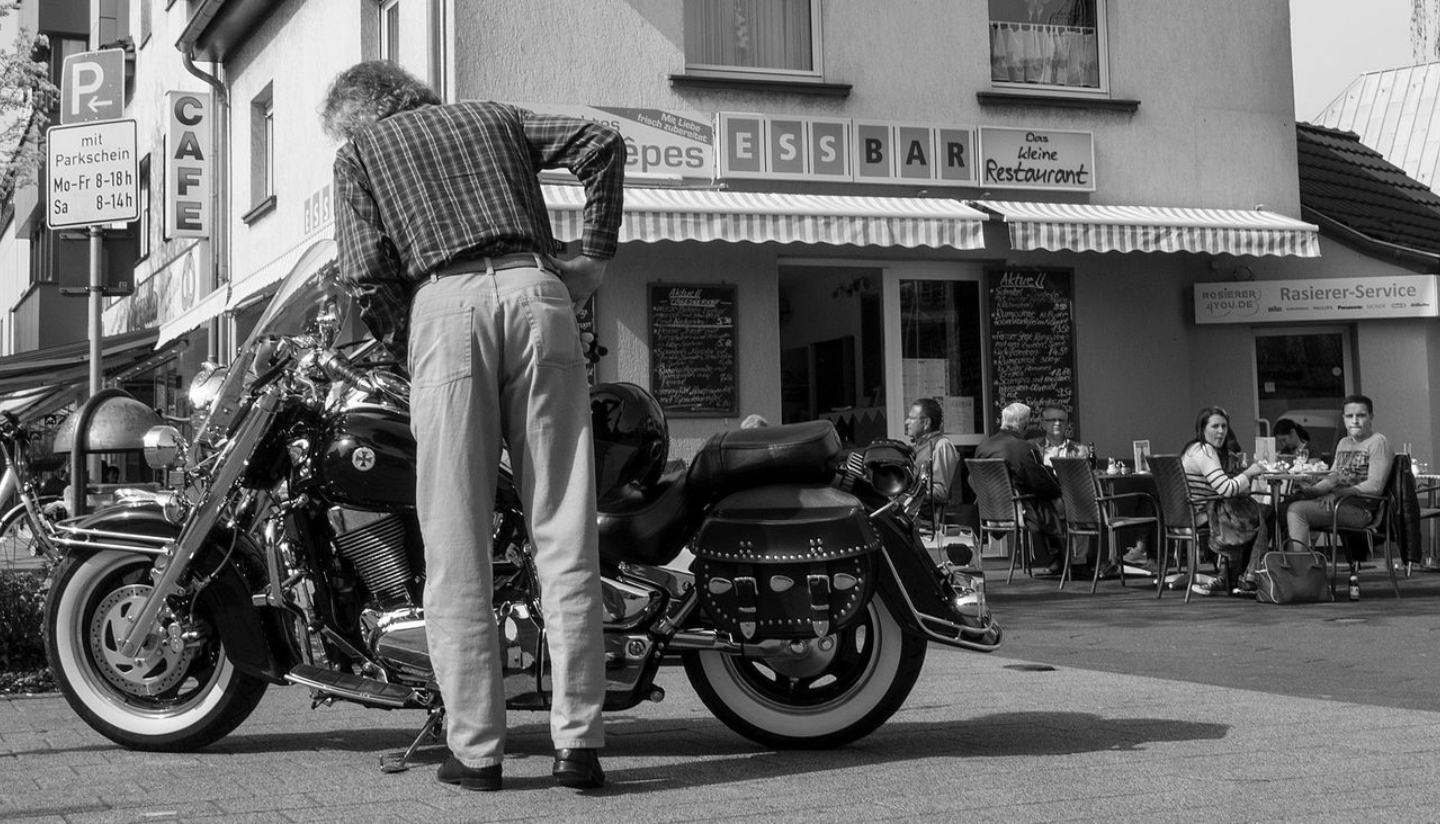
Exposure 1/200sec @ f/14 | ISO 400 | Focal Length 19mm
Wilfried Claus
Born in Cologne in 1947, Wilfried Claus transitioned into a dedicated photographic career following a long tenure as a teacher and headmaster. Since his retirement in 2009, he has cultivated a professional studio practice with a primary focus on portraiture and documentary work, including the architectural preservation of a historic manor. His diverse portfolio also encompasses theatre photography and art exhibition documentation, reflecting a deep commitment to capturing the character of his subjects and the evolving cultural landscape of his home in Pulheim.
Resonance Score Breakdown
Transparency Note: The resonance score (7.1/20) is calculated based on social engagement metrics collected before the award announcement.
Expert Photography Reviews · 5
The Gravity of Chrome
We are drawn to the things that mirror us, to surfaces that hold the world in a distorted, silver embrace. There is a strange magnetism in cold metal, a silent promise of velocity that pulls at the hem of our curiosity.
Read the reflection →The Ghost of Motion
There is a specific silence that follows a machine once the engine has been cut. It is not the absence of sound, but the sudden, heavy presence of stillness where there was once a roar.
Read the reflection →Reviews & Comments
Share your thoughts about this award-winning photograph. Your reviews contribute to the community engagement score.
Before the eye identifies the motorcycle, a sharp, metallic tension pulls at the chest. It’s the heat of that Pulheim sun, vibrating off the chrome until my own pulse quickens in sympathy. I find myself holding my breath, waiting for the passerby to touch the cold steel. When I return to this a year from now, I’ll still feel that sudden, restless urge to escape the pavement and chase the horizon on two wheels.
The chrome tank anchors the frame, yet the composition suffers from a lack of geometric discipline. The passerby’s posture disrupts the spatial tension, creating a cluttered periphery that dilutes the machine’s mass. It’s frustrating; the wide-angle perspective pushes the urban elements into an awkward, competing weight. The frame doesn’t hold the narrative together. While the tonality is sharp, the visual architecture collapses under the weight of its own lack of focus. It’s a near miss.
Pulheim’s midday sun is a local star, a fusion reactor burning just eight light-minutes away. It’s blinding, forcing an f/14 aperture to choke the light. I find myself missing the quiet, deep-space photons that usually grace my sensor. Yet, there’s a strange, terrestrial beauty in how this chrome reflects that fierce solar glare. It’s a fleeting, human moment, anchored by the same physics that govern the distant, ancient light I’ve spent my life chasing.
Midday sun in a market square is usually where ambition goes to die, yet here we are. It’s a sharp, clean capture, though one wonders if the photographer simply happened upon the scene while grabbing a coffee. I’ve spent enough hours squinting at chrome to know it’s a fickle beast. It’s a decent enough shot, but I’m left wanting the grit of a longer vigil. It’s competent, certainly, but did he wait for it?
The harsh Pulheim sun carves sharp, metallic highlights across the motorcycle’s chrome, turning the machine into a mirror of the square itself. It’s a cold, industrial geometry that demands space. When the passerby leans in, they aren’t just looking; they’re surrendering to that magnetism. I’m struck by how the bike’s rigid, polished surfaces dwarf the human form. It’s a fascinating power dynamic—the machine dictates the posture, and the person simply follows its lead.