Women’s Lives by Shahnaz Parvin
In the heart of rural Bangladesh, the photographer captured a poignant tableau of daily life, focusing on the rhythmic, practiced movements of women at work. The image highlights a craftswoman molding clay with innate precision, contrasted by the quiet, contemplative presence of an elderly woman whose weathered features reflect a lifetime of experience. This photograph is award-worthy for its authentic portrayal of human resilience and cultural heritage, masterfully balancing the raw simplicity of the setting with a profound sense of dignity and the passage of time.
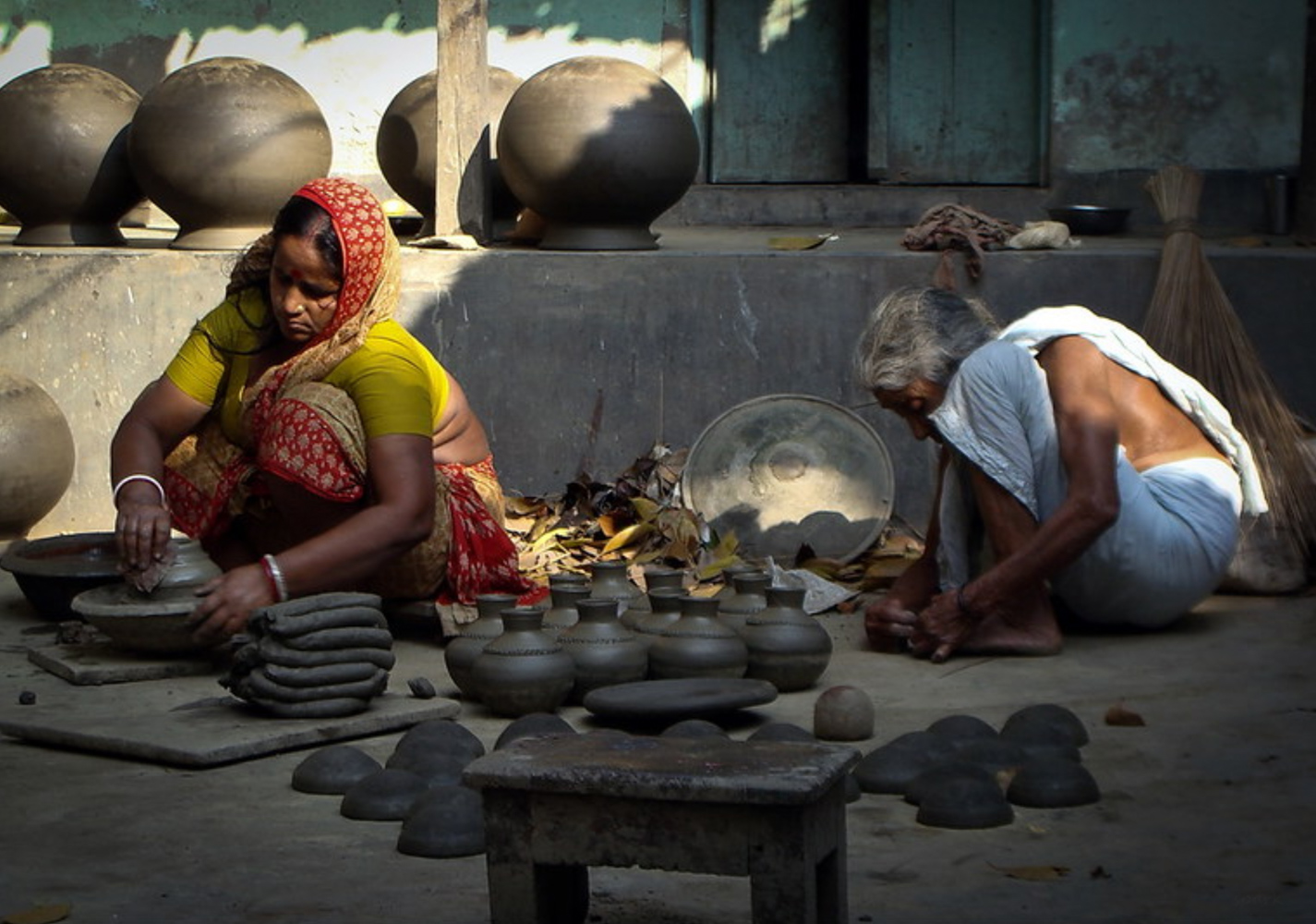
Exposure 1/400sec @ f/1.8 | ISO 200 | Focal Length 85mm
Shahnaz Parvin
Shahnaz Parvin was a celebrated award-winning photojournalist and a passionate advocate for Bangladeshi culture. Based in Dhaka, she gained international recognition for her powerful documentary photography, consistently ranking among the world's top photographers during her career. As a dedicated contributor to Light & Composition, she documented the complexities of life across South Asia with a lens focused on people, culture, and conflict until her untimely passing in 2016.
Resonance Score Breakdown
Transparency Note: The resonance score (13.4/20) is calculated based on social engagement metrics collected before the award announcement.
Expert Photography Reviews · 7
The Weight of Earth
There is a specific, cool dampness to clay that stays with you long after you have washed your hands. It is the smell of the ground itself, a scent that speaks of deep, hidden places and the slow, geological patience of the earth.
Read the reflection →The Weight of Clay
The hands remember what the mind forgets. We spend our lives gathering things—words, possessions, regrets—but the earth remains the only thing that truly holds a shape. To press fingers into wet clay is to acknowledge a debt.
Read the reflection →Reviews & Comments
Share your thoughts about this award-winning photograph. Your reviews contribute to the community engagement score.
What strikes me immediately in ‘Women’s Lives’ is the raw, unforced authenticity. Shahnaz Parvin has a rare gift for stepping into a community and capturing moments of profound human dignity without intrusion. The subject’s expression and posture speak with complete honesty; there is no performance here, only life witnessed with deep empathy and respect. You waited for the exact right second, and the result is timeless.
Optically and technically, ‘Women’s Lives’ delivers exceptional execution. The depth of field is measured to isolate the vital textural details while maintaining context in the background. Exposure values are tightly controlled, retaining subtle highlight gradations without crushing the shadow details. The shutter speed captures the organic cadence of the environment cleanly, proving that intentional camera craft is the bedrock of powerful imagery.
The structural balance in ‘Women’s Lives’ demonstrates a rigorous spatial discipline. Shahnaz Parvin anchors the visual weight with precision, establishing a clear hierarchy that guides the eye across the frame without hesitation. The negative space functions not as an empty void, but as an intentional counterbalance to the central subject. There is a geometric integrity here that holds the entire scene together with commendable authority.
One suspects Shahnaz didn’t just stumble upon this. That clay-caked hand and the elder’s gaze suggest a photographer who sat in the dust long enough to become part of the furniture. It’s a rare thing to see such quiet intimacy without the subject flinching. I’ve spent enough damp mornings in the field to know when someone’s earned their keep. She didn’t just take a picture; she waited until the rhythm of the work felt like her own.
The ochre of the damp clay, reminiscent of a Morandi still life, anchors the frame in a tactile, earthy warmth that makes my heart ache with its quietude. It’s a palette of sun-baked dust and shadow, where the light doesn’t merely illuminate but caresses the weathered skin like a Vermeer window. One finds here a chromatic resonance so profound that the vibrant, fleeting blues of the women’s saris feel like a sudden, breathless prayer against the soil.
Clay doesn’t just yield to the hands; it absorbs the history of the fingers pressing into it. Parvin’s shadows here aren’t mere voids, but the heavy, unyielding silence of a life lived in the dust. I’ve stared at the elder’s eyes until my own ache. She isn’t just watching the craft; she’s anchoring the light. It’s a brutal, necessary darkness that refuses to let the viewer escape the gravity of her exhaustion. It’s hauntingly, painfully real.
Most entries I see from this region rely on tired tropes of poverty. Shahnaz avoids that trap. By focusing on the tactile intimacy of the clay-stained hands against the elder’s lined skin, she captures a quiet, rhythmic dignity that feels timeless. It’s the contrast between the wet, malleable earth and the dry, etched face that hits me; I actually felt a lump in my throat. This will still matter in thirty years because it honors the craft.