Noisy Market by Sonia Olmos de Castro
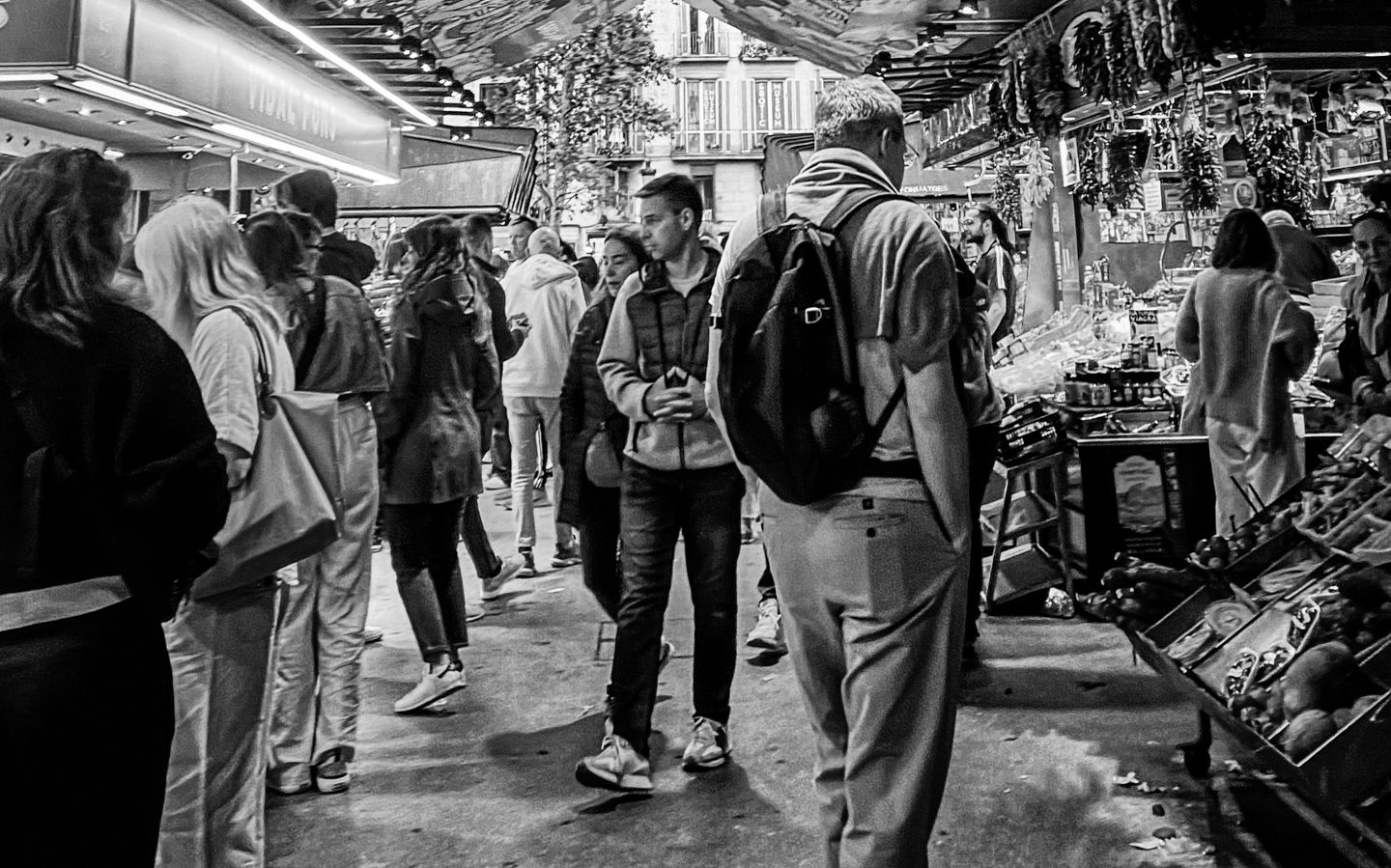
During a stroll through the iconic El Mercat de la Boquería in Barcelona, the photographer captured the vibrant, chaotic energy of the historic modernist and neoclassical market. Amidst the throngs of tourists and the sensory overload of fresh produce and local delicacies, the photographer sought to distill the essence of this bustling urban landmark. The resulting image serves as a candid observation of daily life, elevated by the photographer's ability to find order within the noisy, crowded environment. It is an award-worthy snapshot that transforms a routine family outing into a compelling visual narrative of Barcelona's cultural heart.
Sonia Olmos de Castro
Sonia Olmos de Castro is a Barcelona-based graphic designer and amateur photographer who captures the world through a deeply intuitive lens. Her work is defined by a sensory-driven approach, often developed during long walks by the sea or through the rhythmic pulse of city life. Known for her exclusive black and white collection, “Alice in BNW Land,” she prioritizes emotional resonance and authentic observation over technical artifice, consistently finding beauty in the quiet and vibrant moments of her daily environment.
Resonance Score Breakdown
Transparency Note: The resonance score (7.3/20) is calculated based on social engagement metrics collected before the award announcement.
Expert Photography Reviews · 5
The Weight of the Crowd
There is a particular kind of solitude found only in the middle of a crowd. You are surrounded by the friction of other lives, the heat of voices, the constant movement of hands and eyes. Yet, you remain an island.
Read the reflection →The Choreography of Exchange
A city market is rarely just a place of commerce; it is a social theater where the scripts are written by the daily necessity of survival and the ritual of gathering.
Read the reflection →Reviews & Comments
Share your thoughts about this award-winning photograph. Your reviews contribute to the community engagement score.
The frame struggles against the chaotic density of the Boquería. While the vertical lines of the market stalls attempt to anchor the composition, the visual weight remains dangerously unmoored. It’s a frantic scramble for order that doesn’t quite resolve. I’m exhausted by the lack of a clear fulcrum. The eye is refused a place to rest, caught in the noise of the foreground. It’s technically competent, yet the spatial tension collapses under its own clutter.
El Mercat de la Boquería isn’t just a backdrop; it’s a site of intense consumption. When I look at these blurred faces, I feel a sudden, sharp exhaustion. Why do we insist on turning local life into a static, aestheticized commodity for our digital feeds? The framing flattens the human struggle of working in such a frantic space. Does the photographer see the people, or just the geometry of the chaos? It’s a pretty picture, but at what cost?
There’s a frantic energy here, but I’m left wondering if the subject even knew they were being watched. It’s a classic street grab—quick, sharp, and technically sound—but it lacks that essential, quiet permission. I don’t see a person; I see a prop in a busy scene. It’s a shame, because there’s a whole life in that face I’d love to have known. I’m just not sure the photographer ever bothered to ask.
Of the thousands of street shots I’ve reviewed, most drown in the chaos of their own subjects. What separates this from the usual tourist clutter is the decisive geometry of the stall’s edge cutting through the crowd. It’s a rare moment of stillness in a frantic space. I’ll admit, the grit of the iPhone sensor actually helps here; it feels honest. Thirty years from now, this won’t just be a market; it’ll be a memory.
1/100sec at f/1.8, 26mm. The iPhone 11 sensor struggles here. That wide aperture at 26mm creates a shallow plane that doesn’t resolve the market’s chaos; it just blurs the periphery into digital mush. I’ve seen this sensor fail in low light too often, and it’s frustrating. The shutter speed is barely enough to freeze the motion. It’s a snapshot masquerading as a narrative. The technical limitations aren’t overcome; they’re just ignored. It’s technically lazy.