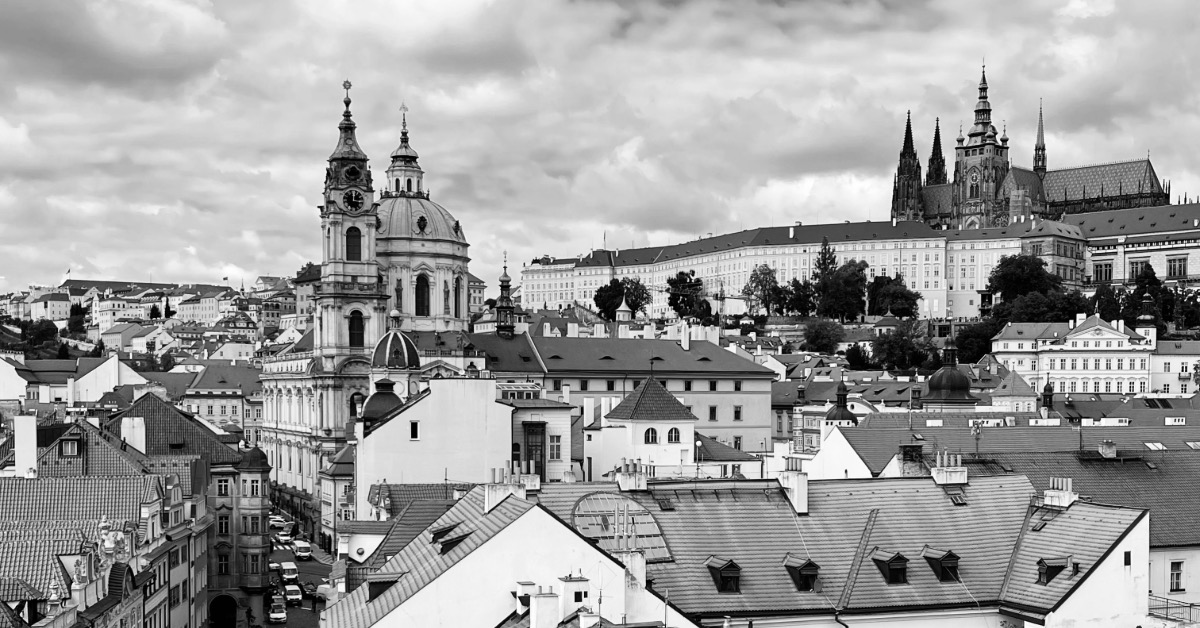
Iconic St. Nicholas Church by Mirka Krivankova
Captured in the historic heart of Prague, this photograph highlights the architectural dialogue between the slender Svatomikulášská Municipal Belfry and the expansive dome of the Church of St. Nicholas. The photographer skillfully framed these late Baroque landmarks to emphasize their dynamic contrast against the Malá Strana skyline. By utilizing the precise optics of an iPhone 12 Pro Max, the image captures the intricate details of these iconic structures, transforming a classic urban vista into a compelling study of light and geometry. This work is award-worthy for its masterful composition and its ability to elevate a familiar historical site into a fresh, evocative visual narrative.
Mirka Krivankova
Hailing from Mestec Kralove, Czech Republic, Mirka Krivankova is an emerging talent whose work spans the diverse landscapes of the Czech countryside, evocative portraiture, and dynamic event documentation. Her photographic approach is defined by a sophisticated use of formalism, where natural light and shadow are carefully balanced to guide the viewer’s eye through her subjects' surroundings. Constantly refining her portfolio, Krivankova demonstrates a dedicated commitment to her craft, with a growing body of work that reflects both technical evolution and a keen sensitivity to the interplay between people and their environments.
Resonance Score Breakdown
Transparency Note: The resonance score (8.4/20) is calculated based on social engagement metrics collected before the award announcement.
Expert Photography Reviews · 7
Stone Anchors in the Mist
We spend our lives building monuments to the things we fear losing, stacking stone upon stone as if height could somehow bargain with time.
Read the reflection →Stone Echoes in the Mist
There is a particular hour in the old quarters of any city when the stone seems to remember the hands that carved it.
Read the reflection →Reviews & Comments
Share your thoughts about this award-winning photograph. Your reviews contribute to the community engagement score.

1/4sec at f/1.6, ISO 202. Handheld long exposure on a mobile sensor is a gamble, and here, it’s a loss. The motion blur in the architectural lines isn’t artistic; it’s a failure of stability. I’ve spent years staring at sensors, and this lack of micro-contrast hurts to look at. You can’t fix a soft file with a monochrome filter. It’s a technical oversight that undermines the geometry. The intent was there, but the execution wasn’t.
Prague’s skyline demands patience, but here, the geometry feels locked in. I love how the belfry cuts through that dome; it’s a sharp, rhythmic collision of stone. Still, I’m hunting for the human pulse. Where’s the life? Cartier-Bresson wouldn’t just frame the architecture; he’d wait for the shadow of a passerby to break that static silence. It’s technically clean, sure, but the street is missing. One tenth of a second later, and maybe something actually happened.
Prague’s skyline is a graveyard of tired tourist snapshots, yet Krivankova finds a pulse here. Most photographers settle for the postcard; she forces a conversation between the belfry’s needle and the dome’s weight. It’s the tension in that vertical alignment that makes me stop. I’ve seen thousands of cityscapes, but this geometry feels permanent. It’s not just a record of stone; it’s a quiet, cold, and enduring argument for why we still look up.
Prague’s skyline is a crowded affair, yet one finds a certain stillness here. It’s a clean composition, though I can’t help but wonder if the photographer stood in the biting wind long enough for the tourists to clear, or if she simply clicked and moved on. It’s a tidy piece of geometry, certainly. I’ve spent enough freezing mornings in the Malá Strana to appreciate the effort, but I’m left wanting a bit more grit.
The belfry cuts the sky. It’s a sharp, vertical breath. Beside it, the dome rests. Heavy. Still. I’ve spent minutes watching the grey air between them. It’s not just space. It’s a weight. A silence. I feel my own pulse slow down here. Nothing is accidental. The empty corner isn’t empty. It’s the place where the stone stops and the quiet begins. Krivankova knows. She’s left enough room for the architecture to finally breathe.
Prague’s St. Nicholas Church is a tourist staple, yet here it feels strangely hollow. Why does the iPhone’s digital sharpening strip the stone of its history? It’s technically precise, sure, but it feels like a postcard sold to someone who doesn’t care about the city’s soul. I find myself craving a smudge of grit or a human shadow. Whose Prague are we actually seeing? It’s a clean, sterile view that ignores the weight of the past.
Prague’s Baroque density usually defies the static frame, yet here, the belfry’s verticality anchors the dome’s heavy curvature. It’s a clever study of datum and mass, though I’m left wanting the street-level threshold—the human scale that gives these stones their pulse. The light hits the masonry with a crispness that almost tricks me into feeling the chill of the Czech air. It’s a sharp, honest geometry, even if it’s missing the city’s chaotic, living breath.