From Graveyard to Playland by Aakash Gulzar
In this evocative image, a young boy stands pensively beneath the canopy of a tree, serving as a quiet anchor amidst the vibrant energy of his friends playing nearby. The setting, a former graveyard reclaimed as a lively playground, creates a profound juxtaposition between the somber history of the space and the exuberant joy of youth. By capturing this intersection of reflection and playfulness, the photographer highlights the resilience of the human spirit. The composition is award-worthy for its ability to weave a complex narrative of emotion and transformation, turning a site of mourning into a testament to the enduring presence of life and laughter.
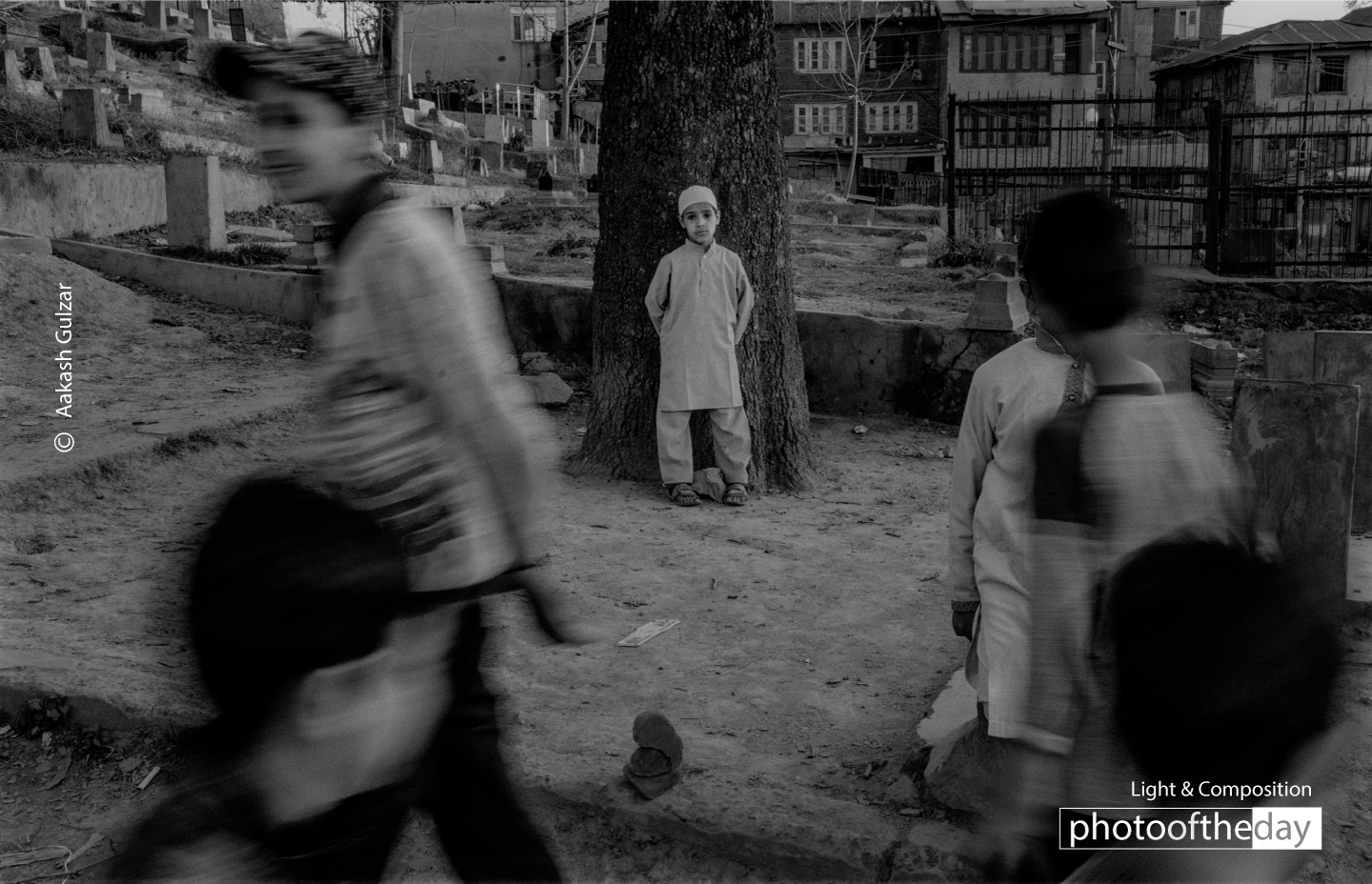
Exposure 1/25sec | ISO 635 | Focal Length 26mm
Aakash Gulzar
Hailing from the scenic region of Kashmir, India, Aakash Gulzar is an adventurous photographer and nature enthusiast dedicated to the art of visual storytelling. With his Nikon D7200 in hand, he traverses untamed landscapes to document the beauty and hidden narratives of the world around him. His work reflects a vibrant personality and a deep commitment to sharing his thrilling expeditions, consistently capturing the raw essence of his subjects for an international audience.
Resonance Score Breakdown
Transparency Note: The resonance score (8.1/20) is calculated based on social engagement metrics collected before the award announcement.
Expert Photography Reviews · 3
The Soil of Memory
Seneca once observed that we are all, in a sense, guests of time—that the ground we stand upon is not truly ours, but merely a place where we linger for a season.
Read the reflection →The Soil Beneath Our Feet
When I was seven, my cousin Tunde and I spent an entire Saturday digging in the corner of my grandmother’s garden. We were convinced that if we went deep enough, we would find the roots of the world.
Read the reflection →Reviews & Comments
Share your thoughts about this award-winning photograph. Your reviews contribute to the community engagement score.
Death doesn’t retreat here; it merely waits in the periphery of the frame. Gulzar understands that shadow is the architecture of memory. By anchoring the boy in the dark, heavy foliage, he forces us to confront the weight of the soil beneath those running feet. It’s unsettling, really. I felt a sudden, cold shiver looking at the way the light refuses to touch the graves. We aren’t watching play; we’re watching time devour history.
The tension between the boy’s stillness and the blurred motion of his peers echoes the rhythmic layering of Henri Cartier-Bresson, yet the setting demands a more somber lineage. It’s a haunting dialogue with the social realism of the thirties, though Gulzar’s lens finds a strange, modern optimism in the ruins. I’ve spent decades studying how we frame mortality, but this collision of play and headstones genuinely unsettled me. It’s a rare, visceral subversion of the traditional graveyard trope.
The boy doesn’t move. He watches the blur of motion beyond the tree. It’s a heavy stillness. I’ve felt this weight before, standing in old gardens where the ground remembers everything. The graveyard isn’t gone; it’s just waiting. The empty space around him isn’t an absence. It’s a breath. Nothing here is accidental. The empty corner is not empty. It’s the sound of a child choosing to be quiet while the world runs past him.