Harbour Lights by Leanne Lindsay
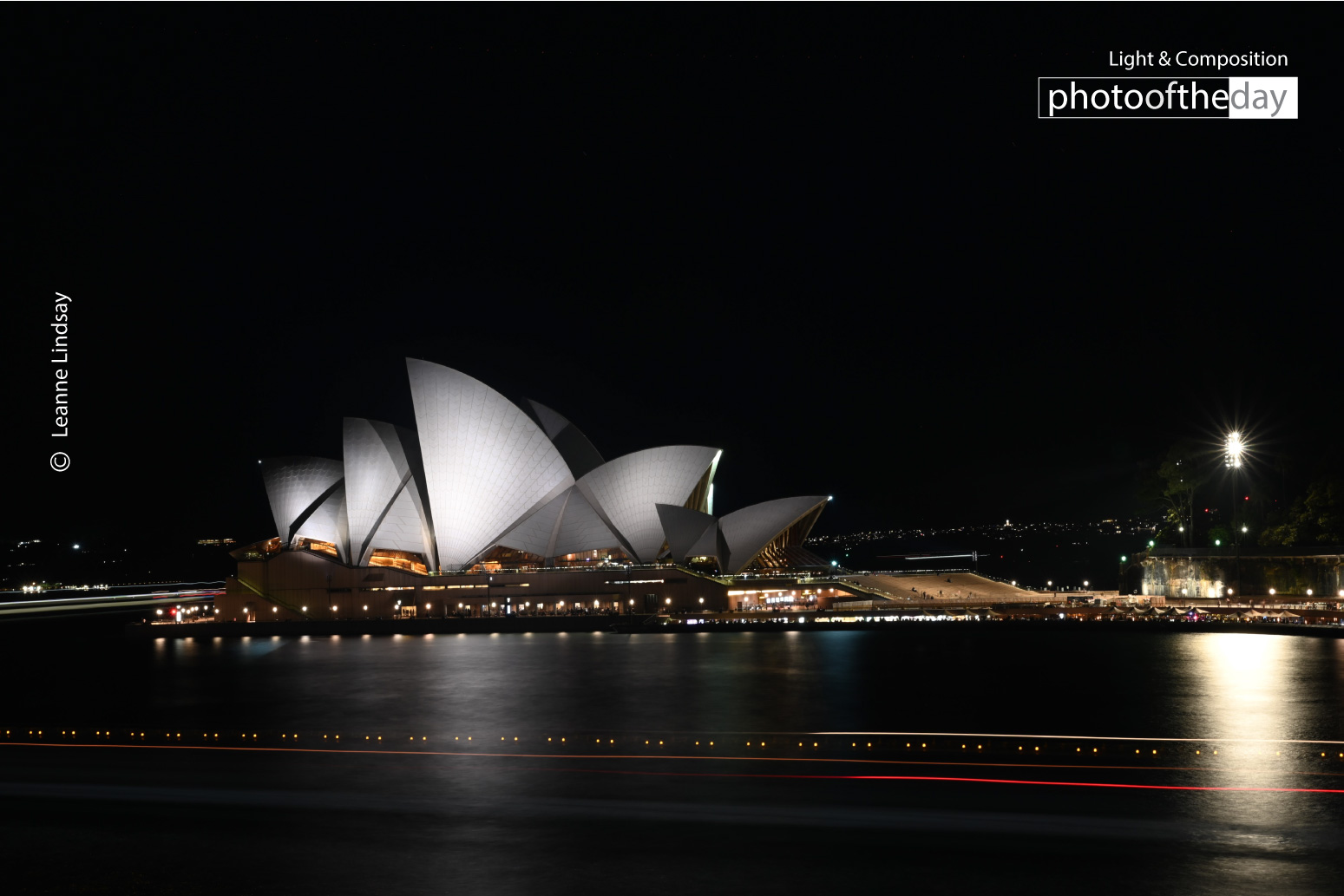
In this captivating long-exposure study of Sydney Harbour, the photographer captures the rhythmic pulse of the city at night. By employing a 30-second shutter speed, the image transforms the movement of passing ferries into ethereal ribbons of light, set against the stark, iconic silhouette of the Sydney Opera House. The deliberate choice of a 50mm prime lens creates an intimate perspective, while the intentional motion blur adds a dynamic, painterly quality to the scene. This photograph is award-worthy for its masterful balance of technical precision and artistic vision, turning a familiar landmark into a vibrant, immersive narrative of light and motion.
Leanne Lindsay
Born in Adelaide in 1962, Leanne Lindsay relocated to Sydney during her youth, where she eventually rediscovered a long-dormant passion for photography in her late fifties. Though she now specializes in family and newborn portraiture, her portfolio reflects a deep appreciation for the structural beauty of architecture and the expansive nature of landscapes. Lindsay’s work is defined by a resilient creative spirit, as she continues to refine her technical skills and explore the vibrant visual storytelling opportunities found within her home city of Sydney.
Resonance Score Breakdown
Transparency Note: The resonance score (7.5/20) is calculated based on social engagement metrics collected before the award announcement.
Expert Photography Reviews · 8
The Pulse of the Tide
I remember sitting on a rusted bollard at the edge of a pier in Marseille, watching a fisherman mend his nets as the sun dipped below the horizon. He told me that the water never really sleeps; it just changes its rhythm.
Read the reflection →The Ghost of the Transit
There is a specific silence that follows a ferry as it pulls away from the dock. It is not the silence of an empty room, but the silence of a departure that has already begun to erase itself.
Read the reflection →Reviews & Comments
Share your thoughts about this award-winning photograph. Your reviews contribute to the community engagement score.
Sydney’s harbor has been documented to death, yet Lindsay’s thirty-second exposure finds a pulse I haven’t felt in years. It’s reminiscent of Alvin Langdon Coburn’s vortographs, though here the light trails replace his fractured geometry. Using a 50mm prime for such a vast cityscape is a bold, intimate choice. It’s refreshing to see the Opera House treated not as a postcard, but as a silent anchor for this kinetic, painterly energy. I’m genuinely moved by the rhythm.
Utzon’s shells are reduced to mere silhouettes here, stripped of their tectonic weight. By flattening the harbour into a long-exposure blur, Lindsay erases the threshold between solid structure and the fluid void of the water. It’s technically clean, yet I find myself mourning the loss of the building’s actual mass. Where is the rhythm of the fenestration? I’d trade these ethereal light ribbons for a single, honest glimpse of how the light actually hits that ceramic skin.
Thirty seconds is an eternity in my world. It’s a blur, not a peak. While the light ribbons look pretty, they lack the physiological tension I crave. There’s no singular, explosive instant here—just a long, soft exhale. I’ve spent my life chasing the millisecond where muscle meets gravity, and this feels like watching a race after the finish line. It’s technically clean, sure, but it doesn’t make my heart race. I need the snap, not the smear.
We look at these ribbons of light and we aren’t just seeing a harbor; we’re hearing the city’s heartbeat. Leanne’s 50mm lens captures the Opera House like a silent listener watching the ferries dance by. It’s a portrait of a place that’s finally stopped talking long enough to let us hear its rhythm. I find myself holding my breath, waiting for the water to settle. It’s a photograph that asks to be returned to, again and again.
I’ve seen thousands of Sydney Harbour shots, and frankly, most are postcards. What separates this from the clutter is the 50mm constraint; it forces a claustrophobic intimacy that wider lenses usually destroy. The light trails don’t just blur; they anchor the Opera House in a frantic, rhythmic pulse. It makes me miss the city’s hum. In thirty years, this won’t be a dated travel snap, but a precise record of how light felt in 2023.
Before the eye identifies the Opera House, a sudden stillness settles in the chest. The long exposure turns the harbour’s pulse into a soft, rhythmic hum that slows my own breathing. It’s the light ribbons that stay with me; they feel like ghost-trajectories of people I’ve never met. I find myself returning to the dark water, feeling a strange, quiet ache for a city I’ve never called home. It’s a beautiful, lonely sort of haunting.
30 seconds at f/14, ISO 100 on a 50mm prime. It’s a rigid, calculated approach. The f/14 aperture forces a diffraction limit that softens the Opera House edges, yet it’s necessary to sustain that long exposure. I’ve seen a thousand Sydney shots, but the light trails here don’t bleed into the architecture. That’s precise. It’s technically sound, even if the composition feels a bit safe. I’m actually impressed by the lack of sensor noise.
Thirty seconds? That’s an eternity. Cartier-Bresson would’ve laughed. Street photography isn’t about smoothing out the world into a painterly blur; it’s about the jagged, unrepeatable collision of life. I’m looking at these light ribbons, and honestly, I feel bored. It’s too controlled, too static. Where’s the grit? Where’s the human pulse? One tenth of a second later and the shadow moves, but here, the moment just dissolves into a long, sleepy smear. It’s technically clean, but it’s missing the street.