Documenting the Family Home by Leanne Lindsay
Captured at Sydney's Museum of Contemporary Art, this image documents a poignant art installation where a childhood home is recreated through charcoal rubbings on paper. The photographer masterfully frames the scene to highlight the striking contrast between the solid, grounded presence of the museum visitors and the ethereal, almost cartoon-like fragility of the paper structure. This juxtaposition creates a compelling narrative about memory and the physical remnants of our past. The photograph is award-worthy for its keen observational eye, which transforms a static exhibition into a dynamic commentary on the intersection of human presence and architectural history.
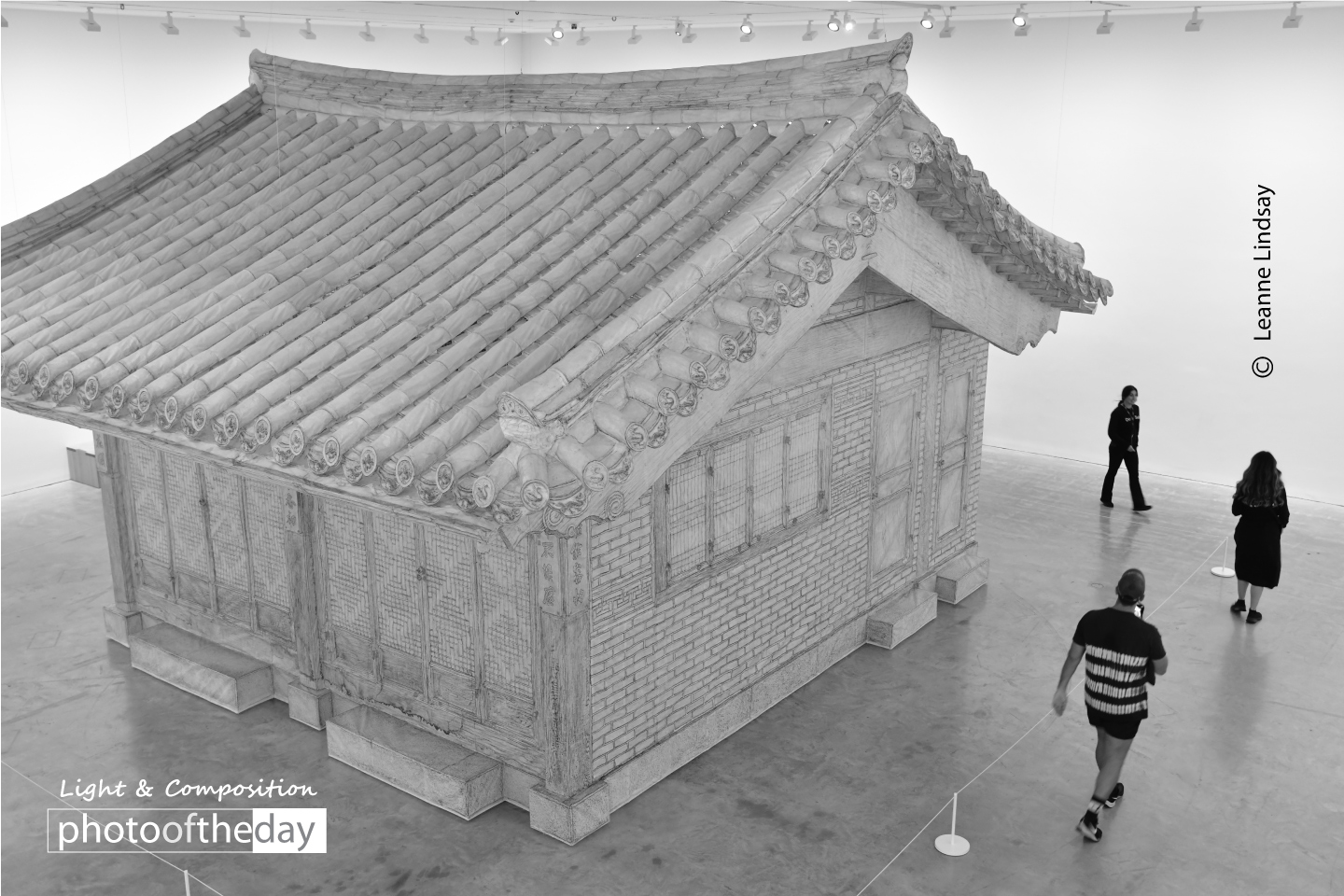
Leanne Lindsay
Born in Adelaide in 1962, Leanne Lindsay relocated to Sydney during her youth, where she eventually rediscovered a lifelong passion for photography in her sixties. Though her professional repertoire includes family and newborn portraiture, she finds particular creative fulfillment in the study of architecture and landscapes. Lindsay’s work is defined by a renewed sense of artistic purpose, capturing the world with a fresh perspective that celebrates both the structural beauty of her surroundings and the intimate moments of human experience.
Resonance Score Breakdown
Transparency Note: The resonance score (7.9/20) is calculated based on social engagement metrics collected before the award announcement.
Expert Photography Reviews · 6
The Architecture of Echoes
We often speak of home as if it were a fixed coordinate, a set of floorboards and window frames that hold our history in place. But memory is a far more porous thing.
Read the reflection →The Architecture of Echoes
If a house is built of stone, it shelters the body; but what is it that shelters the memory of a room once the walls have turned to dust?
Read the reflection →Reviews & Comments
Share your thoughts about this award-winning photograph. Your reviews contribute to the community engagement score.

The charcoal dust seems to hang in the air, heavy with the weight of forgotten rooms. Leanne waited for the visitors to become ghosts, their solid forms grounding the paper’s fragile, flickering memory. I’ve stood in such quiet halls, feeling the past press against my skin. It’s a haunting stillness. She didn’t just record an installation; she captured the exact moment when a house stops being wood and stone and finally becomes a prayer.
The visitor’s stride is caught mid-step, but it’s a fraction too late. The heel has already made contact with the floor, killing the momentum of the movement. I’ve spent my life watching bodies in transition; I wanted to see that split-second of suspension before the weight hit the ground. It’s a shame, because the tension between the paper walls and the human form is perfect. I just wish the shutter had fired earlier.
One suspects Leanne waited for the gallery to thin, or perhaps she simply stood there until her feet ached, watching the shadows shift against those charcoal walls. It’s a quiet, patient study. I’ve spent enough hours in drafty halls to recognize the discipline required to catch that precise intersection of visitor and memory. It’s a rare thing to find such stillness in a crowded room. She didn’t just snap a frame; she earned the silence.
The frame divides into a precise 1:2 ratio, anchoring the solid, dark silhouettes of observers against the ethereal, charcoal-rubbed paper walls. It’s a brilliant geometric tension. The vertical axis of the paper structure creates a fragile vector that pulls the eye upward, contrasting sharply with the grounded, heavy masses of the visitors. I’m genuinely struck by how the negative space resolves the equation of memory. It’s a perfectly balanced spatial problem, solved with elegant, mathematical clarity.
Most entries in this category rely on the architecture itself, but Leanne captures the ghost of a home. The charcoal rubbings against the heavy, blurred figures of the visitors create a friction between permanence and decay that I haven’t seen elsewhere this year. It’s haunting. I found myself lingering on the paper’s texture, wondering if we’re just rubbings of our own histories. In thirty years, this will still feel like a quiet, necessary ache.
The museum floor is a stage, and Lindsay caught the actors perfectly. Those charcoal walls look like ghosts, but the visitors are solid, grounded. I love how the paper structure bends under the weight of the moment. One tenth of a second later and the alignment would have collapsed into clutter. It’s sharp, it’s honest, and it’s alive. Winogrand would have tipped his hat to this timing. You nailed the geometry, Leanne. It’s a keeper.