The Golden Time of Life by Shovan Acharyya
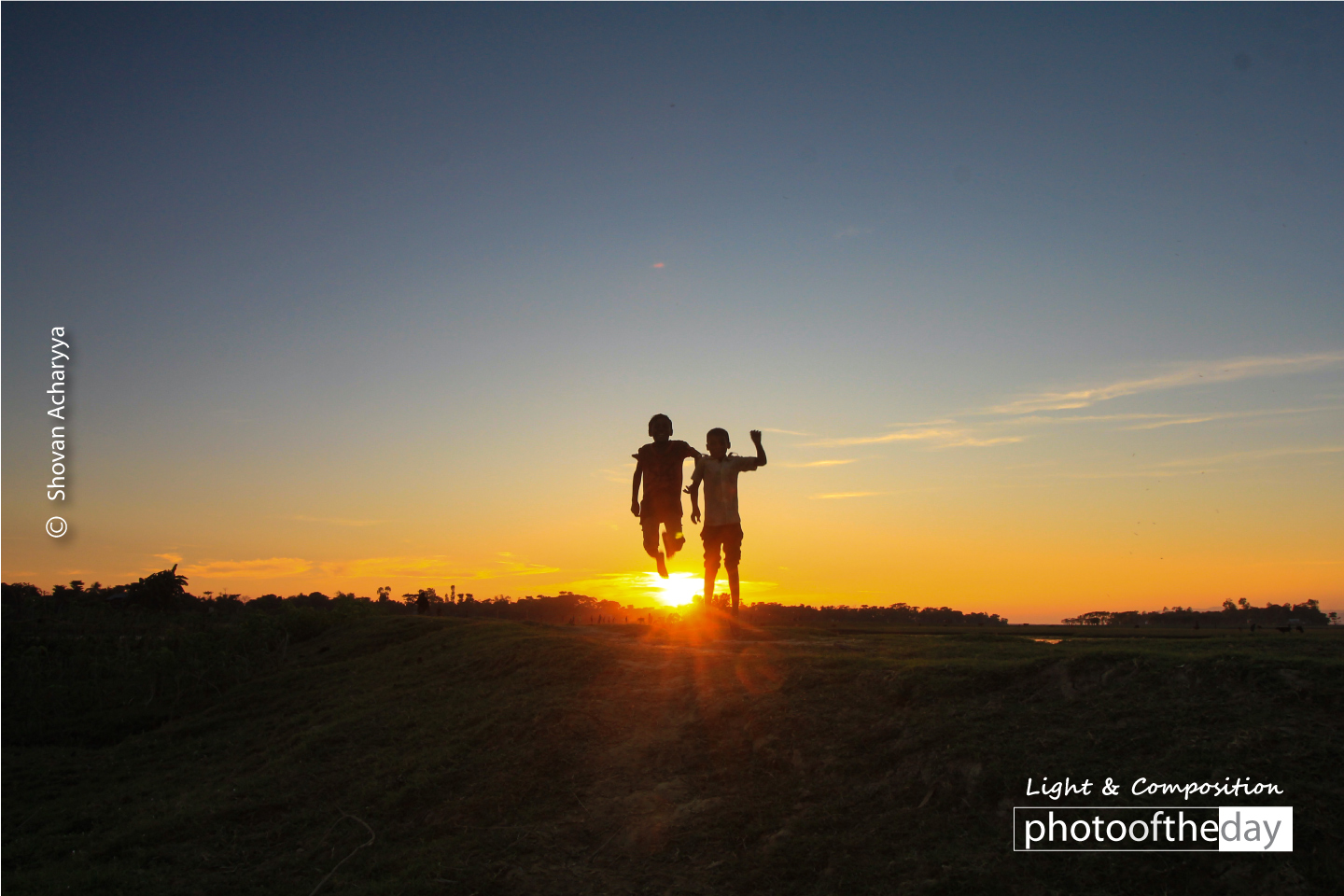
The Golden Time of Life captures the resilient spirit of youth in the remote village of Dudhalta, Sunamganj. In a landscape submerged for most of the year, the photographer documents children who navigate a challenging existence defined by fishing and limited educational access. Despite the hardships of poverty and isolation, the image radiates the pure, unadulterated joy found in simple childhood pursuits. By framing these moments against the backdrop of a difficult life, the photographer highlights the profound contrast between environmental struggle and the enduring, infectious smiles of the youth, ultimately celebrating the golden, fleeting nature of childhood.
Shovan Acharyya
Born in the small town of Sunamgonj, Bangladesh, Shovan Acharyya is a dedicated photographer currently based in Dhaka. After completing his Master’s degree in Economics at the University of Chittagong, he pursued his passion for the lens through foundational training at Pathshala. Now working for a literature and lifestyle magazine, Shovan explores diverse photographic disciplines, with a particular focus on landscapes, lifestyle, and wildlife, as he strives to establish himself as a prominent professional in the field.
Resonance Score Breakdown
Transparency Note: The resonance score (8.2/20) is calculated based on social engagement metrics collected before the award announcement.
Expert Photography Reviews · 5
The Weight of Sunlight
I keep a small, smooth river stone on my desk, worn down by years of water and the friction of my own thumb. It is heavy for its size, a dense anchor of earth that reminds me of a summer when time felt infinite, before the edges of the days began to fray.
Read the reflection →The Weight of Amber
There is a specific quality to the light just before the sun dips below the horizon in late autumn, a low-slung, honeyed orange that seems to thicken the very air.
Read the reflection →Reviews & Comments
Share your thoughts about this award-winning photograph. Your reviews contribute to the community engagement score.
The low, raking light of Sunamganj doesn’t just illuminate these children; it breathes with them. I’ve stood in such damp, quiet places, waiting for the air to soften. Shovan didn’t rush the shutter. He waited until the golden hour turned the water into a mirror for their laughter. It’s a rare, fragile grace. Looking at their faces, I feel a sudden, sharp ache for the simplicity of a world that hasn’t yet learned to be heavy.
The horizon line bisects the frame at a precise one-third interval, anchoring the composition’s vertical axis. Acharyya utilizes a 16mm wide-angle distortion to pull the children’s figures toward the center of visual gravity, creating a dynamic tension against the expansive, flooded negative space. It’s a beautifully solved spatial equation. I’m genuinely moved by how the converging diagonals of the boat’s prow direct the eye toward those smiles. The geometry doesn’t just hold the frame; it elevates the joy.
Sunamganj’s floods shouldn’t be a backdrop for aestheticized poverty. Acharyya captures these children’s smiles, but at what cost to their agency? I feel a sharp, uncomfortable prick of guilt looking at their joy framed against such systemic neglect. Why does the photographer prioritize the golden light over the reality of their isolation? It’s a beautiful composition, sure, but it’s also a transaction. Are we celebrating their resilience, or are we just consuming their hardship for our own comfort?
The wide 16mm perspective echoes the expansive, social-documentary gaze of Dorothea Lange, yet it’s the tonal interplay that catches me. Acharyya avoids the trap of sentimentalizing poverty, instead finding a kinetic energy that recalls the candid vitality of Helen Levitt’s street work. It’s rare to see such unforced joy framed against the harsh, submerged reality of Sunamganj. I’ve spent decades looking at these landscapes, but the sheer, defiant brightness in these children’s eyes genuinely stopped my breath.
You waited for that light to hit their faces, and it’s paid off. I’ve spent enough time in places like Sunamganj to know that joy isn’t just a reaction to the water; it’s a defiance of it. You didn’t just capture children playing; you captured the exact second they forgot their struggle. And honestly, it makes my chest ache a little. You were there, you felt their pulse, and you didn’t look away. That’s the work.