Dinner for Father by Shovan Acharyya
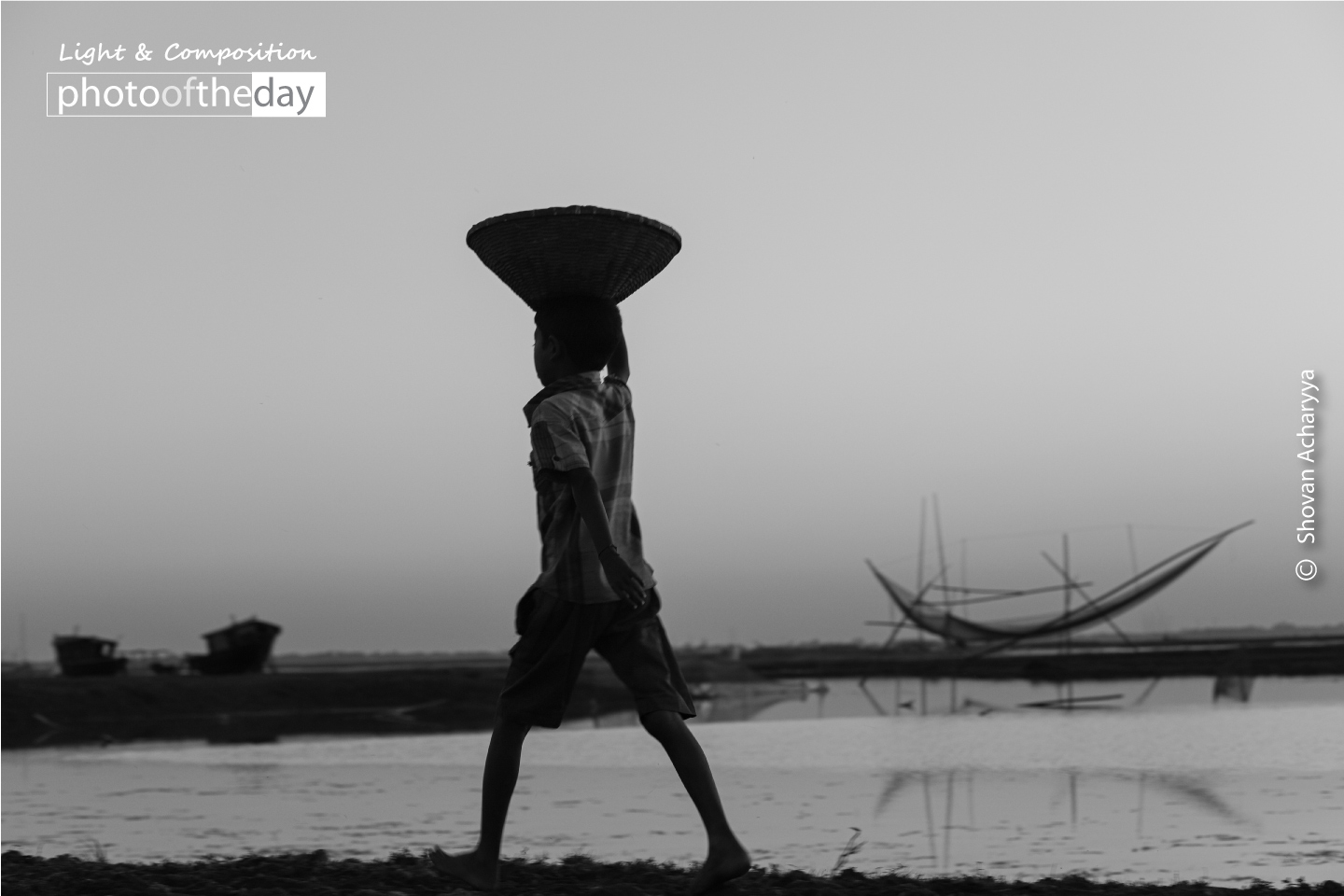
In the arid spring season of Sunamganj, Bangladesh, the receding water levels of the wetlands create a unique, isolated environment for local fishermen. The photographer captures a poignant moment as a young boy hurries across the landscape to deliver dinner to his father, who lives in a temporary bamboo shelter far from home. The image masterfully balances the vast, calm serenity of the wetland with the urgent, fleeting light of sunset. This photograph is award-worthy for its evocative storytelling, highlighting the intersection of rural livelihood, familial devotion, and the challenging realities of life in the remote fishing zones.
Shovan Acharyya
Born in the small town of Sunamgonj, Bangladesh, Shovan Acharyya is a Dhaka-based photographer with an academic background in Economics from the University of Chittagong. After honing his craft through foundational courses at Pathshala, he transitioned into a professional role as a photographer for a lifestyle and literature magazine. His portfolio reflects a versatile approach to the medium, though he maintains a particular passion for capturing the nuances of landscapes, wildlife, and human lifestyle, striving to document the authentic stories of his home country.
Resonance Score Breakdown
Transparency Note: The resonance score (8.2/20) is calculated based on social engagement metrics collected before the award announcement.
Expert Photography Reviews · 8
The Weight of Devotion
Epictetus once remarked that we should not seek for things to happen as we wish, but rather wish for things to happen as they do. It is a stern discipline, one that asks us to accept the world in its raw, unvarnished state.
Read the reflection →The Weight of a Meal
I burned my toast this morning. It was a small, stupid mistake, but it left me standing in the kitchen feeling strangely heavy. I had been rushing, thinking about a dozen things at once, and suddenly the simple act of feeding myself felt like a chore I was failing at.
Read the reflection →Reviews & Comments
Share your thoughts about this award-winning photograph. Your reviews contribute to the community engagement score.
The sun is dying over Sunamganj, casting that long, bruised gold across the mud. I’ve stood in such stillness, waiting for the world to exhale. He stood here as the boy ran, catching the fleeting warmth before the shadows claimed the wetlands. It’s a quiet, aching devotion. I feel a lump in my throat watching that small figure cross the vast, empty expanse. He didn’t rush the moment; he let the light dictate the boy’s path.
The vast, arid expanse of Sunamganj swallows the boy whole. Why does the frame prioritize the landscape’s serenity over the child’s labor? It’s a beautiful composition, yet I can’t shake the discomfort of watching his exhaustion become aesthetic fodder. Does the father’s isolation justify the romanticization of this boy’s daily trek? I’m left wondering if we’re celebrating the devotion or merely consuming the poverty. Whose gaze benefits from this distance? It’s a haunting, uneasy beauty.
Most submissions this year relied on cheap sentimentality, but this one earns its place. The 85mm compression flattens the Sunamganj wetlands into a stage where the boy’s frantic stride against the encroaching dusk feels genuinely desperate. I’ve seen thousands of rural portraits, yet the way his silhouette cuts through that specific, bruised light makes me ache for his journey. It’s not just a meal; it’s a tether. In thirty years, we’ll still recognize that quiet devotion.
The boy’s stride is caught mid-transition. His lead foot is planted, but his rear leg hasn’t fully extended into the next push. It’s a fraction of a second too early; he’s still gathering momentum rather than hitting the peak of his sprint. I’ve spent my life watching bodies in motion, and I wanted that final, explosive push. Still, the urgency in his posture hits me hard. It’s a near-perfect capture of a boy running against time.
Sunamganj isn’t a place one visits for the comfort. I’ve spent enough time in similar marshes to know that mud doesn’t yield its secrets to the casual tourist. Acharyya clearly didn’t just stumble upon this boy; he waited for that specific, fading light to catch the movement. It’s a quiet, aching sort of dedication. I find myself shivering just looking at the damp expanse. He’s earned this frame, and that’s a rare thing indeed.
We watch the boy cross the Sunamganj wetlands, his small frame cutting through the vast, golden silence. He’s not just walking; he’s carrying a promise of warmth to a father waiting in the bamboo shadows. I find my own breath catching at the weight of that bowl. It’s a quiet, aching devotion captured in the fading light. We look at this face and we understand something profound about the ties that bind us to home.
Sunamganj isn’t just a landscape; it’s a crucible of endurance. The boy’s silhouette cuts through the dying light, a fragile tether between domesticity and the void. I find myself shivering at the way the shadows swallow the horizon, turning the wetlands into an infinite, ink-stained silence. It’s not a simple errand; it’s a desperate negotiation with the dark. Acharyya understands that light here is merely a brief, cruel reprieve from the inevitable, encroaching night.
Sunamganj’s receding wetlands offer a stark contrast to the light-starved depths I usually inhabit. Here, the air doesn’t steal the red spectrum like water does at ten metres. It’s refreshing to see such crisp, warm light hitting the boy’s face instead of fighting the refractive index or backscatter that ruins my own shots. I’m genuinely moved by the stillness; it’s a rare, dry clarity that makes me miss the surface. It’s a beautiful, quiet triumph.