Ingredients by Rodrigo Aliaga
In this meticulously crafted still life, the photographer explores the narrative potential of culinary elements, centering the composition around the distinct, geometric beauty of star anise. By anchoring the star anise in the frame and arranging the surrounding ingredients according to the Golden Ratio, the photographer creates a harmonious visual flow. This image stands out for its deliberate balance and technical precision, demonstrating how thoughtful placement can transform simple ingredients into a compelling story. The result is an award-worthy study of form and texture, where every element serves a specific purpose in creating a cohesive, elegant aesthetic.
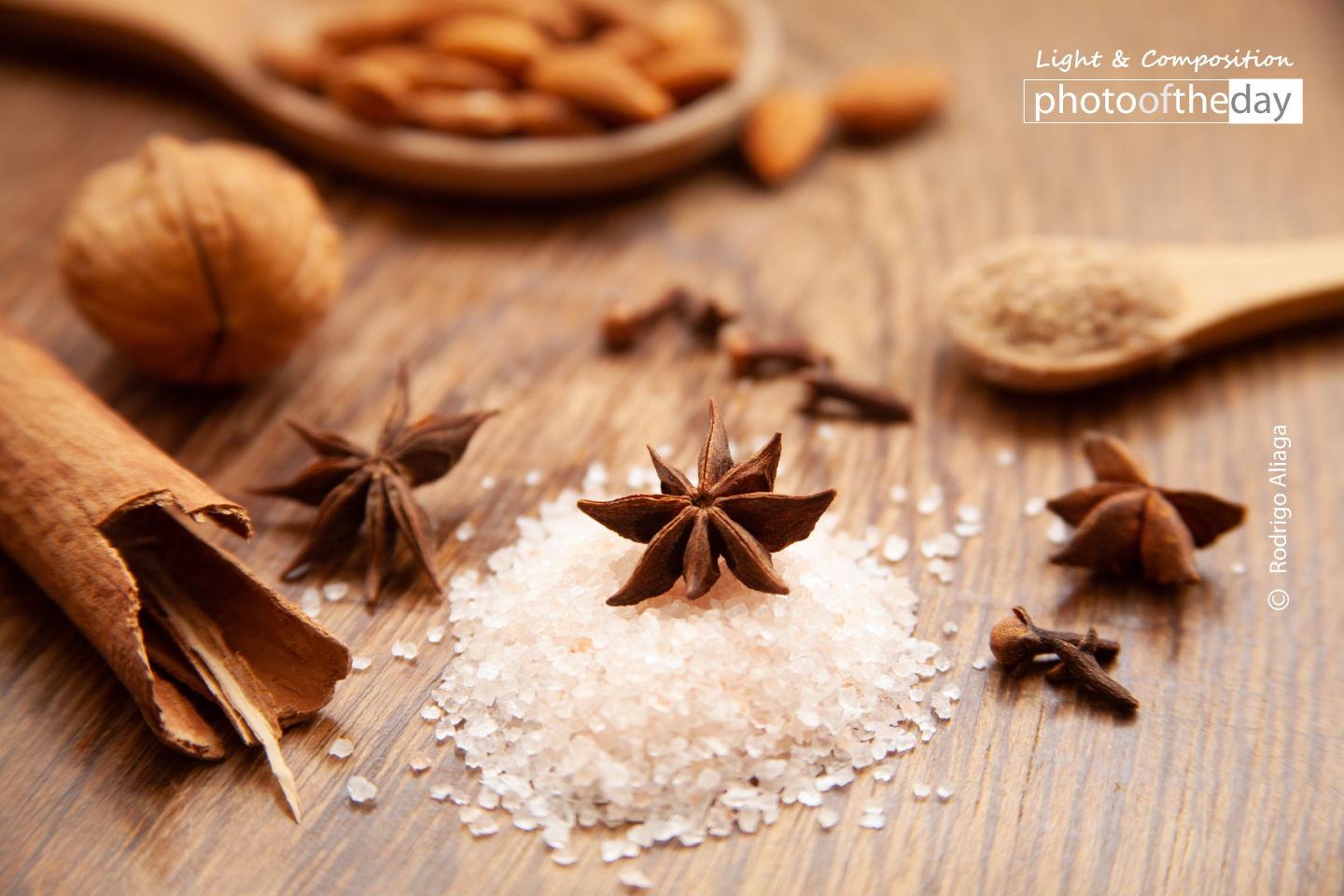
Exposure 1/40sec @ f/5.6 | ISO 400 | Focal Length 135mm
Rodrigo Aliaga
Born in La Paz, Bolivia, Rodrigo Tato Aliaga is a professional director of photography who brings a cinematic eye to the world of still imagery. With a background in film production and television advertising, he transitioned into digital photography to explore the intersection of technical precision and creative expression. He specializes in food photography, where he leverages his extensive experience in lighting and composition to craft exquisite, sensory-driven images that elevate culinary subjects into fine art.
Resonance Score Breakdown
Transparency Note: The resonance score (7.9/20) is calculated based on social engagement metrics collected before the award announcement.
Expert Photography Reviews · 8
The Anatomy of Small Things
It is 3:15 am, and the house has finally stopped settling. In the silence, I find myself obsessing over the architecture of the mundane. We spend our days rushing past the details, convinced that the grand gestures are the only ones that hold weight.
Read the reflection →The Sharpness of Memory
The kitchen of my childhood was a place of dry, biting scents that clung to the back of my throat.
Read the reflection →Reviews & Comments
Share your thoughts about this award-winning photograph. Your reviews contribute to the community engagement score.
It’s a relief to see such crisp, warm tones without fighting the ocean’s relentless theft of the red spectrum. Down here, light vanishes within meters, leaving us with cold, monochromatic blues. I’m genuinely envious of how Rodrigo captured these star anise textures; there’s no backscatter to blur the edges, no refractive distortion to warp the geometry. It’s perfectly dry, sharp, and vibrant. I’ve spent my life chasing clarity in the deep, so this precision feels almost alien.
At 135mm, the focal plane is razor-thin, isolating the star anise’s fibrous geometry with surgical intent. The f/5.6 aperture keeps the diffraction limit at bay, allowing the sensor to resolve the microscopic dust on the spice’s surface. It’s a rare pleasure to see such crisp micro-contrast. I’m genuinely moved by how the light catches those jagged edges; it’s as if the lens has finally revealed the hidden, architectural soul of the ingredient itself. Simply exquisite work.
It’s technically perfect, sure. But where’s the pulse? I’m looking at this star anise and I feel nothing. It’s too staged, too quiet. Cartier-Bresson hunted for the chaos of life, not the stillness of a kitchen counter. One tenth of a second later and the shadow has moved, the frame has collapsed—but here, nothing is moving at all. I’d trade all this Golden Ratio precision for one messy, unrepeatable second on a La Paz street.
It’s a tidy bit of geometry, though one wonders if the star anise was moved a dozen times before the light hit just so. I’ve spent enough hours shivering on Andean slopes to appreciate when someone actually bothers to compose rather than just snap. It’s precise, certainly. I find myself wanting to reach out and rearrange the spices, which is perhaps the highest compliment I can offer. It’s earned, even if it’s indoors.
It’s technically precise, sure, but it leaves me cold. I spend my life waiting for the unpredictable pulse of the wild, where a star anise would be a fleeting scent on a forest floor, not a prop in a sterile studio. I’d trade this entire geometric arrangement for one messy, unposed moment in the field. It’s a clean, quiet composition, but it’s entirely extracted. Where’s the life? I find it hard to care.
It’s a static study, but I can’t help but look for the kinetic energy. The star anise is perfectly centered, yet it feels like it’s waiting for a starting gun that never fires. I’ve spent my life chasing the exact millisecond of peak tension, and while this composition is technically sound, it’s too still for my blood. It’s a clean, quiet frame, but it doesn’t have the pulse of a body in motion.
The star anise’s scorched, woody umber resonates against the muted, chalky ochre of the grain, evoking a Morandi-esque stillness that I find utterly intoxicating. It’s a palette of parched earth and ancient spice, where the light doesn’t merely illuminate but caresses the textures, turning simple ingredients into a quiet, chromatic meditation. One feels the dry, thin air of La Paz in these hushed, dusty tones; it’s a sensory feast that lingers long after the gaze shifts.
Before the eye identifies the star anise, something in the chest tightens. It’s the sudden, sharp scent of an Andean kitchen I haven’t visited in years. The geometry doesn’t just organize the frame; it anchors a phantom memory of warmth. I find myself leaning in, waiting for the spices to release their heat. It’s a quiet, rhythmic pulse of nostalgia that follows me home, lingering long after the screen goes dark. It’s hauntingly precise.