Saint Patrick’s Kiwis by Rodrigo Aliaga
For this food photography assignment, the photographer meticulously arranged thin slices of kiwi against a window, utilizing a white backdrop to capture the interplay of light. By carefully positioning the fruit to allow natural illumination to pass through the translucent slices, the photographer created a vibrant, glowing composition. The use of a toothpick to stabilize the delicate fruit demonstrates a high level of technical precision. This image is award-worthy for its clean, minimalist aesthetic and the creative use of backlighting, which transforms simple, everyday ingredients into a compelling study of texture, color, and light.
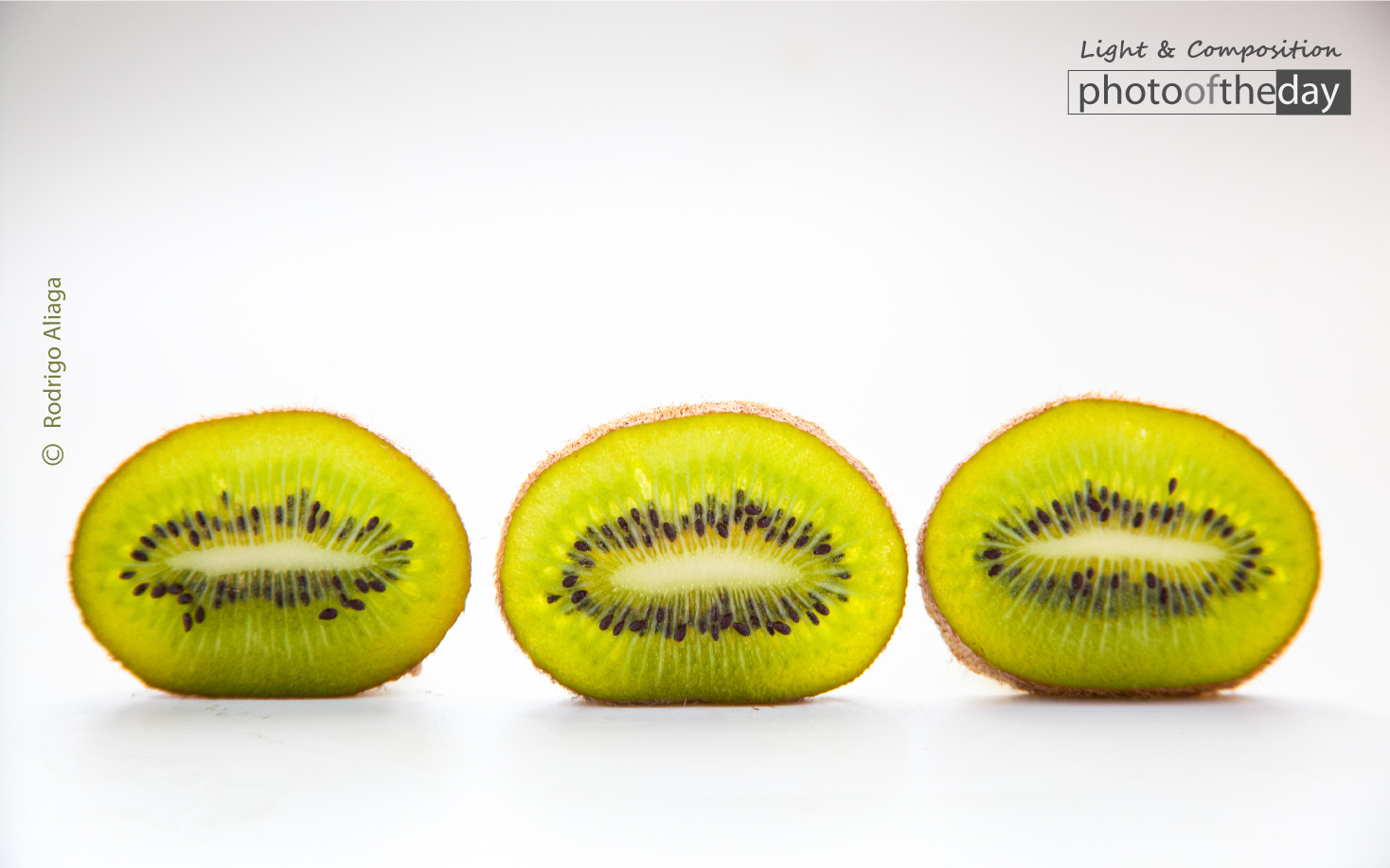
Exposure 1/40sec @ f/5.6 | ISO 800 | Focal Length 135mm
Rodrigo Aliaga
Born in La Paz, Bolivia, Rodrigo Tato Aliaga is a professional director of photography with extensive experience in film production and television advertising. Transitioning his expertise from analog film to digital photography, he has found a unique niche in food photography, where he masterfully blends technical precision with artistic creativity. His work is defined by a commitment to achieving exquisite visual results, reflecting his deep understanding of lighting, composition, and the narrative power of the lens.
Resonance Score Breakdown
Transparency Note: The resonance score (7.4/20) is calculated based on social engagement metrics collected before the award announcement.
Expert Photography Reviews · 7
The Geometry of Morning Light
There is a market stall in La Paz where the fruit is stacked with the precision of a clockmaker’s workshop. I often find myself lingering there, not to buy, but to watch how the morning sun catches the edges of things.
Read the reflection →The Architecture of Light
There is a quiet alchemy in how the sun chooses to reveal the hidden geometry of the earth. We often walk past the ordinary—the rind of a fruit, the vein of a leaf—without realizing that beneath the surface lies a cathedral of light waiting to be unlocked.
Read the reflection →Reviews & Comments
Share your thoughts about this award-winning photograph. Your reviews contribute to the community engagement score.
You’ve got a sharp eye for light, Rodrigo. Those kiwis glow like stained glass, and I appreciate the patience it took to balance them. But I’m looking for the person behind the fruit. Where’s the hunger, or the hands that sliced them? It’s technically perfect, yet it feels a bit cold to me. I want to see the life in La Paz, not just the produce. You’ve got the skill; now, find the pulse.
It’s strange to see a kiwi slice treated with the same reverence I usually reserve for a nebula. At f/5.6, the light passing through that fruit is just photons hitting a sensor, much like the ancient starlight I track. The translucent green cells look like a microscopic galaxy. I’ve spent my life looking up, but this quiet, glowing geometry in La Paz makes me feel surprisingly grounded. It’s a beautiful, humble collision of light and matter.
We look at these translucent kiwi slices and we don’t just see fruit; we see a quiet, patient conversation. Rodrigo has listened to the light, letting it reveal the hidden, emerald veins of the harvest. It’s a portrait of stillness. I find myself leaning in, searching for the hands that placed that tiny toothpick, feeling the gentle care behind the lens. It’s a photograph that asks to be returned to, a beautiful, glowing secret shared.
Translucency isn’t clarity; it’s a veil. By pinning these kiwis against the window, the light doesn’t reveal the fruit, it interrogates its cellular architecture. I’m unsettled by the toothpick—that jagged, metallic intrusion into the organic. It’s a violent anchor in an otherwise ethereal space. We’re staring at a biological autopsy masquerading as breakfast. It’s beautiful, sure, but it’s a cold, clinical beauty that refuses to let me look away from the rot waiting beneath the rind.
At f/5.6, the 135mm focal length compresses the kiwi’s cellular structure, pushing the limits of the Canon’s sensor. The backlighting forces photons through the fruit’s translucent pericarp, revealing a mesmerizing, organic geometry. I’m genuinely moved by how the light scatters through those tiny, dark seeds; it’s a masterclass in refractive index. It doesn’t just show fruit—it captures the physics of life itself. It’s a rare, luminous moment where optics and biology collide in perfect, quiet harmony.
Light bleeds through the kiwi slices like a stained-glass window in a quiet cathedral. It’s a static sequence, a macro-shot that breathes. The backlighting turns simple fruit into glowing, organic film cells. I’m struck by the tension; that toothpick is the only thing holding the scene together, preventing a collapse. It’s a frame the editor keeps because it captures the exact moment light turns texture into narrative. I’d watch this frame for hours.
The radial symmetry of these kiwi slices creates a compelling geometric grid. By aligning the circular seeds along the vertical axis, Aliaga solves the spatial problem of organic chaos. The 1:1 ratio of light transmission through the translucent pulp against the negative quadrant of the white backdrop is mathematically precise. I’m genuinely struck by how the toothpick’s diagonal vector disrupts the pattern, grounding the floating forms. It’s a beautifully calculated equation of texture and light.