Ordinary Children by Jose Juniel Rivera-Negron
Captured during a spontaneous afternoon in his own backyard, Jose Juniel Rivera-Negron documents the pure, unscripted joy of neighborhood children at play. Drawn to the authenticity of their laughter and camaraderie, the photographer sought to preserve the essence of childhood innocence through a documentary lens. By stepping into the scene with a respectful and observant approach, he successfully transformed a casual neighborhood encounter into a poignant study of human connection. The image is award-worthy for its ability to find profound beauty in the ordinary, showcasing a keen eye for candid emotion and the timeless spirit of youth.
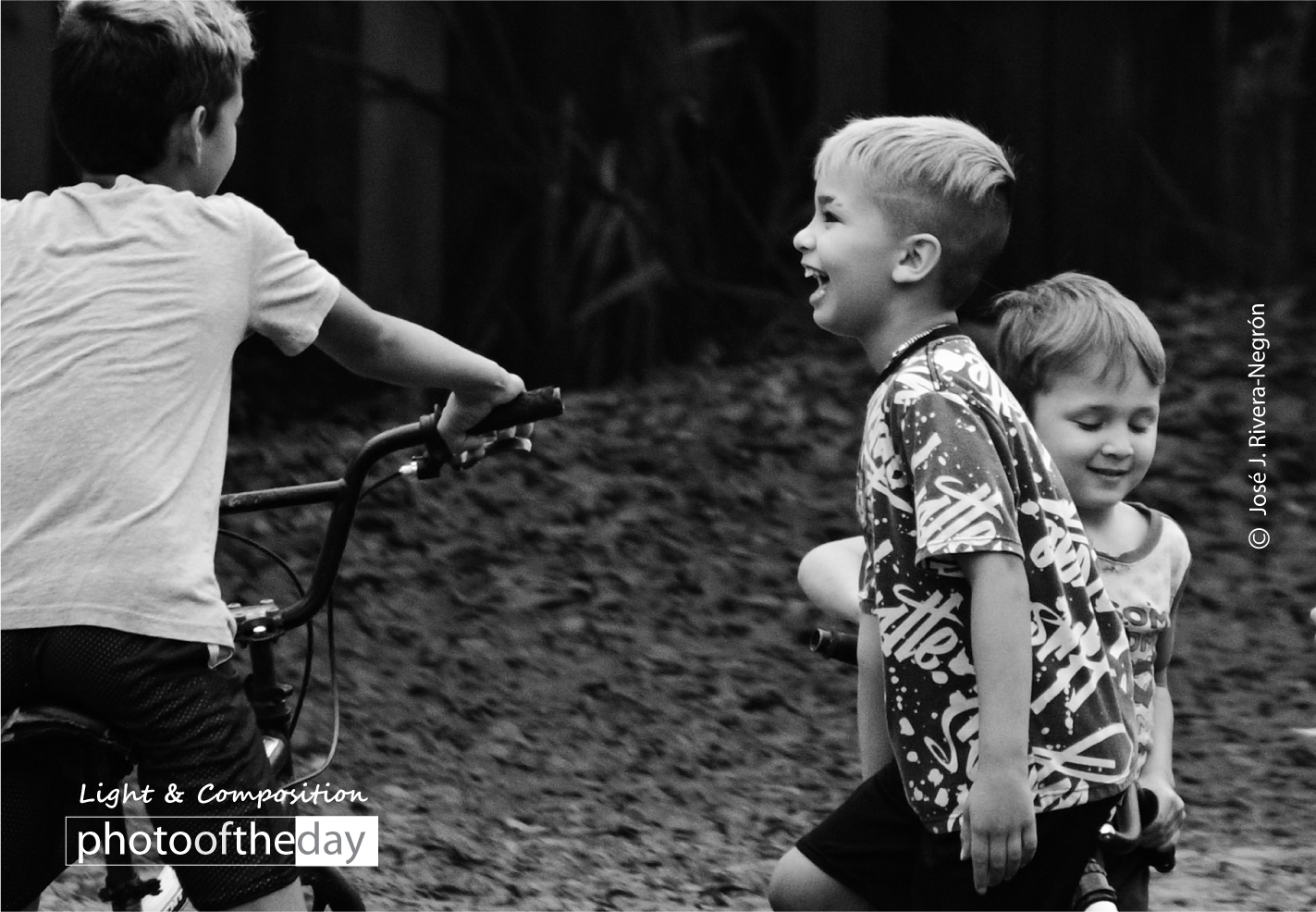
Exposure 1/125sec @ f/4.5 | ISO 1000 | Focal Length 75mm
Jose Juniel Rivera-Negron
Born on the tropical island of Puerto Rico, Jose Juniel Rivera-Negron is a resilient artist currently based in Tampa, Florida. After overcoming significant personal hardships, he turned to photography as a powerful medium to document the human experience and share his unique perspective with the world. Driven by a desire to inspire others, he demonstrates that it is never too late to pursue one's creative dreams, using his lens to highlight the beauty and possibilities found within everyday life.
Resonance Score Breakdown
Transparency Note: The resonance score (8.2/20) is calculated based on social engagement metrics collected before the award announcement.
Expert Photography Reviews · 8
The Weight of Unfinished Games
I keep a small, rusted marble in a velvet-lined box on my desk, a relic from a game played on a sidewalk that no longer exists. It is chipped, its once-vibrant swirl of blue now dulled by the friction of years spent rolling through dirt and grass.
Read the reflection →The Weight of a Whisper
I found a marble in the pocket of my coat this morning. It was dusty and chipped, a small, cold sphere that immediately pulled me back to a summer when the days felt like they would never end. Back then, we didn't need reasons to be anywhere.
Read the reflection →Reviews & Comments
Share your thoughts about this award-winning photograph. Your reviews contribute to the community engagement score.
At 75mm and f/4.5, the Nikon Z50’s sensor captures a delicate transition through the focal plane. The bokeh, a function of the lens’s optical design, renders the Florida foliage into soft, chromatic-aberration-free circles that don’t distract from the subjects. I’m genuinely moved by how the diffraction of light across their skin reveals such raw, unscripted vitality. It’s a rare moment where the glass doesn’t just record the scene; it elevates the physics of childhood into something truly luminous.
The backyard isn’t just grass. It’s a field of potential. The children occupy one edge, leaving the rest to the light. I’ve spent minutes watching that expanse of lawn. It’s the weight of the air between them. Nothing here is accidental. The empty corner isn’t empty. It’s a pause. It’s where the laughter goes to breathe. I feel a sudden, sharp ache for my own quiet afternoons. It’s a rare, still grace.
Most documentary work today feels staged, but Rivera-Negron’s backyard scene avoids that trap. It’s the unforced geometry of the children’s limbs that caught me; they aren’t posing for a camera, they’re just existing. I’ve seen thousands of shots of playing kids, yet this one lingers because it’s devoid of sentimentality. It’s raw, honest, and frankly, it makes me miss the simplicity of my own childhood. In thirty years, this will still feel like a genuine memory.
It’s jarring to see such crisp, unfiltered light. Down here, we’re constantly battling the refractive index of water and the relentless loss of the red spectrum. Rivera-Negron’s backyard scene is blissfully free of backscatter, that persistent enemy that ruins so many of my own close-focus attempts. I’m genuinely envious of how easily he captures these children’s joy without fighting the physics of light absorption. It’s a clean, honest clarity I rarely find beneath the surface.
The Florida light here doesn’t merely illuminate; it saturates the scene in the bruised, humid gold of a late afternoon, reminiscent of a sun-drenched Vermeer interior pushed outdoors. I’m utterly captivated by how the children’s skin tones vibrate against the verdant, chlorophyll-heavy shadows, creating a chromatic tension that feels like a held breath. It’s a gorgeous, fleeting alchemy of warmth and shade that makes one ache for the lost, unburdened summers of our own youth.
The frame’s geometry relies on the precarious alignment of the central figures. It’s a study in spatial tension where the background blur threatens to dissolve the subjects entirely. The composition holds, though barely. There’s a jarring lack of anchor in the lower quadrant that makes me anxious. It doesn’t collapse, but it’s close. The weight of the children is distributed unevenly, creating a tilt that demands more discipline. It’s technically functional, yet structurally restless.
Sunlight in Florida isn’t just illumination; it’s an erasure. Rivera-Negron’s children exist in the glare, yet I’m haunted by the pockets of gloom beneath the foliage. It’s here the image thinks. We’re told this is innocence, but I see the encroaching dark, the inevitable weight of time pressing against their play. I feel a sudden, sharp ache for their fleeting ignorance. It’s a beautiful resistance, a fragile defiance against the shadows that will eventually claim them.
The backyard isn’t just a backdrop; it’s a threshold where the rigid geometry of the fence meets the fluid, chaotic energy of play. Rivera-Negron captures how light hits the grass, softening the harsh Florida sun against the solid mass of the home. I’m struck by the way the children’s movement disrupts the static datum of the architecture. It’s a rare, honest look at how we actually inhabit our domestic voids, turning structure into a living, breathing stage.