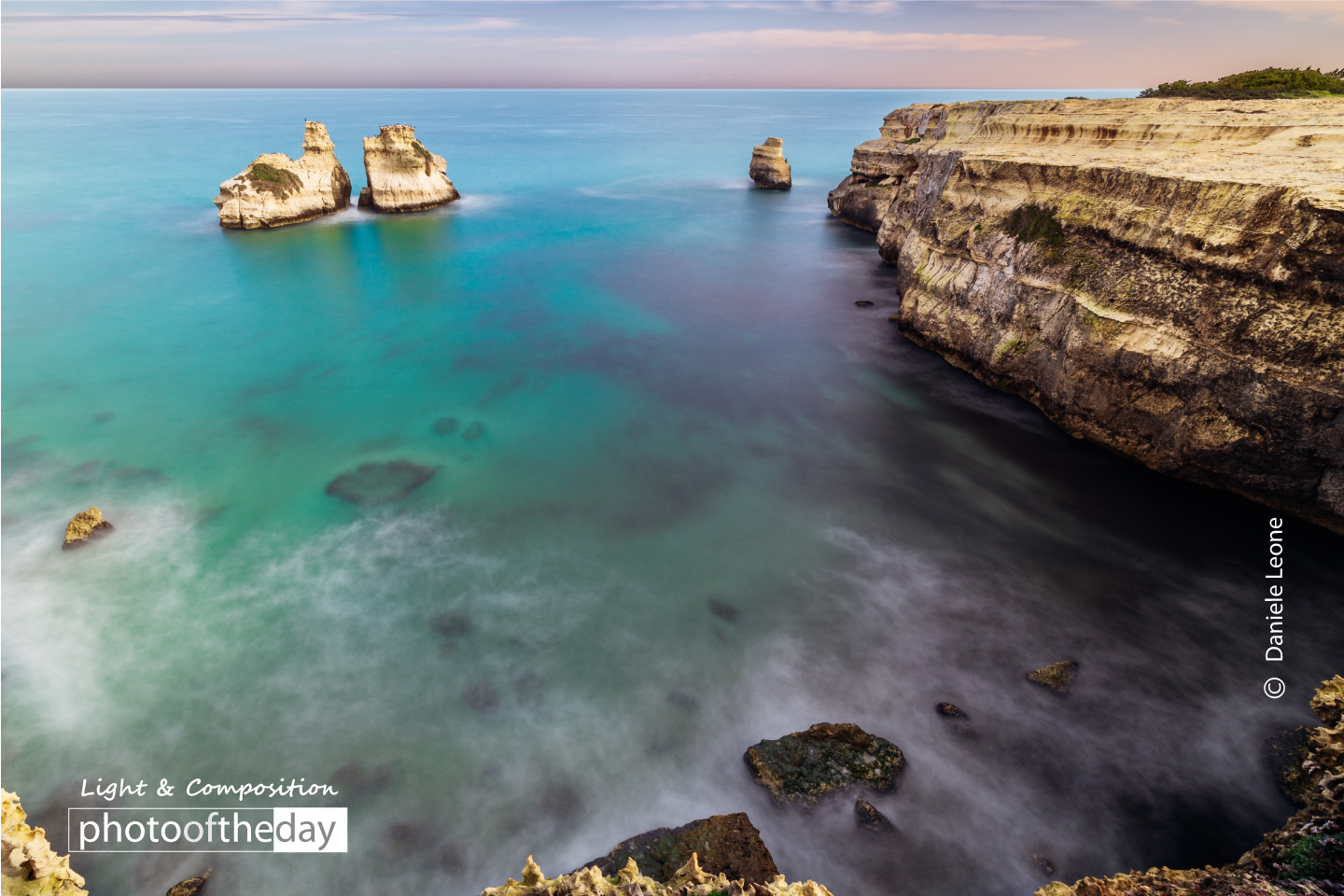
Two Sisters by Daniele Leone
Captured in the bay of Torre dell'Orso, this evocative landscape features the iconic 'Two Sisters' rock formations rising from the Ionian Sea. Daniele Leone masterfully frames these geological sentinels, which have been sculpted over time by the relentless erosion of wind and waves. The composition highlights the poignant, mirror-like quality of the rocks, suggesting a silent, eternal dialogue between the two stone figures. This image is award-worthy for its ability to transform a natural landmark into a narrative of time and endurance, rendered with a profound sense of place and atmospheric stillness.
Daniele Leone
Born in Milan in 1974, Daniele Leone is a photographer who considers himself an Apulian by adoption. His early exposure to Italy’s diverse landscapes and cultural heritage during childhood travels ignited a lifelong passion for visual storytelling, which he first explored using a Minolta camera. Influenced significantly by his uncle, a technical designer and traveler, Leone developed a sophisticated eye for the intersection of architecture and natural beauty. Today, he resides in Lecce, where he continues to document the evocative landscapes of his adopted home.
Resonance Score Breakdown
Transparency Note: The resonance score (10.0/20) is calculated based on social engagement metrics collected before the award announcement.
Expert Photography Reviews · 6
The Patience of Stone
Seneca once observed that time is a river that carries us along, yet there are certain anchors in our lives that seem to defy the current.
Read the reflection →The Weight of Stone
We are taught that time is a river, something that flows and leaves us behind. But look at the coast. Look at the way the salt eats the cliff, how the water shapes the land into something that resembles a memory.
Read the reflection →Reviews & Comments
Share your thoughts about this award-winning photograph. Your reviews contribute to the community engagement score.
The diffraction of light across the Ionian surface is, in the strictest physical sense, extraordinary. Leone’s focal plane holds the limestone’s porous texture with such clinical precision that I’m genuinely moved by the micro-contrast. It’s rare to see a sensor resolve the transition between wet stone and atmospheric haze so cleanly. The bokeh, a function of a well-chosen aperture, doesn’t just blur the horizon; it elevates these sisters into a silent, optical dialogue I can’t stop watching.
Most landscape entries this year relied on tired, saturated sunsets. Leone avoids that trap by embracing a muted, melancholic palette that feels honest to the Ionian coast. The way the two rocks mirror each other’s erosion creates a quiet tension I haven’t stopped thinking about. It’s not just a postcard; it’s a meditation on solitude. I’d hang this in my own home because it doesn’t scream for attention—it simply endures, just like the stone itself.
Leone’s framing of these stacks echoes the stark, elemental isolation found in Hiroshi Sugimoto’s seascapes, yet it lacks that profound metaphysical weight. While the long exposure smooths the Ionian surface into a meditative veil, it’s a well-trodden path. I’ve seen this geological melancholy a thousand times since the Pictorialists. Still, the way the light catches the limestone’s porous texture genuinely stirred me; it’s a quiet, tactile intimacy that almost saves the composition from its own predictability.
You’ve captured a quiet, heavy loneliness in these rocks. I’ve stood by water like this, feeling small against the tide, and you’ve managed to pull that same ache into the frame. It’s not just a landscape; it’s a conversation between two ghosts. Because you waited for that light, the stone feels alive, almost breathing. There’s something honest happening here. You didn’t just take a picture of the sea; you felt the weight of the silence.
The Two Sisters rock formations rise from the Ionian Sea, yet I’m struck by how lonely they feel. Leone frames them as eternal, but whose eternity are we consuming? By stripping away the tourists and the plastic debris that inevitably litter Torre dell’Orso, he manufactures a pristine, colonial-style silence. Does this erasure serve the landscape, or does it just make the geography easier to own? It’s beautiful, sure, but I find the artifice deeply unsettling.
f/11 at 1/2 second, ISO 100, 24mm. A standard landscape configuration, yet it’s executed with clinical precision. The diffraction limit hasn’t compromised the sharpness of the limestone stacks. Leone’s shutter speed choice effectively smoothed the Ionian tide without turning it into featureless fog. It’s technically sound, though I’d prefer a tighter focal length to isolate the erosion patterns. I’m actually annoyed by how well this works. The data supports the narrative. It’s a correct decision.