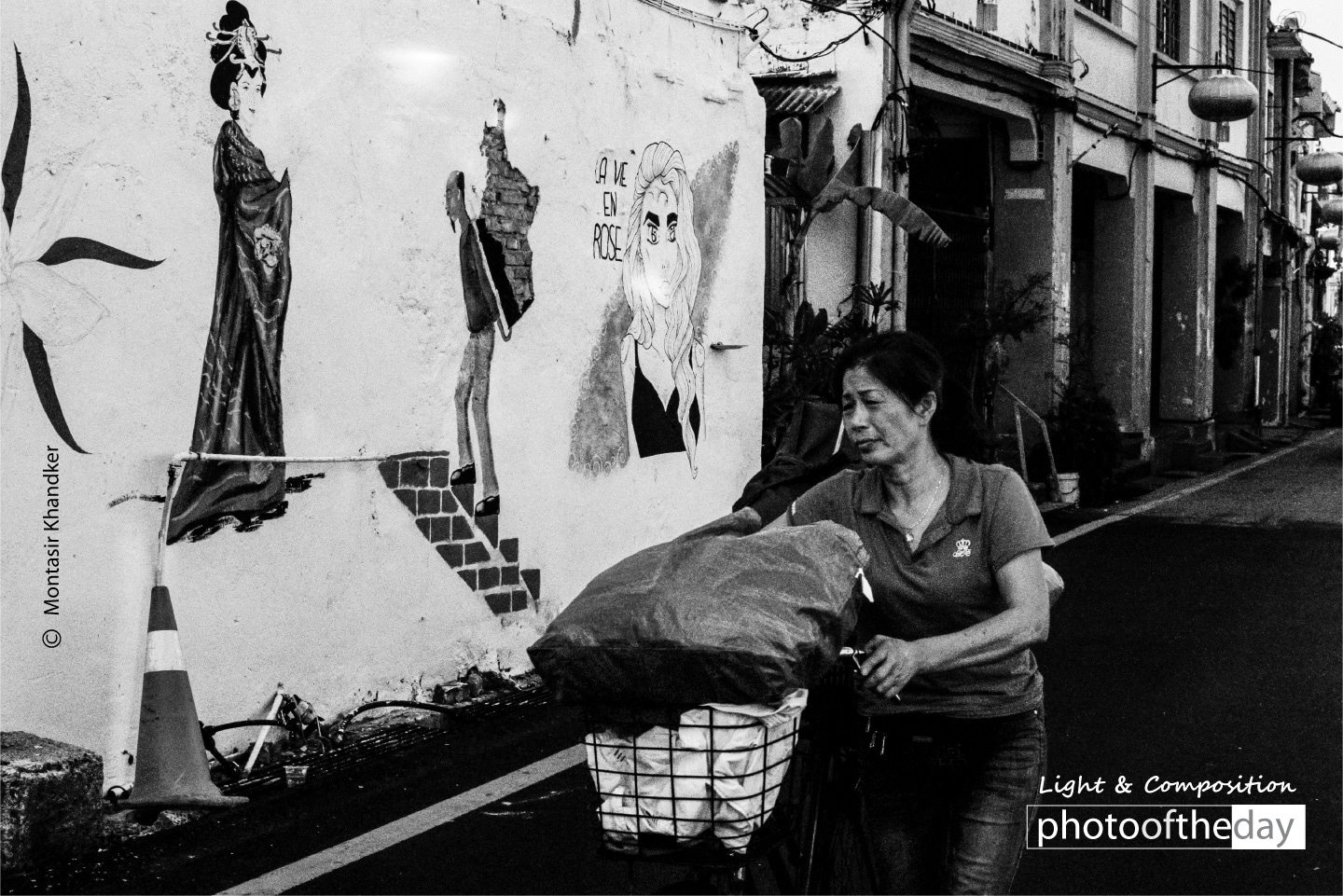
Malacca Graffiti by Montasir Khandker
In the historic streets of Malacca, Malaysia, the photographer captures the vibrant transformation of ordinary walls into canvases of cultural expression. By focusing on the intricate brushstrokes of local artists, the image highlights the UNESCO-listed city’s evolving urban landscape. The composition draws the viewer into the colorful riverside and Jonker Street surroundings, where traditional architecture meets contemporary street art. This photograph is award-worthy for its ability to document the intersection of heritage and modern creativity, showcasing the photographer’s keen eye for the subtle, artistic details that define the unique character of this Malaysian gem.
Montasir Khandker
Born and raised in Bangladesh and currently residing in Kuala Lumpur, Malaysia, Montasir Khandker began his photographic journey during his college years using a vintage Yashica Electro 35 rangefinder. What started as a simple hobby quickly evolved into a profound passion for visual storytelling. As an amateur photographer, Khandker specializes in capturing evocative scenes that possess a compelling narrative quality, consistently seeking to document the world through a lens that finds beauty in both the ordinary and the extraordinary.
Resonance Score Breakdown
Transparency Note: The resonance score (9.1/20) is calculated based on social engagement metrics collected before the award announcement.
Expert Photography Reviews · 4
The Skin of the City
I keep a small, rusted skeleton key in a velvet pouch, though I have long since forgotten which door it once opened. It is heavy, cold, and worn smooth by the friction of a hand that no longer exists.
Read the reflection →The Walls That Remember
I remember sitting in a small cafe in George Town, watching an old man scrub a layer of grime off a brick wall. He wasn't restoring it to look new; he was just revealing the ghost of a faded advertisement from the fifties.
Read the reflection →Reviews & Comments
Share your thoughts about this award-winning photograph. Your reviews contribute to the community engagement score.

The artist’s hand is mid-stroke, but the tension in the wrist is already dissipating. It’s a fraction of a second too late. I’ve spent my life chasing that singular, explosive apex of effort, and this misses the mark. The brush has already met the wall; the kinetic energy is gone. It’s a pretty scene, sure, but it lacks the physiological snap I crave. I’d have preferred the moment of contact, not the aftermath.
Before the eye identifies the peeling plaster or the spray-painted layers, something in the chest tightens. It’s the friction between Malacca’s ancient, humid decay and the frantic, neon urgency of the graffiti. I find myself holding my breath, waiting for the paint to flake further. When I return to this, I don’t see a city; I feel the restless pulse of a place that refuses to be static. It’s a beautiful, aching dissonance.
Staring at these Malaccan walls, I can’t help but miss the pulse of the wild. It’s a clean, static composition, but it lacks the tension of a living subject. I’ve spent weeks in humid blinds waiting for a kingfisher to land; that’s where the real art hides. Here, the artist didn’t have to wait for anything to breathe or move. It’s technically sharp, sure, but it feels entirely extracted, not earned. I’m bored.
Malacca’s walls have become a palimpsest, echoing Brassaï’s fascination with urban graffiti, yet Khandker’s framing lacks the grit of his Parisian predecessors. It’s a polite documentation of decay. I’m genuinely charmed by the way the peeling plaster mimics the texture of early salt prints, but the composition feels too safe. It doesn’t push the conversation forward. I’ve seen this intersection of heritage and spray paint before; it’s time we demanded more than just a colorful surface.