Catch the Light by Kirsten Bruening
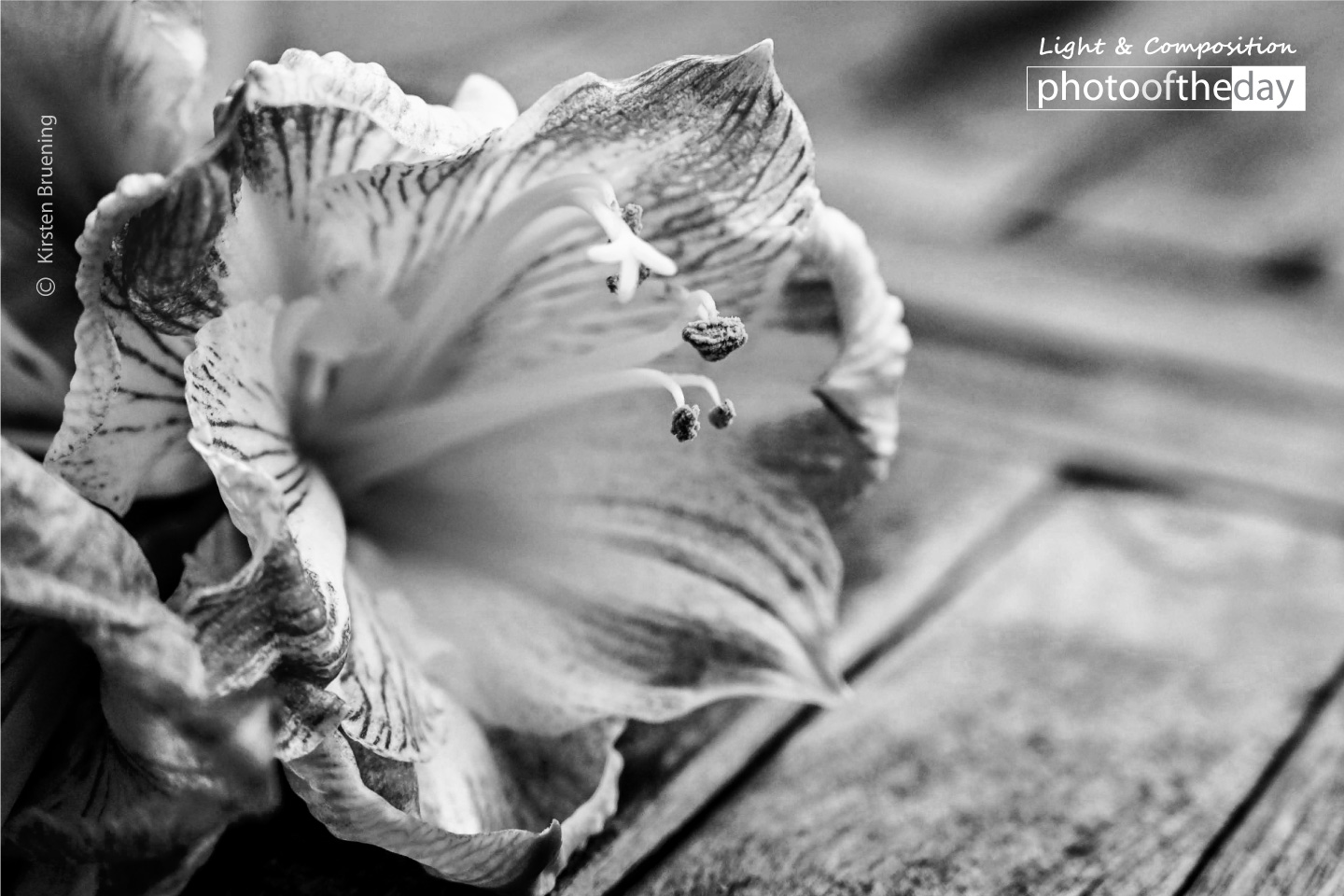
In this evocative close-up study, the photographer strips away the distraction of color to focus entirely on the intricate textures and delicate forms of a flower. By utilizing a monochromatic palette, the image accentuates the subtle interplay of light and shadow across the petals and stems, revealing a tenderness that might otherwise go unnoticed. This deliberate technical choice shifts the viewer’s attention to the fine details and structural elegance of the subject. The photograph stands as an award-winning example of how black-and-white composition can transform a simple botanical study into a profound exploration of natural beauty and emotional depth.
Kirsten Bruening
Based near Cologne, Germany, Kirsten Bruening is a dedicated photographer whose artistic journey began in childhood with an early fascination for analogue techniques. After a fifteen-year hiatus, she returned to the craft with a renewed focus on nature, portraiture, and wildlife photography. Her work is defined by a deep appreciation for the expressive power of light and shadow, particularly within monochrome compositions. Currently pursuing further academic study in the field, she continues to refine her technical knowledge and artistic vision.
Resonance Score Breakdown
Transparency Note: The resonance score (10.6/20) is calculated based on social engagement metrics collected before the award announcement.
Expert Photography Reviews · 7
The Quiet Weight of Being
Dear reader, I have been thinking about the things we overlook simply because they are too close to us. We spend our lives searching for grand gestures, for loud declarations of existence, while the most profound truths are often huddled in the corners of our own gardens.
Read the reflection →The Weight of Petals
I keep a pressed carnation inside a heavy dictionary, its edges now the color of tea-stained lace. It was once vibrant, a shock of crimson that demanded attention, but time has turned it into something fragile and translucent, like a ghost of a bloom.
Read the reflection →Reviews & Comments
Share your thoughts about this award-winning photograph. Your reviews contribute to the community engagement score.
Botanical studies usually lack the kinetic urgency I crave, but there’s a tension here in the petal’s curl. It’s the exact millisecond before the bloom fully unfurls, caught in a state of maximum structural strain. I’ve spent my life watching muscles coil; seeing that same potential energy trapped in a flower’s edge is genuinely unsettling. It’s the frame. Not the one before, not the one after. This one. It’s a perfect, silent sprint.
Monochrome doesn’t merely strip color; it forces the flower to confront its own mortality. Bruening’s petals aren’t soft—they’re architectural, carved by a light that refuses to offer comfort. I’ve stared at these veins for an hour, and I’m unsettled by how much they resemble human skin under duress. It’s a cold, precise dissection. When the shadows finally swallow the stem, I feel a sudden, sharp ache for the darkness that inevitably claims us all.
We lean in, expecting a flower, but we find a face. Kirsten has listened to this bloom, capturing the way its petals curve like a weary traveler’s shoulder. It’s a portrait of resilience, stripped of color so we can finally hear the silence within the folds. I’m moved by how the light clings to those edges, whispering secrets of growth. It’s a photograph that asks to be returned to, because it feels like a conversation I’ve already had.
Stripping away the chromatic spectrum feels like a mournful silence, yet here, the absence of colour reveals a ghostly, silvered luminescence reminiscent of Morandi’s dust-laden still lifes. It’s a stark, monochromatic meditation where the light doesn’t merely land; it clings to the velvet contours of the petals like mist. I’m truly haunted by this lack of hue, as if the flower’s very soul has been bleached into a fragile, structural ache that I can’t quite escape.
The petals curve into shadow. It’s a quiet geometry. I’ve spent minutes watching the light settle on the stem. It doesn’t demand attention. It simply exists. The frame holds a stillness I rarely find in Cologne. Nothing here is accidental. The empty corner is not empty. It’s a breath. I feel my own pulse slow down just looking at it. Such restraint. It’s rare to see a flower allowed to be this lonely.
Botanical studies often feel sterile, but there’s a quiet, rhythmic patience here that I actually find quite moving. It’s refreshing to see a photographer slow down enough to let the light reveal the petal’s architecture rather than forcing a macro shot with aggressive artificial gear. I’ve spent days waiting for light to hit a leaf just so; it’s clear she didn’t rush this. It’s a rare, honest study of stillness in a frantic world.
It’s strange to look at these petals, so terrestrial and fleeting, when I’ve spent my life chasing photons that have traveled eons. Kirsten’s monochrome study feels like a quiet pause in the universe’s expansion. I find myself holding my breath, searching for the thermal noise I’d expect in a long exposure, but finding only stillness. It’s a tender, fragile thing. I’m genuinely moved by how she’s captured a life cycle that lasts days, not millennia.