Interior of the Grand Colosseum by Achintya Guchhait
Captured during a dedicated visit to Rome, this image showcases the majestic scale of the Grand Colosseum. The photographer visited the site three times over four days, meticulously observing the structure under varying light to capture its shifting moods. By focusing on the false platform of the podium, the composition offers a compelling glimpse into the monument's former grandeur. This award-winning shot demonstrates a keen eye for architectural history, balancing technical precision with a deep appreciation for the site's enduring legacy and structural complexity.
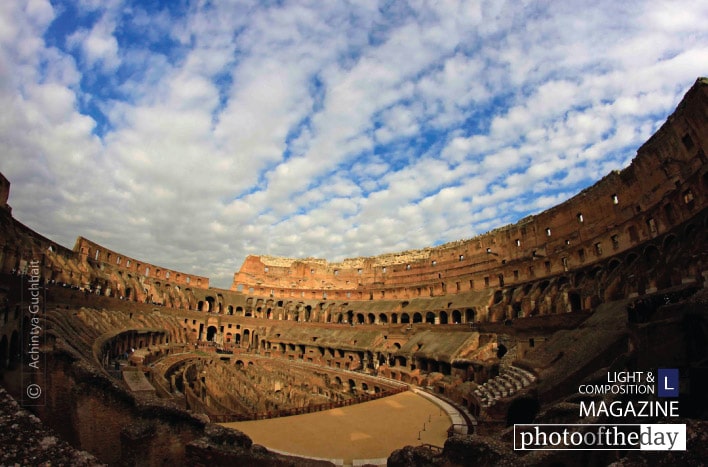
Exposure 1/200sec @ f/11 | ISO 100 | Focal Length 18mm
Achintya Guchhait
Based in Bangalore, India, Achintya Kumar Guchhait is a dedicated photographer and tech professional who discovered his passion for imagery at an early age. His photographic journey evolved from early experiments with film to a serious pursuit of digital storytelling, characterized by a desire to capture the authentic coexistence of life and the human world. A frequent traveler and Getty contributor, Guchhait continuously refines his craft, drawing inspiration from the diverse environments he encounters while maintaining a versatile portfolio that spans architectural, street, and event photography.
Resonance Score Breakdown
Transparency Note: The resonance score (12.2/20) is calculated based on social engagement metrics collected before the award announcement.
Expert Photography Reviews · 7
The Weight of Echoes
We often speak of ruins as if they were merely the absence of what once stood. We look at a fallen pillar or a hollowed arch and see only the subtraction of stone. But perhaps it is the opposite.
Read the reflection →The Architecture of Silence
We are all, in our own way, ruins in the making. We build our lives with the frantic certainty of stone, stacking days like bricks, believing that if we pile them high enough, we might outlast the wind. But time is a patient sculptor; it does not rush.
Read the reflection →Reviews & Comments
Share your thoughts about this award-winning photograph. Your reviews contribute to the community engagement score.
The frame’s geometry is rigid, yet it doesn’t quite resolve. The podium’s horizontal line cuts the picture plane, creating a sharp fulcrum that demands balance. While the negative space above the arches offers necessary relief, the lower quadrant feels cluttered. It’s a struggle between historical weight and structural clarity. I’ve found myself frustrated by the lack of vertical alignment here. The composition holds, but only just. It’s a clinical exercise that barely survives its own ambition.
Stone arches frame the void. It’s a heavy silence. I’ve stood in these ruins, but here, the shadows hold more weight than the rock. The platform pulls the eye toward the center. It doesn’t ask for attention. It demands stillness. Nothing here is accidental. The empty corner is not empty. It’s a breath held in the dark. I feel a sudden, sharp ache for the time that’s vanished. It’s quiet. It’s enough.
Three trips in four days for a single frame. It’s a rare sort of stubbornness that I find rather refreshing. Most tourists simply point and click, but Guchhait clearly stood his ground until the light finally stopped playing games with the podium. I’ve spent enough damp mornings waiting for the sun to behave to know the ache in his legs. It’s a solid, honest piece of work. He didn’t just find this; he earned it.
Most architectural shots of the Colosseum are just postcards. What separates this from the thousands I’ve reviewed is the choice to frame the podium’s decay against the vast, empty arena floor. It’s a quiet, brutal reminder of what’s been lost. I felt a genuine chill looking at those jagged stone teeth against the sky. It’s not just a record of a ruin; it’s a confrontation with time itself. That’s why it’ll still matter in thirty years.
The ochre of these ancient stones, weathered into the dusty, sun-bleached palette of a Morandi still life, vibrates against the bruised, cerulean shadows of the Roman sky. It’s a haunting chromatic dialogue; I’ve felt my breath hitch at the way the light clings to the crumbling travertine, turning history into a tactile, golden ache. One finds here a profound, melancholic harmony that doesn’t merely document architecture, but rather breathes life into the very bones of antiquity.
The stone here doesn’t just hold history; it breathes. Achintya waited for the light to soften, catching those deep, hollow shadows where the past still lingers. I’ve stood in such places, feeling the weight of centuries pressing against my own skin. It’s quiet, isn’t it? He didn’t rush the frame. By focusing on the podium’s edge, he let the architecture speak for itself. I find myself shivering slightly, imagining the silence he must have felt that day.
At f/11, the 18mm focal length pushes the sensor toward its diffraction limit, yet the stone textures remain remarkably crisp. I’m genuinely moved by how the light cascades across the podium’s weathered edges; it’s a masterclass in managing micro-contrast. While the Canon 500D’s sensor struggles with the dynamic range of the shadows, the optical geometry holds firm. It’s rare to see such structural integrity preserved when the lens is forced to resolve this much ancient complexity.