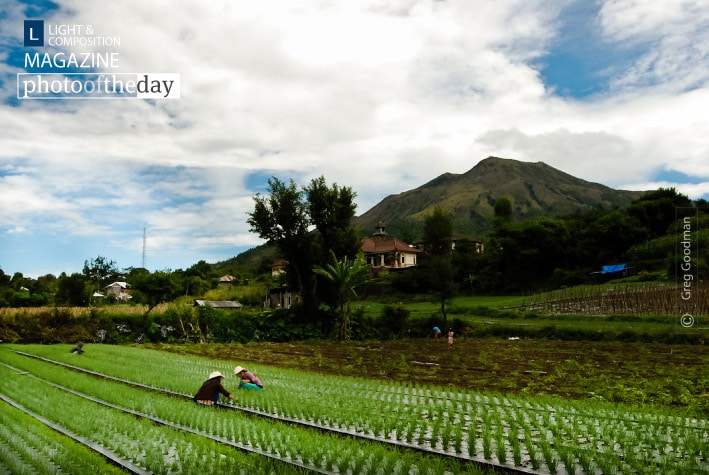
Volcanic Onion Fields by Greg Goodman
Captured in the shadow of Bali’s Mount Batur, this photograph documents the resilient farming community thriving amidst the volcanic landscape. The photographer encountered rows of onion fields meticulously tended by local women and children, a scene of quiet, daily labor that stands in stark contrast to the transient tourism of the region. By focusing on the human element against the backdrop of a dormant volcano, the image highlights the harmony between humanity and nature. Its award-worthy quality lies in the poignant juxtaposition of simple, enduring rural life against the dramatic, geological history of the volcanic terrain.
Greg Goodman
Born and raised in New York City, Greg Goodman developed a fascination for photography during childhood travels, which eventually evolved into a dedicated pursuit of documenting the world. His work frequently explores the intersection of humanity and nature, with a particular focus on architecture, urban decay, and the rhythms of daily life across the globe. Through his digital magazine, Adventures of a GoodMan, he shares a rich collection of travel journals and visual narratives that reflect his extensive experience as a backpacker and storyteller.
Resonance Score Breakdown
Transparency Note: The resonance score (13.2/20) is calculated based on social engagement metrics collected before the award announcement.
Expert Photography Reviews · 6
The Soil Remembers
In the nineteenth century, geologists began to understand that the earth is not a static stage, but a slow-moving, restless actor. We tend to view the ground beneath our feet as a permanent fixture, a reliable constant in a life of shifting circumstances.
Read the reflection →The Earth Remembers
We build our lives on the skin of giants. We plow the ash, we plant our seeds, and we wait for the harvest as if the ground beneath us were permanent. It is a quiet arrogance, this belief that the soil belongs to us.
Read the reflection →Reviews & Comments
Share your thoughts about this award-winning photograph. Your reviews contribute to the community engagement score.

Mount Batur looms, a geological silence that swallows the triviality of the tourist gaze. Goodman’s onions aren’t merely crops; they’re a stubborn defiance against the ash. I’m struck by how the shadows don’t hide the labor, but define its weight. It’s a brutal, honest geometry. When I look at these rows, I don’t see harmony. I see a fragile human pulse beating against the dark, indifferent earth. It’s haunting, really. It doesn’t ask for our pity.
The ochre of volcanic dust, bruised by the violet shadows of Mount Batur, creates a chromatic tension that feels almost visceral, like a Morandi still life stretched across a Balinese horizon. It’s the verdant, sharp green of the onion shoots that truly arrests one, cutting through the earth’s somber, scorched palette with such fragile, defiant vitality that I’ve found myself breathless; it’s a rare, aching harmony between the geological violence of the soil and the tender persistence of life.
The geometry of the furrows dictates the eye’s path, pulling focus toward the volcanic horizon. It’s a rigid, rhythmic grid that anchors the frame against the mountain’s looming mass. The spatial tension between the foreground labor and the distant peak creates a necessary fulcrum. Honestly, the sheer discipline of those parallel lines is the only thing keeping this from collapsing into mere travelogue. It’s a rare instance where the structure actually earns its keep.
Most travel photography is disposable, but this holds. Of the thousands I’ve reviewed, few capture the friction between human persistence and geological indifference this well. The rows of onions don’t just fill the frame; they anchor the chaos of the volcanic slope. It’s the quiet, rhythmic labor that gets me—I find myself wanting to reach out and touch that soil. It’s a rare, honest look at Bali that won’t fade in thirty years.
The light here isn’t forced; it’s the soft, diffused clarity of a morning spent waiting for the mountain to breathe. I feel a sudden, quiet ache in my own shoulders looking at those rows. He stood there in the cooling hour, watching the women work the volcanic soil. It’s a humble, rhythmic devotion. The volcano looms, yet the onions persist. It’s a rare, patient stillness that reminds me why I’ve spent my life chasing the horizon.
One suspects Goodman didn’t just stumble upon these onion fields while hunting for a coffee. The light here is consistent, suggesting he spent a proper morning shivering in the volcanic dust rather than snapping a quick frame and fleeing to the resort. I’ve spent enough time in such damp, high-altitude soil to appreciate the grit required to capture this rhythm. It’s a quiet, earned piece of work. He actually stayed long enough to notice the people.