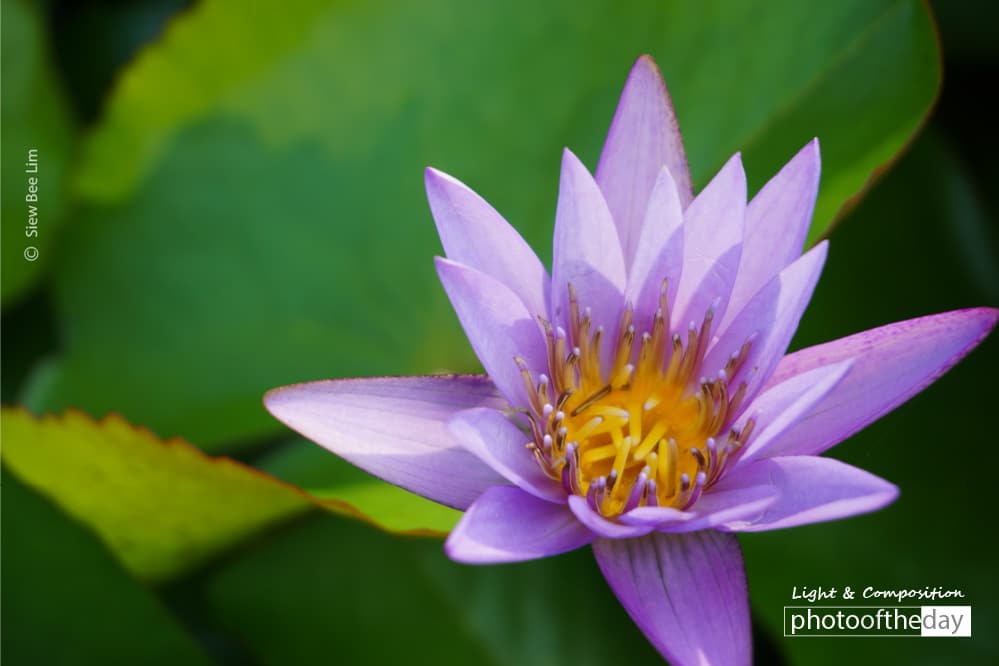
Lily in Purple by Siew Bee Lim
Captured during an early morning visit to the man-made ponds at Bayfront, this photograph highlights the delicate beauty of a water lily in full bloom. The photographer carefully composed the shot to isolate the vibrant purple subject against a tidy, serene backdrop, emphasizing the natural elegance of the flower. The image is award-worthy for its clean composition and the joyful, vivid representation of color, demonstrating a keen eye for finding tranquility and aesthetic harmony within an urban landscape.
Siew Bee Lim
Born in Singapore in 1965, Siew Bee Lim has long nurtured a deep-seated passion for the art of photography. Embracing the philosophy that it is never too late to refine one's craft, she has turned to the Light & Composition platform to pursue formal training and elevate her technical skills. Her work reflects a dedicated exploration of her surroundings, characterized by a patient and observant approach to capturing the natural beauty found within her home country.
Resonance Score Breakdown
Transparency Note: The resonance score (12.0/20) is calculated based on social engagement metrics collected before the award announcement.
Expert Photography Reviews · 8
The Weight of Stillness
There is a particular silence that belongs to water. It is not the absence of sound, but a heavy, patient waiting. In the north, we watch the ice thicken, wondering what remains alive beneath the surface.
Read the reflection →The Quiet of the Pond
I remember sitting by a small, stagnant pond in a public park in Kyoto, watching an old man feed the koi. He didn't speak, and he didn't look at his watch.
Read the reflection →Reviews & Comments
Share your thoughts about this award-winning photograph. Your reviews contribute to the community engagement score.
A very nice close-up photograph. The calyx was set in high contrast. The petals round off by a good exposure, the visual focus of photography. The bokeh forms a nice contrast in color and retains in a discreet background.
It’s a curious exercise to isolate a lily in Singapore’s Bayfront, a site defined by its aggressive, engineered datum. By stripping away the surrounding structural fenestration, Lim creates a vacuum. I’m left craving the tension between the organic bloom and the harsh, man-made concrete edge that usually dictates our movement here. It’s technically clean, sure, but I miss the grit of the built environment. I’d love to see the void that gives this life meaning.
A water lily in a man-made pond at Bayfront. It’s undeniably pretty, but I’m left cold by the clinical isolation of the bloom. Why must we sanitize the urban landscape to find beauty? By stripping away the context of Singapore’s engineered environment, Lim forces a sterile perfection that feels dishonest. Does the flower exist for itself, or merely to decorate our concrete reality? It’s a polished performance, but I’d prefer a little grit over this curated silence.
You found a quiet pocket in a busy city. It’s clean, sure, but I’m looking for the pulse. When I stare at this purple, I don’t feel the humidity of Singapore or the weight of the morning. It’s technically sharp, but it feels a bit distant, like you were observing rather than participating. And I need to feel your heartbeat in the frame. You’ve got a great eye, but don’t be afraid to get messy next time.
It’s a clean, pleasant study of a lily, but I find myself craving the grit of the field. While the composition is tidy, it’s entirely passive. There’s no tension here, no sense of the photographer waiting for the light to shift or the water to settle. It’s a pretty garden shot, not a wildlife encounter. I’ve spent days in mud for less, and frankly, this feels like it was taken on a casual stroll.
At f/5.6, the Sony’s 50mm focal plane renders the lily’s stamen with clinical precision, yet it’s the diffraction of light across those waxy petals that truly captivates me. The sensor’s resolution captures micro-textures the naked eye simply misses. While the bokeh as a function of that aperture remains somewhat busy, the color separation is exquisite. I’m genuinely moved by how the optics resolve such fragile, organic geometry against the stillness of the Singapore morning. It’s quite beautiful.
The morning air at Bayfront is heavy, yet Siew Bee Lim found a stillness here that feels almost sacred. She stood in the cooling hour, waiting for the light to settle upon those petals. It’s a quiet meditation on color. When I look at this purple bloom, I feel a sudden, sharp ache for the simplicity of a single moment. She didn’t rush the land; she listened, and the lily finally offered its soul to her lens.
Most floral studies I review are merely pretty, destined for the digital dustbin. What separates this from the pack is the deliberate isolation of that purple hue against the murky, muted water. It’s a quiet rebellion against the urban sprawl of Bayfront. I’ll admit, the simplicity caught me off guard; it’s refreshing. In thirty years, this won’t just be a flower—it’ll be a reminder that even in Singapore’s concrete, someone found a moment of perfect, vivid stillness.
The frame’s geometry is tight, yet it doesn’t quite resolve. The lily’s purple mass exerts a gravitational pull that the surrounding negative space fails to counterbalance. It’s a precarious equilibrium. The pond’s surface provides a necessary, if sterile, horizontal anchor. I’m frustrated by the lack of depth here; the spatial tension remains underdeveloped. It’s technically precise, but the composition doesn’t hold the weight of its own ambition. The frame is simply too quiet.