Building a Room by Jabbar Jamil
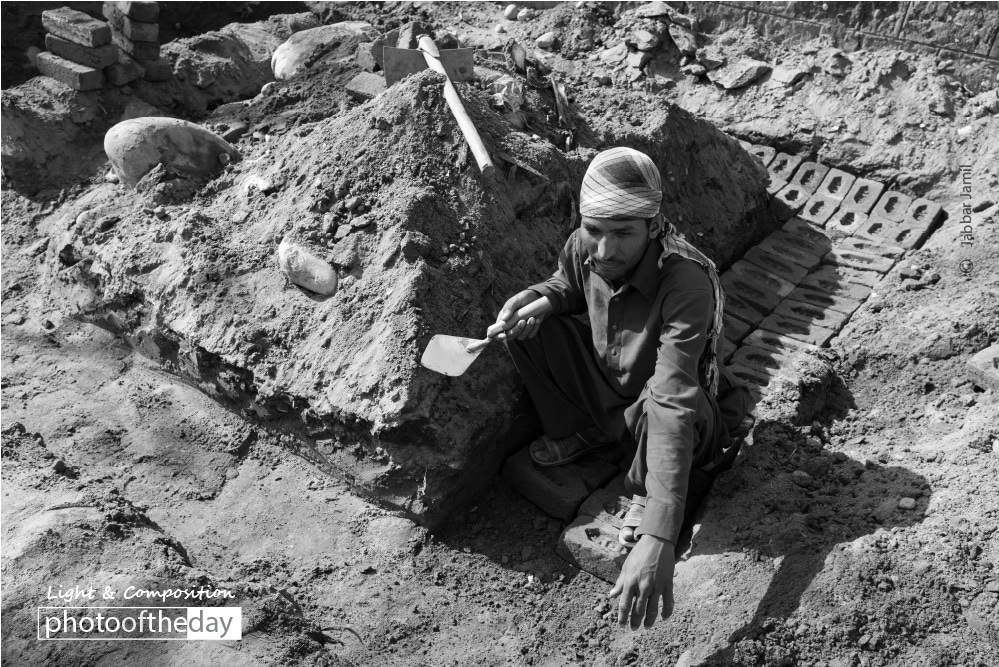
In a village near the border of Pakistan, Jabbar Jamil captured a poignant scene of resilience amidst adversity. The photograph depicts a man laboriously constructing a room for himself, a solitary effort undertaken in a region frequently marred by the loss of homes and livelihoods due to conflict. By choosing to document this quiet, determined act of survival, the photographer highlights the human spirit’s capacity to rebuild despite constant instability. The image is award-worthy for its raw, empathetic storytelling, transforming a difficult reality into a powerful visual narrative that speaks to the universal need for shelter and security.
Jabbar Jamil
Based in Sialkot, Pakistan, Jabbar Jamil is a dedicated street photographer who uses his lens to bridge the gap between his personal comfort zone and the complexities of the outside world. He views photography as both a vital creative outlet and a therapeutic practice, often focusing on the stark, unvarnished realities of life rather than purely aesthetic subjects. Through his work, Jamil seeks to foster human connections, documenting the resilience and struggles of the people he encounters in his community and beyond.
Resonance Score Breakdown
Transparency Note: The resonance score (11.9/20) is calculated based on social engagement metrics collected before the award announcement.
Expert Photography Reviews · 8
The Architecture of Hope
To build is to make a promise to the future. It is a quiet act of defiance against the shifting sands of time and the fragility of our circumstances.
Read the reflection →The Architecture of Persistence
To build is to stake a claim against the indifference of the world. In regions where the ground is constantly shifting—whether by the tremors of conflict or the slow erosion of economic neglect—the act of laying a single brick becomes a radical political statement.
Read the reflection →Reviews & Comments
Share your thoughts about this award-winning photograph. Your reviews contribute to the community engagement score.

The dust in Bajwat doesn’t just settle; it suffocates the light. Jamil’s frame captures a man carving order from chaos, yet it’s the encroaching darkness at the edges that truly haunts me. I feel a cold ache in my chest watching him stack those bricks. He’s building a sanctuary against an inevitable erasure. It’s not about shelter; it’s a desperate, tactile argument against the void. Light here is merely a brief, fragile interruption of the inevitable.
It’s refreshing to see a scene of such heavy, physical labor rendered with this level of restraint. Jamil doesn’t fall into the trap of hyper-sharp documentary cliché. Instead, the soft edges of the construction site feel almost tactile, like a charcoal sketch. I’m genuinely moved by the way he’s left the background to dissolve into the haze. Why resolve the landscape when the man’s struggle is the only thing that truly matters here? It’s beautifully imprecise.
We look at this man in Bajwat and we see the weight of the bricks in his posture. He isn’t just building a wall; he’s anchoring himself against the uncertainty of the border. I’ve spent my life listening to stories, and I can hear the silence in his focus. It’s a quiet, heavy rhythm of survival. My heart aches for the permanence he’s chasing. It’s a photograph that asks to be returned to, again and again.
Before the eye identifies the bricks, a heavy stillness settles in the chest. It’s the weight of solitary labor, the way his spine bows against the dust of Bajwat. I feel a phantom ache in my own shoulders watching him. When I return to this a year later, the silence feels less like isolation and more like a necessary, rhythmic prayer. It’s a quiet, stubborn defiance that follows me into sleep, long after the frame fades.
At f/5.6, the 23mm equivalent lens resolves the texture of the mud bricks with startling clinical sharpness. The light’s diffraction across the rough, sun-baked surfaces creates a micro-contrast that the human eye simply can’t resolve in real time. It’s a gorgeous optical performance. I’m genuinely moved by how the focal plane isolates the man’s labor, turning dust into a crystalline record of survival. It’s a rare moment where physics and human resilience perfectly align.
The dust hangs heavy in the Bajwat air, caught in that flat, unforgiving light that demands everything from a man. I feel a strange ache in my own shoulders watching him stack those bricks. He’s building against the silence of a borderland, and it’s clear he didn’t rush. He waited for the earth to settle. It’s a quiet, holy labor. I’ve stood in such places; you don’t take the shot, you receive it.
Dust settles on the frame. A man stacks bricks against the horizon. He isn’t building a wall; he’s carving out a silence. I feel the weight of his hands in the stillness. The sky above him is vast, heavy with what isn’t there. It’s a quiet ache. Nothing here is accidental. The empty corner is not empty. It’s the space where his hope lives. I’ve never seen such patience in a single frame. It’s enough.
Most entries in this category rely on the drama of rubble, but Jamil focuses on the quiet, rhythmic labor of construction. It’s the man’s posture, bent against the frame, that anchors the scene. I’ve seen thousands of conflict photos, yet this one lingers because it’s about the future, not the ruin. It’s a rare, honest look at survival. Honestly, it makes me ache for the man’s persistence. That’s why it’ll still matter in thirty years.