Hasankeyf – the Ancient Town by Mehmet Masum
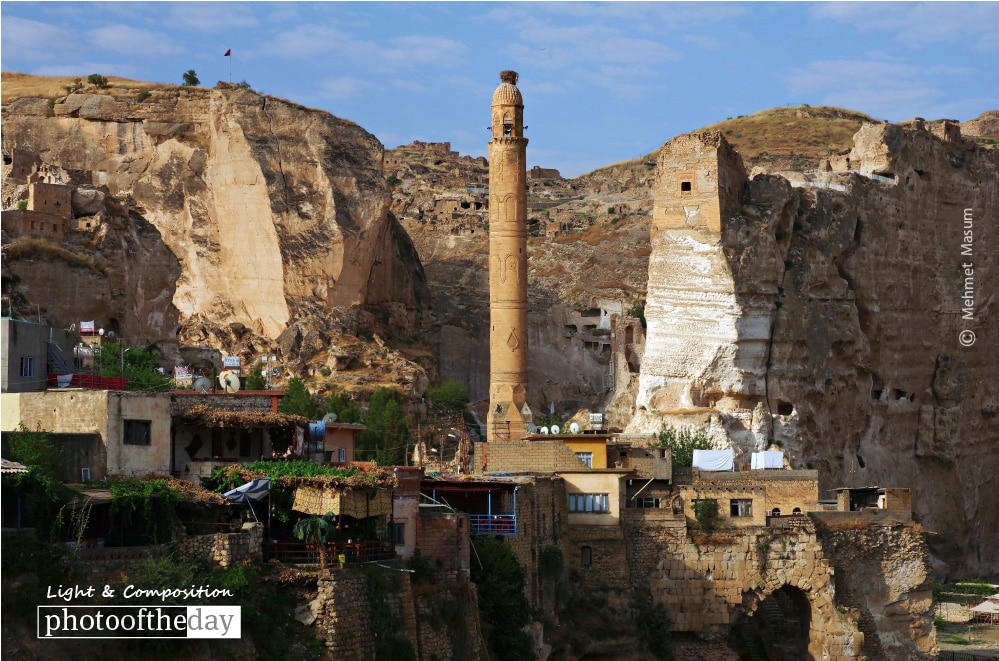
Captured with a keen eye for historical preservation, this photograph documents the ancient town of Hasankeyf in Turkey’s Batman Province. The image serves as a poignant visual record of a site threatened by the Ilisu Dam project, highlighting the cultural and historical significance of its ancient caves and structures. By utilizing a 50mm focal length, the photographer frames the town with clarity and purpose, emphasizing the architectural textures against the landscape. This work is award-worthy for its powerful fusion of documentary journalism and artistic composition, effectively drawing global attention to the urgent environmental and historical stakes facing this irreplaceable heritage site.
Mehmet Masum
Based in Diyarbakir, Turkey, Mehmet Masum Suer is a distinguished documentary photographer and former journalist with a career spanning several decades. His work focuses on the intersection of history, culture, and language, often documenting the architectural heritage of cities like Mardin, Van, and Hasankeyf. An internationally recognized artist with the AFIAP distinction, Suer has exhibited his photography across the globe and earned accolades from the PSA and FIAP. His commitment to preserving cultural narratives through his lens has solidified his reputation as a vital voice in contemporary documentary photography.
Resonance Score Breakdown
Transparency Note: The resonance score (10.8/20) is calculated based on social engagement metrics collected before the award announcement.
Expert Photography Reviews · 5
The Weight of What Remains
I spent this morning clearing out a box of old letters I had tucked away in the back of my closet. Some were from people I barely remember, others from friends who have long since drifted into different lives. Holding those pieces of paper, I felt a strange, heavy ache.
Read the reflection →The Weight of Stone
I keep a small, smooth river stone on my desk, worn perfectly round by water that stopped flowing long ago. It is heavy for its size, a dense anchor of earth that feels like it has witnessed centuries of silence.
Read the reflection →Reviews & Comments
Share your thoughts about this award-winning photograph. Your reviews contribute to the community engagement score.
Hasankeyf’s stone caves look fragile under this harsh, flat light. I feel a sharp, hollow ache looking at these ruins, knowing they’re destined for submersion. But does Masum’s framing capture the people living here, or just the architecture? Why treat this history as a static museum piece rather than a living, breathing community? It’s technically sharp, sure, but it feels like a postcard for a tragedy we’ve already decided to ignore. Whose heritage are we actually saving?
Most entries in this category rely on sentimental framing, but this shot avoids that trap. By choosing a 50mm focal length, Masum forces us to confront the crumbling stone face-to-face rather than from a distance. It’s the raw, tactile weight of the caves that hits me—I can almost feel the dust. It’s not just a record of a town; it’s a document of an impending silence. In thirty years, this clarity will be its greatest virtue.
It’s haunting to see Hasankeyf’s caves framed with such precision, knowing the rising water will soon erase them. I’ve spent enough time in the field to recognize when a landscape is being mourned rather than just exploited. While I usually demand the presence of a living subject, the silence here feels heavy, almost like the breath of an animal waiting for an end. It’s a rare, somber restraint that makes me ache for what’s lost.
It’s technically competent, sure, but that’s precisely the problem. By opting for f/10 and a standard shutter speed, Masum has rendered Hasankeyf with a clinical, almost archival detachment. I’m left craving a trace of the town’s impending erasure—perhaps a long-exposure ghosting or a deliberate motion blur to capture the fragility of its history. Why resolve every stone so perfectly? It’s a missed opportunity to let the medium’s inherent instability mirror the site’s tragic, shifting reality.
The ochre of these limestone cliffs, parched and brittle like a Morandi still life, bleeds into the bruised, dusty violet of a dying afternoon, and it’s here that I feel a sudden, sharp ache for what’s vanishing. One finds the palette isn’t merely descriptive; it’s a lament, where the sun-bleached stone quarrels with the encroaching shadows, creating a chromatic tension that’s far more devastating than any mere documentary record could ever hope to be.