Is Anybody There? by Ryszard Wierzbicki
Captured in the quiet village of Nong Khiaw, Laos, this poignant image features a young girl peering curiously into a classroom. Ryszard Wierzbicki masterfully utilizes a long focal length to isolate the subject, creating an intimate connection between the viewer and the child’s inquisitive gaze. The photograph captures the serene, rustic charm of northern Laos, highlighting the simplicity of village life. Its award-worthy quality lies in the delicate balance of light and composition, which transforms a fleeting moment of childhood curiosity into a powerful narrative about the universal human experience and the quiet beauty found in remote corners of the world.
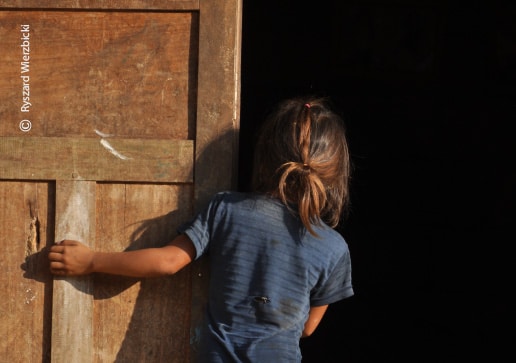
Exposure 1/500sec @ f/5.6 | ISO 200 | Focal Length 164.7mm
Ryszard Wierzbicki
Born in Poland in 1963, Ryszard Wierzbicki transitioned from a diverse career in social sciences and marketing to become a dedicated traveler and photographer. After emigrating to the United Kingdom in 2006, he shifted his focus toward exploring South-East Asia, often volunteering with charitable organizations supporting orphans. His work is deeply informed by his passion for cultural exploration and his background in education, leading him to establish multiple online forums for travelers and photographers. Today, he channels his experiences into evocative photography that documents the human spirit across the globe.
Resonance Score Breakdown
Transparency Note: The resonance score (12.0/20) is calculated based on social engagement metrics collected before the award announcement.
Expert Photography Reviews · 7
The Threshold of Knowing
I keep a small, rusted skeleton key in a velvet pouch, though I have long since forgotten which door it once opened. It is a heavy, cold weight in my palm, a physical reminder of a space I can no longer enter.
Read the reflection →The Threshold of Knowing
In the dense understory of a forest, a sapling often remains in a state of arrested development, waiting for a gap in the canopy to open.
Read the reflection →Reviews & Comments
Share your thoughts about this award-winning photograph. Your reviews contribute to the community engagement score.

Most travel photography relies on the exotic to do the heavy lifting, but Wierzbicki avoids that trap. By using the 164mm compression to flatten the classroom threshold, he forces us to confront the girl’s eyes directly. It’s a quiet, piercing stare that makes me feel like an intruder. I’ve seen thousands of portraits, yet this one sticks because it captures a specific, fleeting hunger for knowledge. In thirty years, that look will still be hauntingly relevant.
At 164.7mm, the compression of the focal plane isolates the girl with surgical precision. The f/5.6 aperture renders the background bokeh as a soft, atmospheric wash, preventing diffraction from muddying the textures of the wooden slats. I’m genuinely moved by how the lens resolves the fine, stray hairs against the shadowed interior. It’s a rare moment where the optics don’t just capture light; they hold the fragile, fleeting curiosity of a human soul.
The frame’s geometry relies on the verticality of the doorframe to anchor the subject. It’s a rigid architecture that forces the eye toward the girl’s gaze. The negative space surrounding her head provides necessary breathing room, preventing the composition from collapsing into sentimentality. I’ve grown weary of such predictable framing, yet the tension here holds. The spatial weight is distributed with enough precision to justify the shot. It’s structurally sound, even if the subject matter remains slight.
The darkness framing that classroom door isn’t merely an absence; it’s a threshold. Wierzbicki’s lens forces the girl into a claustrophobic brilliance, yet I’m haunted by what stays hidden in the periphery. It’s unsettling. Like a Caravaggio painting, the shadows here aren’t empty—they’re waiting. I feel a sudden, sharp ache for the secrets she’s peering toward. When a photographer fears the dark, they lose the soul. Thankfully, this child doesn’t look afraid of the void.
The shutter clicks, and the world stops. That girl’s gaze isn’t just curiosity; it’s the exact second before a scene shifts. The long lens compresses the space, pulling her right into our line of sight. It’s a tight, perfect close-up. I’ve spent years watching for this kind of stillness. It’s the frame the editor keeps because it holds the weight of the entire story. Honestly, it makes me miss the quiet of the cutting room.
A sliver of wood. A face. The rest is shadow and wood grain. I’ve spent minutes watching her eyes. They don’t search for us. They search for something beyond the frame. It’s a quiet tension. The wall isn’t just a barrier; it’s a breath held in the heat of Laos. Nothing here is accidental. The empty corner is not empty. It’s the weight of what she isn’t seeing. I feel a sudden, sharp ache for that stillness.
You waited for that look, didn’t you? It’s that specific, wide-eyed hesitation that hits me right in the chest. I’ve spent enough time in classrooms like that to know that look isn’t just curiosity; it’s a bridge being built. You didn’t intrude. You just stood back with your lens and let her decide to meet you halfway. There’s something honest happening here. You caught a soul, not just a subject. That’s rare. Good work.