Childhood by Ryszard Wierzbicki
Captured in the remote village of Ngong Khiaw, Laos, this photograph documents a poignant moment of communal responsibility among local children. During a visit in December 2012, the photographer observed how older siblings actively participate in the upbringing of their younger brothers and sisters, a dynamic central to the village's social fabric. By utilizing a 100.8mm focal length, the photographer isolates the subjects against their environment, emphasizing the tender, protective bond between them. The image is award-worthy for its authentic storytelling and its ability to capture the universal essence of childhood through a culturally specific lens.
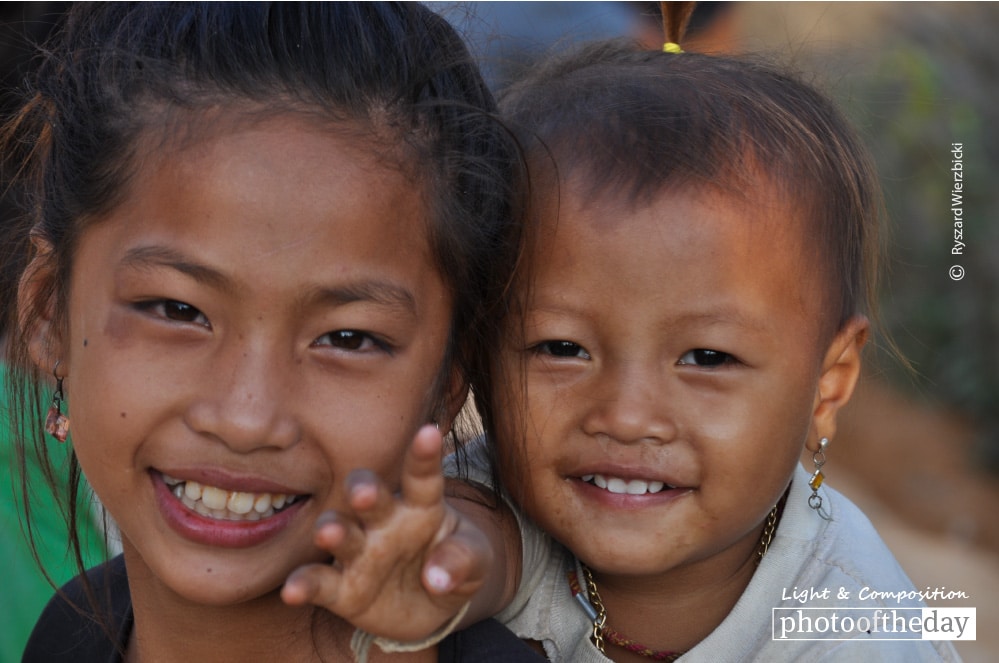
Exposure 1/250sec @ f/8.0 | ISO 200 | Focal Length 100.8mm
Ryszard Wierzbicki
Born in 1963, Ryszard Wierzbicki is a Polish-born photographer and educator currently based in Swindon, United Kingdom. With a background in social sciences and child care, he transitioned from a corporate career to a life dedicated to travel, scuba diving, and photography after emigrating to the UK in 2006. His work is deeply influenced by his exploration of South-East Asia and his volunteer efforts with organizations supporting orphans. As a founder of travel and photography forums, he focuses on documenting the human experience with a compassionate, observational eye.
Resonance Score Breakdown
Transparency Note: The resonance score (12.6/20) is calculated based on social engagement metrics collected before the award announcement.
Expert Photography Reviews · 8
The Weight of Small Hands
To be small is to be constantly measured against the world. We are handed burdens before we have the strength to carry them, and we learn, quite early, that the hand held in ours is the only thing keeping us from drifting away. It is a quiet contract.
Read the reflection →The Weight of Small Hands
I was at the park this morning when I saw a little girl, no older than six, carefully adjusting her brother’s jacket. He was wiggling, impatient to get back to the slide, but she held his shoulders with such steady, quiet authority.
Read the reflection →Reviews & Comments
Share your thoughts about this award-winning photograph. Your reviews contribute to the community engagement score.
The timber slats behind these children create a rhythmic datum, a fragile screen that defines the threshold between domestic interior and the village beyond. It’s a raw, tectonic honesty. By compressing the depth with a long lens, Wierzbicki flattens the space, yet the way light bleeds through those gaps reveals the structure’s porous nature. It’s haunting. I’ve spent years studying grand monuments, but this humble, light-drenched wall feels more like home than any cathedral I’ve visited.
Does this tender gaze belong to the children, or is it a projection of our own romanticized longing? Wierzbicki isolates these siblings in Ngong Khiaw, yet I can’t help but feel uneasy about the distance his lens enforces. Why must we aestheticize their communal labor as a universal truth? It’s a beautiful composition, sure, but does it strip away their agency to satisfy our hunger for the exotic? I find myself wanting more context, less performance.
1/250sec at f/8.0, 100.8mm. It’s a safe, clinical choice. Stopping down to f/8 on a crop sensor Nikon D5000 ensures the subjects remain sharp, but it flattens the background into a distracting, busy texture. I’d have preferred a wider aperture to isolate them further. Still, the shutter speed is sufficient to freeze the movement. It’s technically sound, though I find the lack of depth separation frustrating. It’s a competent capture, if a bit rigid.
The light in Ngong Khiew doesn’t rush. It’s soft, diffused by the mountain air, wrapping these children in a quiet, protective glow. I’ve spent enough mornings waiting for such stillness to know the photographer didn’t just take this; he waited for the village to breathe. Watching the older child’s steady hands, I feel a sudden, sharp ache for the simplicity of that bond. It’s a rare, holy silence captured in the cooling hour.
You waited for that look, didn’t you? It’s not just a shot of kids in Laos; it’s the weight of responsibility resting on those small shoulders. I’ve spent enough time in remote corners to know that look isn’t staged. It’s heavy, and it’s real. Because you held your ground, I can feel the protective tension in their hands. You didn’t just document a village; you caught a human truth. That’s good work, colleague.
The subjects form a tight, isosceles triangle that anchors the frame’s lower-left quadrant. By compressing the depth with a 100.8mm lens, Wierzbicki creates a rigid vertical axis between the older child’s gaze and the infant’s posture. It’s a beautifully solved spatial equation where the negative space above balances the dense, dark mass of the figures. I’m genuinely moved by how the geometry forces a focus on that protective, circular embrace. It’s perfect structural harmony.
In the quiet hills of Ngong Khiew, we see a heavy responsibility resting on small shoulders. It’s not just a child carrying a child; it’s a lineage of care. I’ve watched many portraits, but this one makes my chest ache with its gentle gravity. Ryszard didn’t just look; he listened to the rhythm of their bond. We see the weight of the world held in such tender, tiny arms. It’s a photograph that asks to be returned to.
Of the thousands of travel shots I’ve reviewed, most rely on exoticism to hide a lack of soul. This one survives because of the older child’s grip. It’s not just a pose; it’s a visceral, protective tension in the fingers that anchors the frame. I’ve looked at this for years, and that small, calloused hand still makes my chest ache. It’s a quiet, enduring document of human duty that transcends the village of Ngong Khiaw.