Migration by Martin Meyer
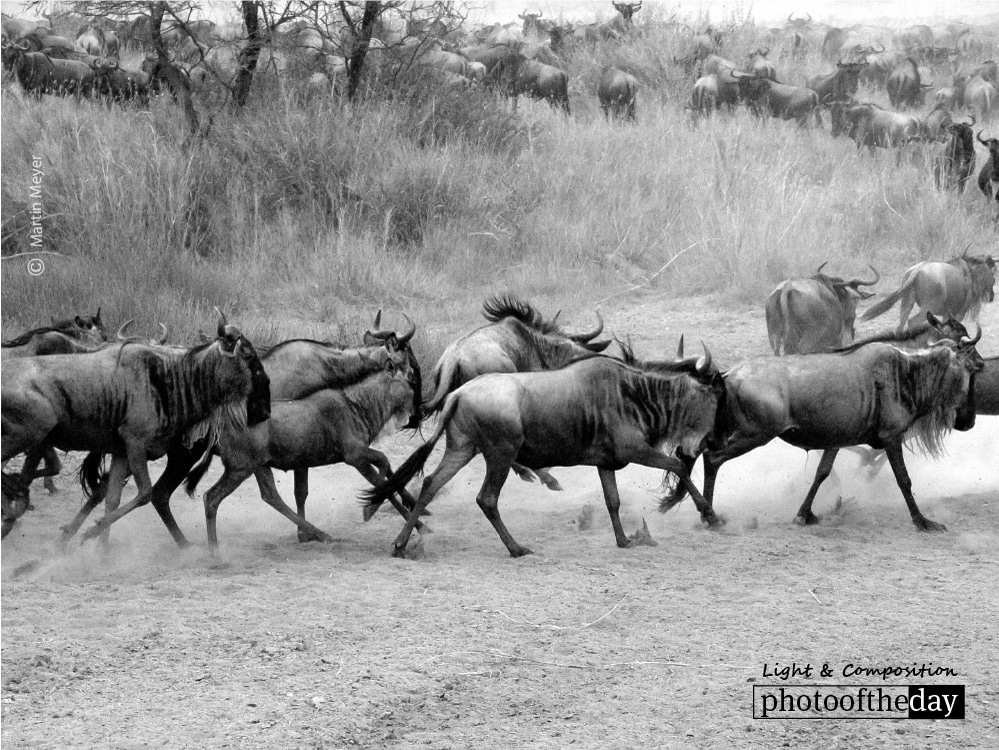
Captured along the Seronera River, this photograph documents the vast, awe-inspiring scale of the great wildebeest migration across the northern Serengeti plains. The photographer utilized the natural movement of the herds to frame a scene that stretches toward the horizon, emphasizing the sheer density and rhythmic motion of the wildlife. This image is award-worthy for its masterful composition, which manages to distill the chaotic energy of the migration into a cohesive, breathtaking narrative of survival and natural beauty, highlighting the photographer’s deep connection to the rhythms of the African wilderness.
Martin Meyer
Based in Cape Town, South Africa, Martin Meyer is a highly experienced field guide and photographer who has spent years documenting the natural wonders of Southern and East Africa. Alongside his partner Nicole, he operates a multi-faceted safari and photography business that emphasizes a global perspective on local wildlife. With his background as a qualified DEAT/FGASA guide and emergency responder, Meyer combines technical expertise with a profound knowledge of natural history, allowing him to capture intimate and expansive moments in the wild that define his unique photographic style.
Resonance Score Breakdown
Transparency Note: The resonance score (12.0/20) is calculated based on social engagement metrics collected before the award announcement.
Expert Photography Reviews · 8
The Rhythm of Moving On
I spent an hour this morning watching a line of ants cross my kitchen floor. They were so focused, each one following the path of the one before it without a single hesitation.
Read the reflection →The Rhythm of the Unending
There is a quiet, terrifying persistence in the way water carves a canyon, or in the way a clock ticks when the house is otherwise silent.
Read the reflection →Reviews & Comments
Share your thoughts about this award-winning photograph. Your reviews contribute to the community engagement score.
A river of dust. Thousands of hooves, yet the frame feels heavy with stillness. I’ve spent hours looking at the horizon line here. It’s not the density that catches me; it’s the vast, pale sky above the herd. It pulls the breath from my lungs. Nothing here is accidental. The empty corner is not empty. It’s a pause. A quiet breath before the next step. I find it difficult to look away.
The Serengeti isn’t a building, yet Meyer captures a structural rhythm here that architects often fail to achieve. The migration acts as a living datum, a shifting mass that defines the void of the plains. I’m struck by how the light rakes across the dust, turning the herd into a textured facade. It’s a chaotic, temporal threshold. I find myself wanting to walk into that frame, feeling the sheer weight of the space itself.
f/8 at 400mm, 1/1000s, ISO 400. A tight compression of the Serengeti. The choice of 400mm flattens the herd, turning individual wildebeest into a rhythmic, repeating texture. It’s a calculated risk that pays off. The shutter speed is sufficient to freeze the motion without introducing noise. I’ve spent years looking at these migrations, and frankly, the sheer mathematical density here makes my pulse quicken. It’s a cold, precise execution of a chaotic subject. Correct.
The Serengeti looks like a stage set here, scrubbed clean of the messy, brutal reality of displacement. Why does the frame flatten these thousands of lives into a rhythmic, aesthetic pattern? It’s a beautiful composition, sure, but it feels like a postcard from a wilderness that doesn’t belong to us. I’m left cold by the distance. Whose gaze are we borrowing to consume this migration? Does the herd exist only to satisfy our hunger for spectacle?
The Serengeti’s dust isn’t merely brown; it’s the parched, ochre-dusted umber of a Morandi still life, vibrating against the pale, bleached-bone sky. It’s a rhythmic, monochromatic ache that I find utterly devastating. One watches these wildebeest dissolve into a haze of sepia and charcoal, their forms blurring into a singular, shifting tide of earth-tones. It’s a haunting, chromatic symphony of survival, and honestly, the sheer, suffocating density of that palette leaves me breathless.
You’ve captured the sheer, crushing weight of survival here. It’s not just a herd; it’s a living, breathing tide. I’ve stood in places like this, and the dust usually chokes the life out of a frame, but you let the rhythm breathe. And honestly, looking at the way those bodies blur into the horizon, I felt a sudden, sharp ache in my chest. You waited for the pulse of the earth. That’s rare. Good work.
Of the thousands of migration shots I’ve reviewed, most are just noise. What separates this is the deliberate compression of the herd against the riverbank. It’s not just chaos; it’s a rhythmic, claustrophobic density that makes my own pulse quicken. I’m glad this exists because it captures the sheer, terrifying weight of survival. It doesn’t just show animals moving; it forces you to feel the ground shaking beneath them. That’s why it endures.
The rhythmic density here recalls the repetitive, almost abstract patterns found in Eadweard Muybridge’s motion studies, yet it’s grounded in the sweeping, epic scale of Peter Beard’s Serengeti journals. It’s a familiar subject, but the way the dust obscures the horizon line creates a haunting, painterly depth I haven’t seen in years. I’m genuinely breathless at how the herd’s chaotic movement resolves into such elegant, monochromatic geometry. It’s a rare, visceral dialogue with the past.