Snow Day by Des Brownlie
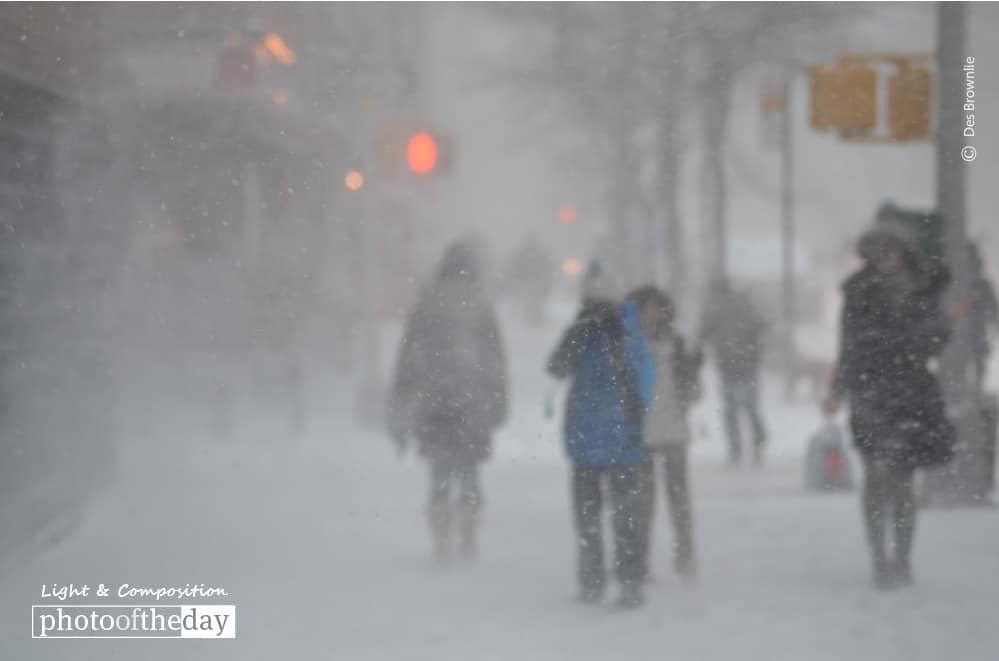
Captured amidst the swirling winds of a Manhattan snowstorm, this image masterfully conveys the visceral experience of a winter day in the city. The photographer utilized the challenging conditions to emphasize the raw, blinding nature of the snowfall, focusing on the difficulty of visibility and the atmospheric intensity of the environment. By positioning the camera to face the elements, the photographer successfully translated the sensation of snow blowing directly into the viewer's path. This evocative street photograph stands out for its ability to transform a common urban weather event into a compelling, immersive narrative of life in New York.
Des Brownlie
Originally hailing from Glasgow, Scotland, Des Brownlie relocated to New York City nearly two decades ago and has since become a dedicated observer of the urban landscape. Based in Manhattan, he maintains a constant readiness to document the city's diverse subjects, finding beauty in both the ordinary and the extraordinary moments that define daily life. His work reflects a deep appreciation for the vibrant color and endless variety found within the streets of New York, where he treats every excursion as a potential photographic opportunity.
Resonance Score Breakdown
Transparency Note: The resonance score (12.0/20) is calculated based on social engagement metrics collected before the award announcement.
Expert Photography Reviews · 7
The White Silence
Winter has a way of erasing the edges of the world. When the sky descends in a flurry of white, the sharp corners of our daily lives—the brick, the iron, the relentless pace of the pavement—are softened into something ghost-like and quiet.
Read the reflection →The Silence of the Storm
I remember a Tuesday in January when the city simply stopped breathing. I was standing on a corner in Brooklyn, watching the flakes grow so thick they erased the skyline, turning the familiar brick buildings into ghosts of themselves.
Read the reflection →Reviews & Comments
Share your thoughts about this award-winning photograph. Your reviews contribute to the community engagement score.
It’s the suffocating, bruised grey of a Turner storm that catches one’s breath, a monochromatic descent where the white of the snow isn’t merely light, but a tactile, freezing shroud. I’m utterly haunted by how the palette drains the city of its warmth, leaving only the ghost of Hudson Street. It’s a Morandi-esque study in desaturated melancholy, where the atmosphere doesn’t just surround the subject; it consumes the very possibility of colour itself.
The city isn’t just a backdrop here; it’s a living, breathing entity. Brownlie stood in the biting cold, letting the Hudson Street gale dictate the frame. I feel a shiver just looking at those swirling, opaque curtains of white. It’s rare to find such stillness in a storm, but he’s listened to the wind’s rhythm. He didn’t force the shot. He waited until the chaos became a prayer, and honestly, it’s hauntingly beautiful.
You stood in that biting Hudson Street wind until your hands went numb, didn’t you? I can feel the grit of the slush and that frantic, blinding cold. It’s not just a weather shot; it’s the isolation of a city trying to keep moving while the sky falls apart. I’ve been there, shivering behind a lens, waiting for the world to blur. You caught the exact moment the city stopped pretending. That’s real.
The blizzard’s white-out on Hudson Street echoes the stark, high-contrast grit of early Weegee, yet it lacks his voyeuristic bite. It’s a familiar urban trope, reminiscent of Stieglitz’s The Terminal, but without that seminal work’s structural rigor. I’ve spent decades tracking these weather-beaten frames, and frankly, the D5100’s sensor struggles with the highlights here. Still, that sudden, blinding opacity caught me off guard—it’s a visceral, shivering reminder of why we keep braving the cold.
Whiteout. Hudson Street dissolves into a single, muted tone. It’s not just weather; it’s a deliberate erasure. Brownlie lets the storm do the work, stripping away the city’s noise until only the cold remains. I feel a sudden, sharp shiver looking at this. The empty corner is not empty. It’s a pause. A breath held in the biting wind. Nothing here is accidental. It’s the quietest New York I’ve ever seen.
The diffraction of light through these suspended ice crystals creates a chaotic, prismatic scattering that pushes the Nikon’s sensor to its limits. It’s a brutal exercise in managing the focal plane amidst high-frequency noise. I’m genuinely moved by how the lens resolves those individual flakes against the dark Hudson Street geometry. It doesn’t just capture a storm; it forces the eye to reconcile the physics of light with the raw, biting cold of a Manhattan winter.
Hudson Street’s geometry dissolves into a chaotic white blur. The frame’s architecture relies on the verticality of the street lamps to anchor the shifting, atmospheric mass. It’s a precarious balance. The negative space doesn’t just surround; it consumes the subject. I’m genuinely unsettled by how the composition threatens to collapse under the weight of the snow. It’s a rigorous, cold exercise in visual erasure. The structure holds, but only by the narrowest of margins.