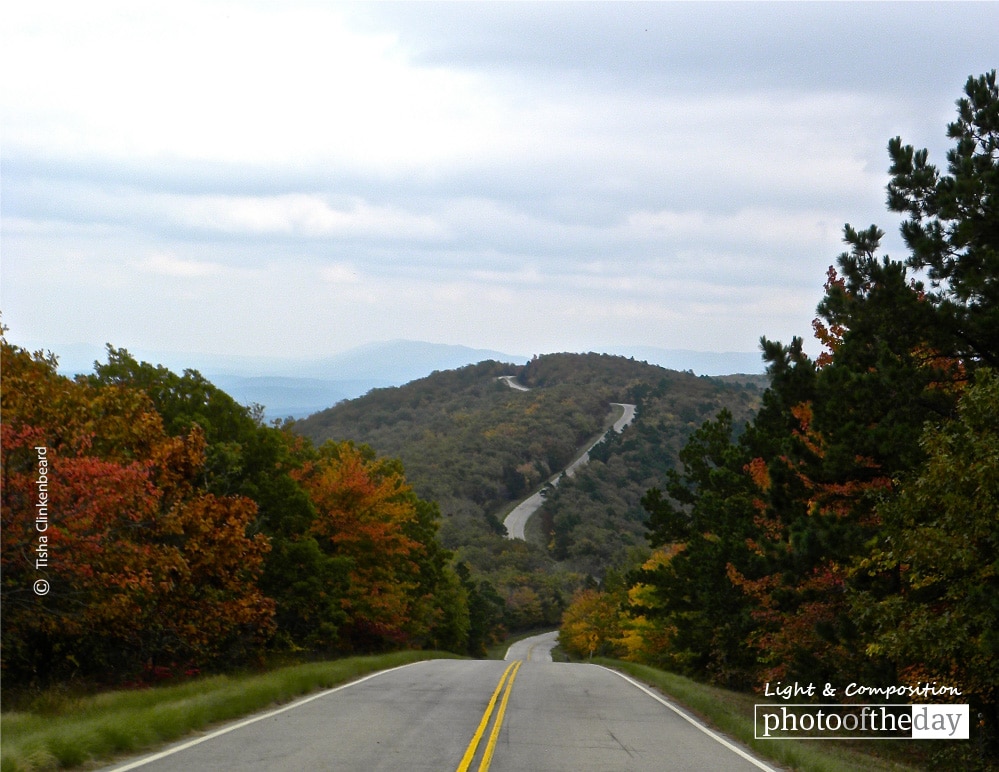
Talimena Drive in the Fall by Tisha Clinkenbeard
Captured along the breathtaking 54-mile National Scenic Byway, this photograph documents the vibrant transformation of the Winding Stair Mountains during peak autumn. As the photographer traversed the route between Talihina and Mena by motorcycle, the winding road offered a dramatic perspective of the landscape draped in seasonal color. The image succeeds by framing the rhythmic curves of the highway against the expansive, forested horizon, effectively conveying the sense of freedom and discovery inherent in a cross-country journey. Its award-worthy quality lies in the harmonious balance between the man-made path and the untamed, golden beauty of the American wilderness.
Tisha Clinkenbeard
Based in Powderly, Texas, Tisha Clinkenbeard is a dedicated photographer whose work explores the beauty found in everyday wanderings. Her artistic journey, which began long before the advent of modern digital technology, has led to exhibitions at prestigious venues such as The Fine Arts Center of Hot Springs and Portland’s Black Box Gallery. Through her blog, Found Round & About, she shares a curated perspective of the world, balancing her time between regional fine art shows and national publications like Birds & Blooms.
Resonance Score Breakdown
Transparency Note: The resonance score (12.0/20) is calculated based on social engagement metrics collected before the award announcement.
Expert Photography Reviews · 6
The Road That Remains
We are always moving toward something. A destination, a border, a change in the weather. We pack our bags and we leave, convinced that the act of going is the same as arriving.
Read the reflection →The Architecture of Letting Go
Autumn is the season when the earth finally admits that holding on is a form of exhaustion. We watch the trees perform their slow, deliberate surrender, turning their grief into gold and letting it drift toward the roots.
Read the reflection →Reviews & Comments
Share your thoughts about this award-winning photograph. Your reviews contribute to the community engagement score.

Most landscape shots of Talimena Drive are just postcards, but this one captures the specific, lonely ache of a motorcycle ride. The way the asphalt curves into the golden canopy forces your eye to follow the road’s momentum rather than just the foliage. It’s the tension between the machine and the mountain that makes me miss the open road. It’s not perfect, but it’s a rare, honest slice of American transit that’ll still matter in thirty years.
The jury’s obsession with clarity here feels stifling. By freezing the Talimena Drive in such clinical detail, Tisha’s lost the kinetic thrill of the motorcycle ride. I’d have preferred a smear of autumn gold, something closer to Sugimoto’s long-exposure theatres than this static postcard. Why resolve every leaf when the road’s rhythm demands a blur? It’s technically competent, sure, but I’m bored. I crave the friction of a lens that dares to lose its way.
The asphalt curves, a dark ribbon through the gold. It’s a quiet descent. I find myself holding my breath, waiting for the engine to cut out. The trees crowd the frame, yet the sky remains. It’s the distance that pulls me in. Nothing here is accidental. The empty corner is not empty. It’s the weight of the road ending. I’ve never felt such stillness in a mountain pass. It’s enough.
The road curves, a ribbon of asphalt surrendering to the Winding Stair Mountains. Tisha didn’t just ride through; she waited for the trees to ignite. I feel a sudden, sharp ache in my chest looking at those golden slopes—it’s the quiet hum of autumn’s departure. She stood here as the light softened, listening to the hills breathe. It’s a rare, fleeting grace, catching the wilderness just before it slips into the long, cold sleep of winter.
The road cuts through the frame like a tracking shot that refuses to end. It’s the rhythm of the asphalt against the chaotic, golden sprawl of the Winding Stair Mountains. I can almost feel the wind hitting my chest on that motorcycle. The composition holds because it doesn’t try to capture everything; it leaves the rest to the horizon. It’s a perfect edit. I’d keep this frame forever. It’s the moment the journey finally finds its focus.
The rhythmic serpentine of the asphalt echoes the topographical studies of Timothy O’Sullivan, yet here, the road serves as a modern intrusion rather than a survey tool. It’s a familiar trope of the American road trip, reminiscent of Robert Frank’s restless lens, though lacking his grit. I’m genuinely struck by the chromatic intensity of the canopy; it’s a vibrant, almost aggressive saturation that pushes against the traditional, muted palettes of the 19th-century landscape tradition.