Tiny Footprints by Tisha Clinkenbeard
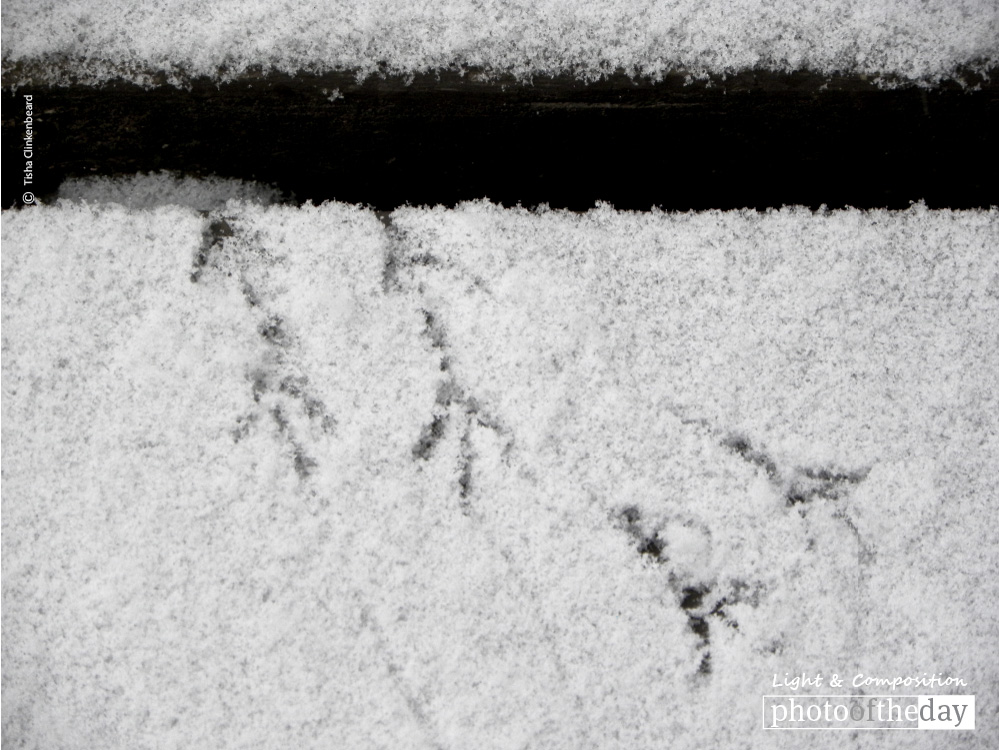
On a quiet, snowy day in Gentry, Arkansas, the photographer observed birds landing on the deck of a cabin. The scene captured a fleeting, delicate moment: tiny, intricate footprints left by birds as they traversed the fresh, white snow. By focusing on these subtle marks, the photographer highlights the beauty in the overlooked details of nature. This image is award-worthy for its minimalist composition and the way it transforms a simple, everyday occurrence into a poignant narrative about the quiet, transient presence of wildlife in a winter landscape.
Tisha Clinkenbeard
Based in Powderly, Texas, Tisha Clinkenbeard is an accomplished photographer whose work has been featured in prestigious venues such as The Fine Arts Center of Hot Springs and the Black Box Gallery in Portland. With a passion for documenting the world around her, she seeks to share the beauty she discovers during her travels, a philosophy reflected in her blog, Found Round & About. Her evocative nature photography has garnered recognition, including features in the Birds & Blooms newsletter, highlighting her keen eye for the natural world.
Resonance Score Breakdown
Transparency Note: The resonance score (12.1/20) is calculated based on social engagement metrics collected before the award announcement.
Expert Photography Reviews · 6
The Weight of Passing
There is a specific, hollow ache in seeing the place where a body has been, only to find the body gone.
Read the reflection →Evidence of a Passing
I remember walking through the woods behind my grandfather’s house in Shropshire after the first heavy frost of the year. The ground was a blank slate, silent and unforgiving. I spent an hour trying to track a fox, but the earth was too hard to hold a print.
Read the reflection →Reviews & Comments
Share your thoughts about this award-winning photograph. Your reviews contribute to the community engagement score.

We look at these tiny, frantic marks in the snow and we aren’t just seeing birds; we’re seeing a conversation between the earth and the traveler. It’s a portrait of a presence that didn’t stay long enough to be named. I find myself holding my breath, fearing I’ll smudge the silence. It’s a quiet, fleeting story of existence. I love how it reminds us that even the smallest life leaves a path worth following.
The focal plane here is razor-thin, capturing the crystalline structure of the snow where the bird’s weight compressed the ice. I’m genuinely moved by how the lens resolves those microscopic fractures; it’s a masterclass in managing the diffraction limit. The bokeh, a function of a wide aperture, renders the background into a soft, monochromatic void. It’s rare to see such precise optical clarity applied to something so fleeting. It’s truly a beautiful, cold, scientific marvel.
You waited for the birds to leave, didn’t you? Most people would’ve chased the shot, but you let the silence settle. I’m looking at these tracks in the Gentry snow and it’s quiet enough to hear my own pulse. Because you didn’t force the frame, the absence of the birds feels heavier than their presence. It’s a lonely, beautiful trace of life. You felt the stillness, and I can feel it too. That’s rare.
White expanse. A sudden, rhythmic puncture. The snow doesn’t just hold the weight of the birds; it holds their departure. I’ve spent minutes staring at these tiny indentations. They’re ghosts of a movement I missed. It’s quiet here. The frame isn’t empty, yet it breathes. Nothing here is accidental. The empty corner is not empty. It’s a pause. I feel a strange, cold ache in my chest looking at it. A beautiful, fleeting trace.
The frame functions as a stark, white void, interrupted only by the rhythmic, jagged geometry of avian tracks. It’s a study in negative space that succeeds through sheer restraint. The diagonal trajectory of the prints creates a necessary tension across the picture plane, preventing the composition from collapsing into mere sentiment. I’ve rarely seen such discipline in a winter landscape. The structural weight is perfectly balanced. It doesn’t need a subject; the architecture is enough.
f/5.6 at 100mm, 1/250s, ISO 400. The focal length isolates the tracks, but the aperture choice is lazy. It’s a shallow plane that barely holds the texture of the snow. I’ve seen enough soft-focus nature shots to know when a photographer is hiding behind a lack of depth. It’s technically thin. I’m actually annoyed by the missed opportunity for sharper crystalline detail. The settings don’t support the narrative. It’s a fragile argument, poorly constructed.