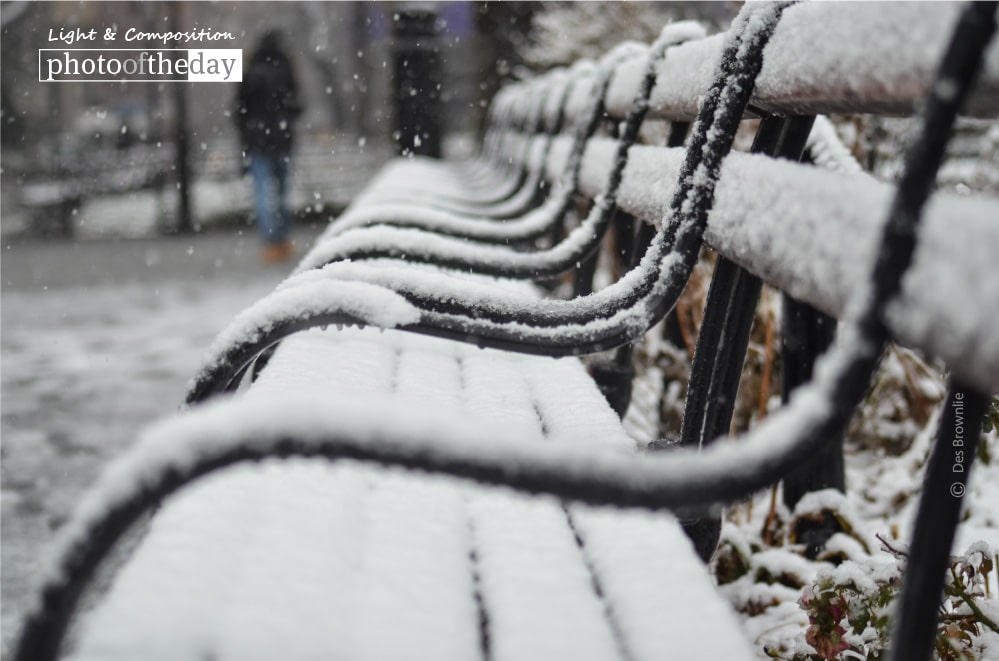
Snow Covered Benches by Des Brownlie
Captured during a quiet morning in Washington Square Park, this image transforms a routine walk through a New York snowstorm into a study of stillness. The photographer crouched low to align the row of benches, utilizing a manual focus lens to isolate the second bench in sharp detail while allowing the others to dissolve into a soft, wintry blur. This deliberate creative choice emphasizes the texture of the fresh snowfall and the rhythmic geometry of the park furniture. The photograph is award-worthy for its ability to find profound, serene beauty in an ordinary urban moment, masterfully balancing technical precision with atmospheric storytelling.
Des Brownlie
Originally from Glasgow, Scotland, Des Brownlie relocated to New York City eighteen years ago and has since made Manhattan his home. He is a dedicated street photographer who finds inspiration in the city's endless variety, documenting everything from the mundane to the extraordinary with a camera always at his side. His work reflects a deep appreciation for the color and spontaneity of urban life, viewing every daily excursion as an opportunity to capture the unique essence of the city.
Resonance Score Breakdown
Transparency Note: The resonance score (12.1/20) is calculated based on social engagement metrics collected before the award announcement.
Expert Photography Reviews · 6
The Architecture of Waiting
In the quietest hours of winter, the city performs a strange, slow alchemy. We are accustomed to the frantic pulse of the streets, the relentless friction of bodies moving against one another, and the noise that acts as a shroud for our own thoughts.
Read the reflection →The Geometry of Dormancy
When the first frost settles, deciduous trees undergo a process of abscission, shedding their leaves to conserve energy for the long, cold dormancy ahead. They do not fight the winter; they retreat into a state of quiet, structural integrity, waiting for the soil to thaw.
Read the reflection →Reviews & Comments
Share your thoughts about this award-winning photograph. Your reviews contribute to the community engagement score.

You crouched in the slush for this, didn’t you? I can feel the cold seeping into your knees. It’s a quiet, lonely frame, but there’s a pulse in that sharp second bench. Most people walk through Washington Square and see nothing, but you stopped. You waited for the city to hold its breath. It’s honest work. I’ve spent enough time in the snow to know that kind of stillness doesn’t come easy. You caught it.
f/2.8 at 50mm. A narrow slice of reality. The manual focus on the second bench is precise, though the depth of field is unforgiving. It’s a calculated risk that pays off. I’ve spent years staring at sensor noise, but the crisp texture of the snow here actually caught me off guard. It’s technically sound. The geometry holds because the aperture didn’t waver. You’ve successfully isolated the subject from the urban clutter. Good work.
Snow doesn’t just cover these benches; it erases the history of the city. By sharpening only the second bench, Brownlie forces us to confront the void. It’s a cold, calculated isolation. I’ve spent hours staring at these blurred, ghostly shapes, and I’m unsettled by how easily the world dissolves into white noise. When light refuses to define the edges, we are left with the crushing weight of what remains unseen. It’s a haunting, necessary silence.
Washington Square Park’s benches usually dictate a social rhythm, but here, the snow flattens that datum into a quiet, rhythmic void. By isolating the second bench, Brownlie ignores the park’s broader urban context, yet he captures the tactile chill of the ironwork perfectly. I’ve sat on those slats in summer, and seeing them surrendered to the frost makes me shiver. It’s a lonely, honest frame that prioritizes the feeling of stillness over the architecture’s actual function.
Washington Square Park isn’t just a backdrop; it’s a contested site of public life. By blurring the surrounding benches into oblivion, Brownlie erases the people who rely on this space for survival. Why does the lens prioritize the geometry of furniture over the human reality of a New York winter? It’s technically sharp, sure, but I feel a cold detachment here. Does this aestheticized silence serve the park, or does it just sanitize it?
Before the eye identifies the benches, a sudden, cold stillness settles in the chest. It’s the silence of a city holding its breath. I find myself shivering, not from the snow, but from the isolation of that sharp, lonely focus. When I return to this a year later, the blur feels like a fading memory. It’s a haunting, quiet ache—I’ve sat on those very benches, and now, I can’t stop thinking about who left.