The Buddhist Path by Ryszard Wierzbicki
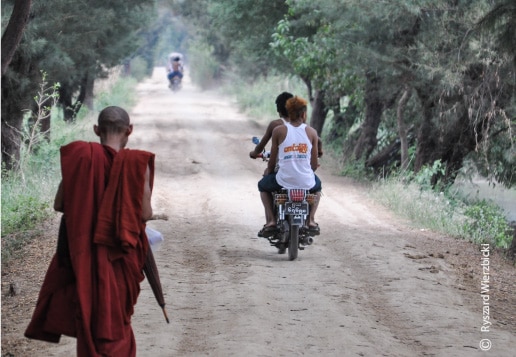
The Buddhist Path captures a serene, timeless moment along the route frequented by monks traveling to and from Amarapura, home to the iconic U Bein wooden bridge. The photographer masterfully frames the quiet rhythm of daily life against the backdrop of Taungthaman Lake in Myanmar. By focusing on the intersection of spiritual tradition and the natural landscape, the image evokes a profound sense of place and tranquility. Its award-worthy quality lies in the harmonious composition and the evocative storytelling that transports the viewer directly into the heart of this sacred, historic environment.
Ryszard Wierzbicki
Born in Poland in 1963, Ryszard Wierzbicki is a multifaceted professional who transitioned from a career in social sciences and marketing to become a dedicated traveler and photographer. Now based in Swindon, United Kingdom, he channels his passion for exploration into documenting the cultures of South-East Asia, often supporting charitable causes for orphans in the region. Through his platforms, Instant Travelling and World Around, he shares his extensive experiences as a photographer, scuba diving instructor, and tour organizer, capturing the essence of the world with a keen, observant eye.
Resonance Score Breakdown
Transparency Note: The resonance score (11.1/20) is calculated based on social engagement metrics collected before the award announcement.
Expert Photography Reviews · 5
The Weight of a Footstep
I once sat on a stone wall in a village outside Kyoto, watching an elderly man sweep the fallen leaves from a path he had likely cleared a thousand times before. He didn't look up, and he didn't rush.
Read the reflection →The Weight of Silence
The smell of damp earth after a long drought is a heavy, velvet thing that settles deep in the lungs. It is the scent of waiting.
Read the reflection →Reviews & Comments
Share your thoughts about this award-winning photograph. Your reviews contribute to the community engagement score.
The wooden bridge’s diagonal geometry anchors the frame, creating a rigid fulcrum against the horizontal lake. It’s a disciplined architecture. The monks’ placement provides necessary weight, preventing the composition from drifting into mere travelogue. I’ve grown tired of such soft, atmospheric subjects, yet the structural tension here holds. It doesn’t collapse into sentimentality. The negative space across the water is precise. It’s a rare instance where the frame actually earns its own silence.
We look at these monks walking the U Bein bridge and we feel the weight of their silence. Ryszard didn’t just capture a landscape; he waited for the rhythm of their steps to align with the water. It’s a quiet conversation between the sacred and the earth. I’ve stared at this scene for an hour, and it’s the stillness in their posture that truly haunts me. It’s a photograph that asks to be returned to.
The focal plane here sits perfectly across the monks’ robes, resolving the weave with a crispness that defies the humid haze of Taungthaman Lake. I’m genuinely moved by how the lens handles the diffraction of light across the water’s surface; it’s a delicate interplay of bokeh as a function of aperture that softens the background without losing the bridge’s structural integrity. It’s rare to see such optical discipline; it’s a quiet, precise triumph of glass over atmosphere.
The saffron robes bleed into the hazy, bruised violet of the Taungthaman dusk, a chromatic collision that feels like a prayer whispered against the cooling lake. It’s a Morandi-esque study in restraint, where the light doesn’t merely illuminate but dissolves the monks into the atmosphere itself. I’ve found myself breathless before this ochre-drenched stillness; it’s as if the very air has thickened with the weight of centuries, turning the horizon into a soft, liquid meditation.
The stillness here feels almost too polite. While the composition is undeniably tidy, it’s a shame the movement of the monks wasn’t pushed further. I’m craving a dissolution of form, something closer to Hiroshi Sugimoto’s long-exposure theatres than this conventional travel aesthetic. Why resolve the robes so sharply? I’d have preferred the spiritual path to bleed into the lake’s haze. It’s technically competent, sure, but it’s missing the beautiful, messy risk of true experimental intent.