Makeup by Ryszard Wierzbicki
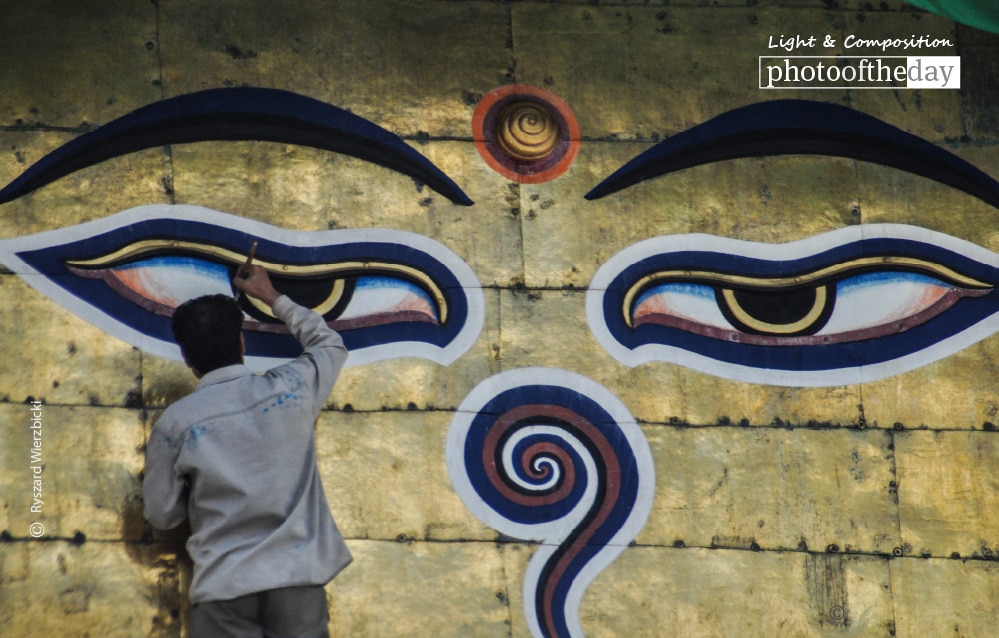
Captured at the iconic Boudhanath Stupa in Kathmandu, this image offers a poignant look at the maintenance of one of the world's most sacred sites. The photographer masterfully frames the juxtaposition of human labor against the eternal, watchful gaze of the Buddha’s eyes, which are painted onto the stupa. By focusing on the delicate process of applying makeup to these ancient symbols, the image highlights the intersection of spiritual devotion and physical preservation. It is an award-worthy piece that transforms a routine maintenance task into a profound narrative about cultural heritage and the enduring nature of faith in Nepal.
Ryszard Wierzbicki
Born in Poland in 1963, Ryszard Wierzbicki is a dedicated traveler and photographer currently based in Swindon, United Kingdom. After a diverse career in education and marketing, he transitioned into a life of exploration, focusing his lens on the vibrant cultures of South-East Asia. His work is deeply informed by his extensive travels and his commitment to humanitarian efforts, including volunteering with organizations supporting orphans in Thailand and Burma. Through his photography, Wierzbicki seeks to document the human experience and the architectural beauty of the world's most sacred locations.
Resonance Score Breakdown
Transparency Note: The resonance score (12.1/20) is calculated based on social engagement metrics collected before the award announcement.
Expert Photography Reviews · 8
The Painted Vigil
In the quiet hours of the morning, before the world fully wakes, there is a ritual of restoration that happens in the corners of our lives.
Read the reflection →The Infinite Gaze
If the divine were to blink, would the world simply cease to be? We spend our lives constructing monuments to the eternal, carving stone and painting symbols in the desperate hope that something of us might outlast the decay of our own skin.
Read the reflection →Reviews & Comments
Share your thoughts about this award-winning photograph. Your reviews contribute to the community engagement score.
The morning light here isn’t just illumination; it’s a conversation between the artisan and the divine. He stood on those scaffolding planks, feeling the weight of centuries beneath his feet as he traced the Buddha’s gaze. I’ve spent enough dawns waiting for the world to wake to recognize that quiet, focused breath. It’s a humble act of devotion. Watching him paint those eyes, I feel a sudden, sharp ache for the stillness he must have found.
The Buddha’s eyes aren’t merely painted; they’re being resurrected by a brush. I’m unsettled by the way the shadow clings to the scaffolding, turning the act of maintenance into a ritual of concealment. It’s not just paint; it’s a veil. When the light hits the pigment, it doesn’t reveal the divine, but the labor required to keep it from fading. I’ve never felt such a heavy, suffocating silence in a place meant for prayer.
We look at these painted eyes, wide and unblinking, and we feel the weight of centuries. Ryszard didn’t just capture a man painting a stupa; he listened to the rhythm of the brush. It’s a quiet dialogue between the mortal hand and the eternal gaze. I find myself holding my breath, watching that delicate touch. It’s a beautiful, humble act of devotion. This is a photograph that asks to be returned to, again and again.
Before the eye identifies the paint, something in the chest tightens. It’s the intimacy of the brush against that vast, unblinking gaze. I’ve returned to this frame three times today, and each time, the silence of the stupa settles into my own pulse. It’s a strange, quiet vertigo. Watching a human hand touch the divine feels like a secret. It doesn’t just document a ritual; it makes me feel the weight of keeping faith alive.
The crispness here feels almost apologetic. Why resolve the texture of the paint so clinically when the subject is the divine gaze? I’d have preferred a long-exposure blur, letting the worker’s motion bleed into the stillness of the Buddha’s eyes. It’s a missed opportunity to dissolve the boundary between the mortal and the eternal. I find myself craving a smudge, a fracture in the clarity, something that acknowledges the messy, human act of creation.
You’ve caught a quiet, heavy moment here. Watching that brush touch the Buddha’s eye, I felt a strange, sudden stillness in my own chest. It’s not just maintenance; it’s an act of intimacy between a man and his god. You didn’t rush the frame, and because you waited, the devotion feels real. It’s rare to see such a sacred connection captured without turning it into a spectacle. You were there, and I’m glad you were.
The eyes watch. A hand reaches. It’s a quiet labor against the stone. I’ve spent minutes staring at the white space around the paint. It’s not just plaster. It’s a breath held in the middle of a busy square. Nothing here is accidental. The empty corner is not empty. It’s the weight of devotion. I feel a sudden, sharp ache in my chest. Silence, finally, in the middle of Kathmandu. It’s enough.
Most travel shots of Boudhanath are just postcards, but this one catches the actual labor behind the holiness. I’ve seen thousands of stupa photos, yet this focus on the brush applying pigment to the Buddha’s eye feels intimate, almost intrusive. It’s the contrast between the worker’s mundane posture and that unblinking, painted gaze that makes me stop. It’s a quiet, fragile moment of preservation that will still matter in thirty years. It’s earned its place.