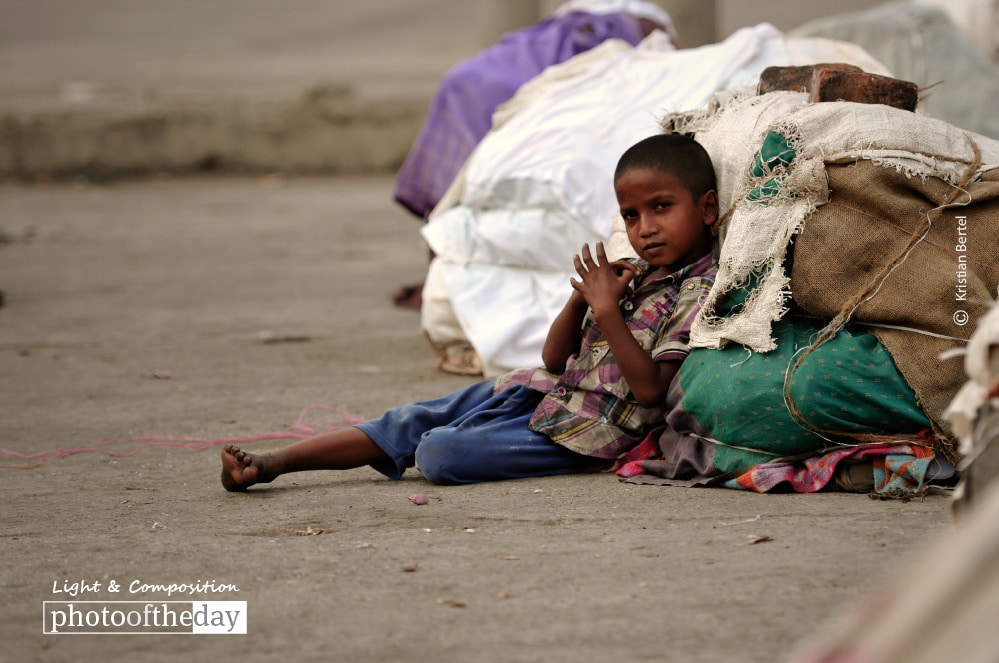
A Slum Boy in India by Kristian Bertel
In this poignant street portrait, Kristian Bertel captures the raw reality of life for a young boy living in the slums of Nashik, India. The image serves as a powerful testament to the human condition, highlighting the resilience of those residing in rapidly expanding urban settlements. By focusing on the individual rather than the statistics of poverty, Bertel invites the viewer into a moment of quiet contemplation. The photograph is award-worthy for its evocative storytelling and its ability to bridge the cultural gap, transforming a complex social issue into a deeply personal and empathetic visual narrative.
Kristian Bertel
Based in Aarhus, Denmark, Kristian Bertel has been dedicated to the art of photography since 2006. He is internationally recognized for his extensive, long-term documentation of India, where he focuses on the human experience, poverty, and the lives of street children. Through his travel and street photography, Bertel strives to weave compelling narratives that shed light on the social conditions of the people he encounters.
Resonance Score Breakdown
Transparency Note: The resonance score (12.8/20) is calculated based on social engagement metrics collected before the award announcement.
Expert Photography Reviews · 4
The Weight of a Glance
I was waiting for the bus this morning, watching a young boy on the sidewalk. He was playing with a loose thread on his sleeve, completely lost in the rhythm of it. He didn’t seem to care that his shoes were worn or that the wind was picking up.
Read the reflection →The Unwritten Map of Dust
We often mistake the surface of a thing for the whole of its history. We see the dust on a child’s cheek and think only of the road, forgetting that the road is also a cradle, a place where roots find purchase in the most unlikely of cracks.
Read the reflection →Reviews & Comments
Share your thoughts about this award-winning photograph. Your reviews contribute to the community engagement score.
The boy stands against a wall that’s more than just a backdrop; it’s a datum of survival. The light rakes across the rough, weathered texture, emphasizing the solid mass of his environment while the shadows soften the threshold between him and the void behind. It’s a harsh, claustrophobic geometry. I’m struck by how the frame omits the rest of the settlement, forcing us to confront the boy’s scale against this crumbling, unforgiving urban structure.
You didn’t just snap a portrait; you sat with him. I can see the dust of Nashik in his eyes, and it’s heavy. Most people would’ve looked away, but you stayed until he let his guard down. There’s a quiet ache in his expression that hits me right in the chest. Because you waited, the boy isn’t a statistic anymore. He’s a person. You felt something true here, and it shows. That’s rare work.
The boy’s gaze anchors the frame, creating a vertical axis that demands total attention. It’s a rigid, unforgiving geometry. The background’s chaotic textures threaten to bleed into the subject, yet the depth of field holds the plane with surprising discipline. I’ve rarely seen such stark spatial tension. It doesn’t rely on sentiment; it relies on the placement of mass. It’s cold, it’s precise, and frankly, the structural integrity of this composition is damn near perfect.
One wonders how many hours Bertel spent in the dust of Nashik before the boy stopped looking at the camera and started looking through it. It’s a rare, quiet intimacy that doesn’t come from a quick snap. I’ve spent enough afternoons shivering in the hills to know when someone’s put in the work. The boy’s gaze is heavy, earned, and frankly, it makes me feel a bit ashamed of my own comfortable life.