Rhythm – The Dance of Life by Prasanta Singha
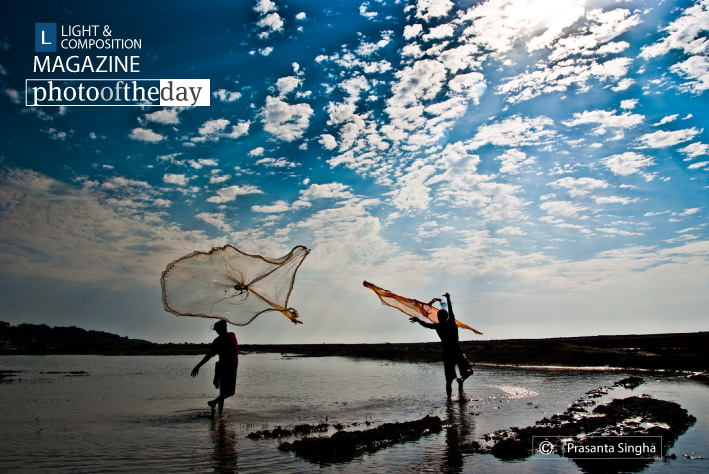
Captured in the soft, ethereal glow of early morning at Junput, West Bengal, this photograph transforms a routine fishing expedition into a poetic performance. The photographer observed the fishermen not merely as laborers, but as figures moving in a synchronized, rhythmic dance against the rising sun. By shifting the perspective, the image captures the men reaching toward the light, turning the act of casting nets into a profound metaphor for the human spirit. This evocative composition stands out for its ability to elevate a simple, everyday moment into a timeless, artistic expression of life and motion.
Prasanta Singha
Based in Kolkata, India, Prasanta Singha is a dedicated travel photographer with a deep-seated passion for documenting the human experience. His work focuses on capturing the authentic lives, emotions, and surroundings of the people he encounters, viewing photography as a vital, flowing extension of his own heart and mind. Driven by a lifelong commitment to his craft, Singha aspires to make a meaningful and lasting contribution to the global photographic community through his evocative storytelling and keen observational eye.
Resonance Score Breakdown
Transparency Note: The resonance score (13.4/20) is calculated based on social engagement metrics collected before the award announcement.
Expert Photography Reviews · 6
The Geometry of Effort
There is a quiet physics to the way we move through our days, a hidden geometry in the tasks we repeat until they become muscle memory. We often think of labor as a straight line—a beginning, a middle, and a finished product—but the truth is far more circular.
Read the reflection →The Weaving of Breath
To live is to cast a net into the invisible. We stand at the edge of our own small shores, throwing our hopes out into the vast, churning blue, never quite knowing what the tide will return to us.
Read the reflection →Reviews & Comments
Share your thoughts about this award-winning photograph. Your reviews contribute to the community engagement score.
The ochre of the rising sun bleeds into the silt-heavy water like a Turner seascape, dissolving the fishermen into silhouettes of bruised violet. It’s a chromatic ache that catches in one’s throat, a delicate friction between the warmth of the horizon and the cool, damp shadows of the nets. I’m utterly undone by how the light clings to the spray, turning mundane labor into a shimmering, liquid gold that feels almost sacred, doesn’t it?
The salt air at Junput must have been heavy that morning. I’ve stood in that same damp stillness, waiting for the light to break. Prasanta didn’t just capture men casting nets; he listened to the rhythm of their labor against the rising sun. It’s a quiet, sacred choreography. Looking at the spray caught in that 1/1600th of a second, I feel a sudden, sharp ache for the simplicity of their devotion. It’s truly beautiful.
The frame’s geometry relies on the diagonal sweep of the nets, creating a necessary tension against the horizon line. It’s a rigid architecture that prevents the motion from dissolving into chaos. The spatial weight is distributed with surprising precision, anchoring the figures firmly within the picture plane. I’ve grown tired of sentimental fishing scenes, but the structural discipline here doesn’t falter. It’s a rare instance where the rhythm of the frame actually justifies the subject’s reach.
Sunlight here doesn’t illuminate; it interrogates. By forcing these fishermen into silhouettes against the Junput horizon, Singha denies us their faces, leaving only the raw geometry of labor. It’s a brutal, necessary erasure. I’ve spent hours staring at the tension in those nets, and honestly, it makes my own chest ache with the weight of their struggle. When light is this aggressive, the shadow becomes the only sanctuary where the human spirit can actually breathe.
One suspects the light cooperated on the first attempt. It often does, for the lucky. Yet, there’s a deliberate geometry here that suggests Singha didn’t just stumble upon these fishermen. He’s clearly spent hours in the mud, waiting for that precise, synchronized arc of the nets. I’ve been cold in enough tidal flats to recognize the commitment required to frame such rhythm. It’s a decent bit of work, earned through patience rather than mere shutter speed.
Most submissions from this region rely on tired silhouettes, but Singha’s work avoids that trap. By choosing a wide 18mm focal length, he forces the viewer into the surf with the fishermen. It’s the tension between the chaotic spray and the men’s deliberate, synchronized reach that makes this endure. I’ve looked at thousands of fishing shots, yet this one still makes me catch my breath. It’s a rare, honest rhythm that will matter thirty years from now.
awesome !
Just awesome.