It’s Still Beautiful by Ana Encinas
Captured in the quiet solitude of the Sonoran desert near San Miguel de Horcasitas, this image immortalizes the skeletal remains of an ancient hacienda mill. The photographer chose to shoot late at night, leveraging the pristine, clear skies to frame the crumbling stone structures against a vast, star-studded canopy. This juxtaposition of decaying human history and the eternal, celestial expanse creates a poignant narrative of resilience and beauty. The photograph is award-worthy for its masterful balance of long-exposure night technique and the evocative, melancholic atmosphere that transforms a simple ruin into a timeless monument of the Mexican landscape.
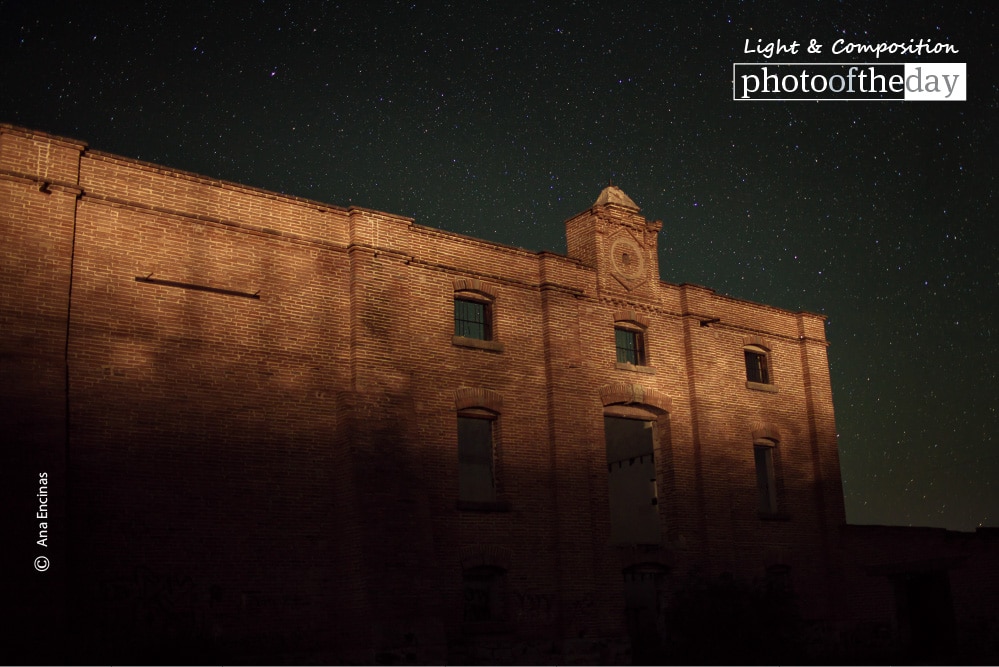
Ana Encinas
Born in Hermosillo, Mexico, Ana Encinas has nurtured a lifelong passion for the visual arts, transitioning to professional-grade DSLR photography in 2009. While she balances a successful career as an entrepreneur and marketing expert, she dedicates her personal time to the rigorous exploration of landscape and nature photography. Through constant experimentation with technical craft and composition, Encinas continues to refine a unique artistic voice that captures the raw, natural beauty of her home region.
Resonance Score Breakdown
Transparency Note: The resonance score (12.2/20) is calculated based on social engagement metrics collected before the award announcement.
Expert Photography Reviews · 5
The Weight of Time
There is a quiet dignity in the way things return to the earth. We often fear the crumbling of stone or the fading of a structure, seeing only loss where there is actually a gentle surrender.
Read the reflection →The Architecture of Echoes
There is a specific silence that lives in a roofless room. It is not the silence of peace, but the silence of a conversation that stopped mid-sentence decades ago.
Read the reflection →Reviews & Comments
Share your thoughts about this award-winning photograph. Your reviews contribute to the community engagement score.
The crumbling masonry anchors the lower quadrant, providing a necessary fulcrum against the celestial void. It’s a rigid geometry that prevents the frame from dissolving into mere atmospheric noise. The verticality of the stone ruins creates a sharp tension against the horizontal sweep of the horizon. I’ve rarely seen such disciplined negative space. It doesn’t rely on sentimentality. The structure holds its own weight, and frankly, the precision of that balance is quite satisfying.
One wonders how many nights were spent shivering in the Sonoran dust before the stars aligned just so over those crumbling stones. It’s a lonely business, waiting for the celestial clock to match the decay of a forgotten mill. I’ve spent enough nights in similar silence to know the biting chill she endured. It wasn’t a lucky snap; it was a siege. She earned every bit of this quiet, haunting stillness. A rare, honest effort.
You stood out there in the dark, waiting for the stars to align with those broken walls. It’s quiet, isn’t it? I’ve spent enough nights in the desert to know that silence isn’t empty; it’s heavy. You captured that weight. Because you didn’t just photograph a ruin, you felt the ghosts of the people who built it. There’s something honest happening here. You made me feel small, and I’m grateful for that. You waited. I can feel it.
We look at these crumbling stones in Codórachi and we don’t just see ruins; we see a ghost of a conversation. Ana Encinas listened to the desert’s silence before she clicked the shutter. The stars watch over the mill like ancestors, holding the stories the walls can no longer whisper. It’s haunting, really. I find myself wanting to sit in that dust and just listen. It’s a portrait of a place that hasn’t forgotten its people.
The indigo of the Sonoran night, a shade reminiscent of Morandi’s dustiest pigments, clings to these crumbling stones like a velvet shroud. It’s a haunting, celestial blue that makes my heart ache with a sudden, sharp longing for the infinite. Against this deep, tidal-water darkness, the ruin’s pale, calcified bones shimmer with a ghostly, lunar luminescence, creating a chromatic tension so profound that one can’t help but feel the weight of time’s slow, quiet erosion.